
健康大脑的睡眠纺锤波:从出生到 18 岁。
Sleep spindles in the healthy brain from birth through 18 years.
机构信息
Department of Neurology, Massachusetts General Hospital, Boston, MA, USA.
Harvard Medical School, Boston, MA, USA.
出版信息
Sleep. 2023 Apr 12;46(4). doi: 10.1093/sleep/zsad017.
STUDY OBJECTIVE
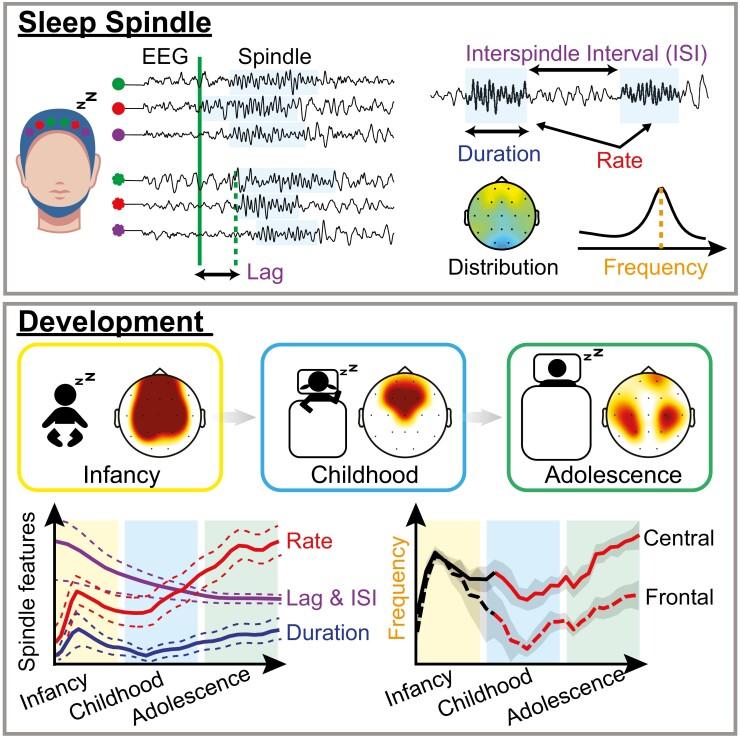
Sleep spindles are present from birth and reflect cognitive functions across the lifespan, but normative values for this cognitive biomarker across development are lacking. This study aims to establish normative spindle features over development.
METHODS
All available normal 19-channel electroencephalograms from developmentally normal children between February 2002 and June 2021 in the MGH EEG lab were analyzed. Approximately, 20 000 spindles were hand-marked to train and validate an automated spindle detector across ages. Normative values for spindle rate, duration, frequency, refractory period, and interhemispheric lag are provided for each channel and each age.
RESULTS
Sleep EEGs from 567 developmentally normal children (range 0 days to 18 years) were included. The detector had excellent performance (F1 = 0.47). Maximal spindle activity is seen over central regions during infancy and adolescence and frontopolar regions during childhood. Spindle rate and duration increase nonlinearly, with the most rapid changes during the first 4 months of life and between ages 3 and 14 years. Peak spindle frequency follows a U-shaped curve and discrete frontal slow and central fast spindles are evident by 18 months. Spindle refractory periods decrease between ages 1 and 14 years while interhemispheric asynchrony decreases over the first 3 months of life and between ages 1 and 14 years.
CONCLUSIONS
These data provide age- and region-specific normative values for sleep spindles across development, where measures that deviate from these values can be considered pathological. As spindles provide a noninvasive biomarker for cognitive function across the lifespan, these normative measures can accelerate the discovery and diagnosis in neurodevelopmental disorders.
研究目的
睡眠纺锤波从出生起就存在,反映了整个生命周期的认知功能,但缺乏这种认知生物标志物的发育正常标准值。本研究旨在建立发育过程中的正常纺锤波特征。
方法
分析了 2002 年 2 月至 2021 年 6 月期间在 MGHEEG 实验室发育正常的儿童的所有可用的正常 19 通道脑电图。大约 20000 个纺锤波被手工标记,以在各个年龄段训练和验证自动纺锤波检测器。为每个通道和每个年龄提供了纺锤波频率、持续时间、频率、不应期和半球间滞后的正常标准值。
结果
共纳入 567 名发育正常的儿童(0 天至 18 岁)的睡眠 EEG。该检测器具有优异的性能(F1 = 0.47)。婴儿期和青春期的中央区域和儿童期的额极区域的最大纺锤波活动最高。纺锤波频率和持续时间呈非线性增加,生命的前 4 个月和 3 至 14 岁之间变化最快。峰值纺锤波频率呈 U 形曲线,18 个月时明显出现离散的额部慢波和中央快波。纺锤波不应期在 1 至 14 岁之间减少,而半球间失同步在生命的前 3 个月和 1 至 14 岁之间减少。
结论
这些数据提供了整个发育过程中睡眠纺锤波的年龄和区域特异性正常标准值,偏离这些值的测量值可被认为是病理性的。由于纺锤波为整个生命周期的认知功能提供了一种非侵入性的生物标志物,因此这些正常标准值可以加速神经发育障碍的发现和诊断。
 Zotero 插件