Newborn Research Centre, Royal Women's Hospital, Melbourne, Victoria, Australia.
Department of Obstetrics and Gynaecology, The University of Melbourne, Melbourne, Victoria, Australia.
Acta Paediatr. 2023 Jun;112(6):1226-1232. doi: 10.1111/apa.16696. Epub 2023 Feb 15.
Systemic postnatal corticosteroids are used to treat or prevent bronchopulmonary dysplasia (BPD) in extremely preterm (EP) or extremely low birth weight (ELBW) infants but are associated with long-term harm. We aimed to assess the relationship between cumulative postnatal corticosteroid dose and neurodevelopmental outcomes.
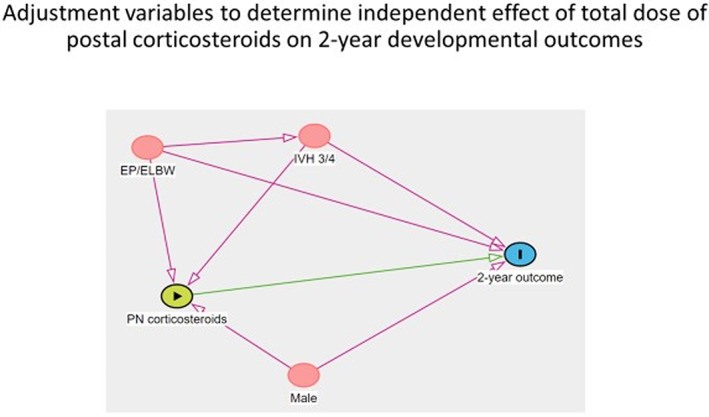
Longitudinal cohort study of all EP/ELBW livebirths in Victoria, Australia 2016-2017. Perinatal data were collected prospectively. Neurodevelopmental assessment was performed at 2 years' corrected age. Linear and logistic regression were used to determine relationships between cumulative corticosteroid dose and neurodevelopment, adjusted for gestational age, birth weight, sex and major intraventricular haemorrhage.
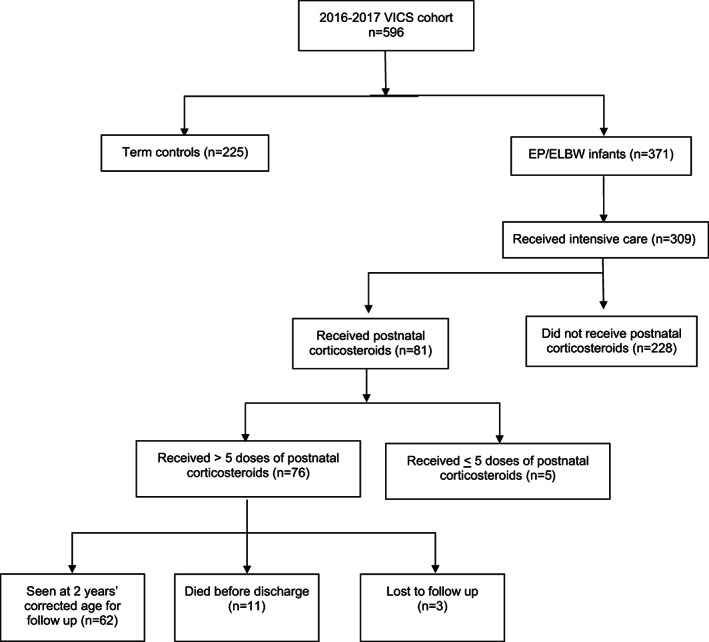
Seventy-six EP/ELBW infants received postnatal corticosteroids to treat or prevent BPD, 62/65 survivors were seen at 2 years. Median (IQR) cumulative postnatal corticosteroid dose was 1.36 (0.92-3.45) mg/kg dexamethasone equivalent. Higher cumulative corticosteroid dose was associated with increased odds of cerebral palsy, adjusted OR (95% CI) 1.47 (1.04, 2.07). Higher cumulative corticosteroid dose was also associated with lower cognitive and motor developmental scores, however, this weakened after adjustment for confounding variables: cognitive composite score adjusted coefficient (95% CI) -1.3 (-2.7, 0.1) and motor composite score adjusted coefficient (95% CI) -1.3 (-2.8, 0.2).
Higher cumulative postnatal corticosteroid dose in EP/ELBW infants is associated with increased odds of cerebral palsy at 2 years' corrected age. Adequately powered studies are needed to assess the independent effects of cumulative steroid dose on neurodevelopmental outcomes.
全身产后皮质类固醇用于治疗或预防极早产儿(EP)或极低出生体重(ELBW)婴儿的支气管肺发育不良(BPD),但与长期危害有关。我们旨在评估累积产后皮质类固醇剂量与神经发育结局之间的关系。
对 2016-2017 年澳大利亚维多利亚州所有 EP/ELBW 活产儿进行纵向队列研究。前瞻性收集围产期数据。在 2 年校正年龄时进行神经发育评估。使用线性和逻辑回归来确定累积皮质类固醇剂量与神经发育之间的关系,调整了胎龄、出生体重、性别和主要脑室内出血。
76 名 EP/ELBW 婴儿接受了产后皮质类固醇治疗或预防 BPD,65 名幸存者中有 62 名在 2 岁时接受了治疗。中位数(IQR)累积产后皮质类固醇剂量为 1.36(0.92-3.45)mg/kg 地塞米松等效物。较高的累积皮质类固醇剂量与脑瘫的几率增加相关,调整后的比值比(95%CI)为 1.47(1.04, 2.07)。较高的累积皮质类固醇剂量也与认知和运动发育评分较低相关,但在调整混杂变量后减弱:认知综合评分调整系数(95%CI)-1.3(-2.7, 0.1)和运动综合评分调整系数(95%CI)-1.3(-2.8, 0.2)。
在 EP/ELBW 婴儿中,较高的累积产后皮质类固醇剂量与 2 年校正年龄时脑瘫的几率增加相关。需要进行充分的研究来评估累积类固醇剂量对神经发育结局的独立影响。