Department of Nephrology, Osaka University Graduate School of Medicine, Suita, Osaka, Japan.
Department of Inter-Organ Communication Research in Kidney Diseases, Osaka University Graduate School of Medicine, Suita, Osaka, Japan.
Clin J Am Soc Nephrol. 2023 Jan 1;18(1):84-90. doi: 10.2215/CJN.0000000000000018.
Gait abnormality is a serious problem among hemodialysis patients. Whole-body vibration is a simple exercise that induces sustained muscular contractions through mechanical vibrations. This training improved gait ability in older adults. We aimed to investigate the effect of whole-body vibration on balance and gait ability in older hemodialysis patients.
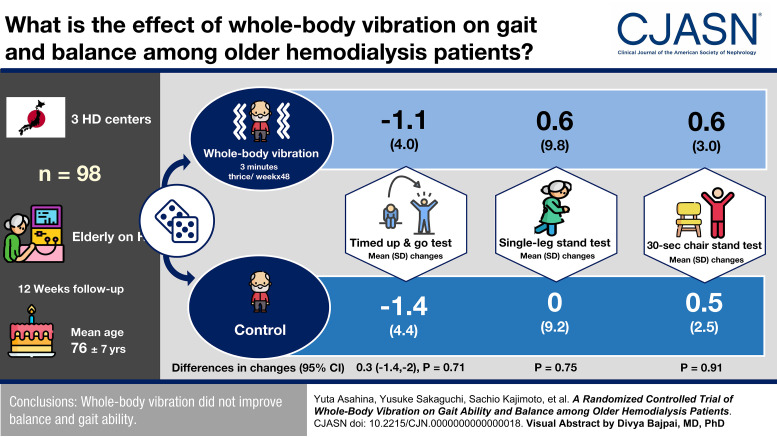
We conducted a 12-week, open-label, multicenter, randomized controlled trial of 98 hemodialysis patients, who were aged ≥65 years, from three dialysis centers in Japan. Those who had difficulty walking alone or dementia were excluded. Patients were randomly allocated to the whole-body vibration group or control group. The training was performed for 3 minutes thrice a week on dialysis days. The primary outcome was the Timed Up and Go test. The secondary outcomes were the single-leg stand test and 30-second chair stand test.
The mean (SD) age of the participants was 76 (7) years. The mean (SD) Timed Up and Go test was 12.0 (6.6) and 11.8 (7.0) seconds in the whole-body vibration and control groups, respectively. During the 12-week study period, 6 (12%) of 49 patients in the whole-body vibration group and 3 (6%) of 49 patients in the control group dropped out. In the whole-body vibration group, 42 (86% of the randomly allocated patients) completed the training according to the protocol. The mean (SD) changes in the Timed Up and Go test were -1.1 (4.0) and -1.4 (4.4) seconds in the whole-body vibration and control groups, respectively (change, 0.3 seconds in the whole-body vibration group; 95% confidence interval, -1.4 to 2.0; P=0.71). The changes in the single-leg stand test and 30-second chair stand test did not differ significantly between groups. There were no musculoskeletal adverse events directly related to this training.
Whole-body vibration did not improve balance and gait ability.
Effect of Whole Body Vibration on Walking Performance in Elderly Hemodialysis Patients NCT04774731.
步态异常是血液透析患者的一个严重问题。全身振动是一种简单的运动,通过机械振动引起持续的肌肉收缩。这种训练改善了老年人的步态能力。我们旨在研究全身振动对老年血液透析患者平衡和步态能力的影响。
我们进行了一项为期 12 周、开放标签、多中心、随机对照试验,纳入了来自日本三个透析中心的 98 名年龄≥65 岁的血液透析患者。排除那些难以独自行走或患有痴呆症的患者。患者被随机分配到全身振动组或对照组。每周三次在透析日进行 3 分钟的训练。主要结局是计时起立行走测试。次要结局是单腿站立测试和 30 秒坐站测试。
参与者的平均(SD)年龄为 76(7)岁。全身振动组和对照组的计时起立行走测试分别为 12.0(6.6)和 11.8(7.0)秒。在 12 周的研究期间,全身振动组的 49 名患者中有 6 名(12%)和对照组的 49 名患者中有 3 名(6%)退出。在全身振动组中,42 名(随机分配患者的 86%)按照方案完成了训练。全身振动组和对照组的计时起立行走测试的平均(SD)变化分别为-1.1(4.0)和-1.4(4.4)秒(变化为全身振动组 0.3 秒;95%置信区间,-1.4 至 2.0;P=0.71)。两组间单腿站立测试和 30 秒坐站测试的变化无显著差异。没有与这种训练直接相关的肌肉骨骼不良事件。
全身振动不能改善平衡和步态能力。
全身振动对老年血液透析患者行走能力的影响 NCT04774731。