Boukhvalov Danil W, Osipov Vladimir Yu, Hogan Benjamin Thomas, Baldycheva Anna
College of Science, Institute of Materials Physics and Chemistry, Nanjing Forestry University, Nanjing, 210037, People's Republic of China.
Institute of Physics and Technology, Ural Federal University, Mira 19 Str., Yekaterinburg, Russia, 620002.
Discov Nano. 2023 Jan 31;18(1):1. doi: 10.1186/s11671-023-03773-0.
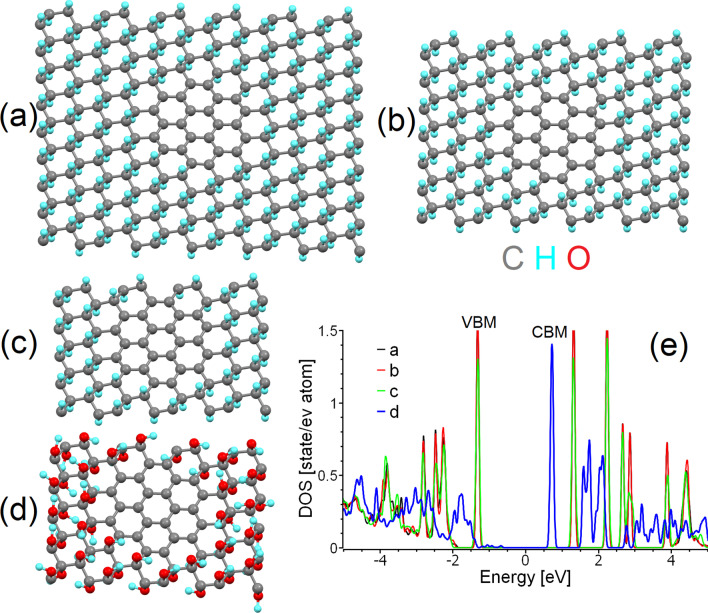
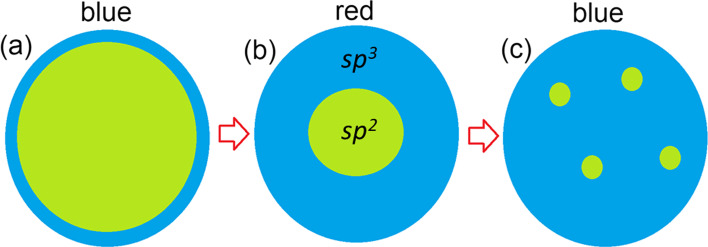
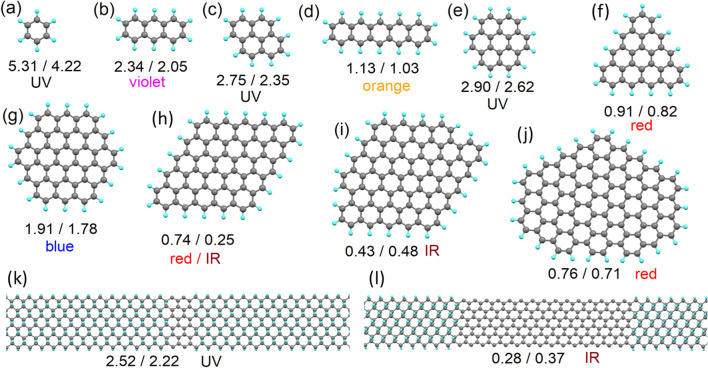
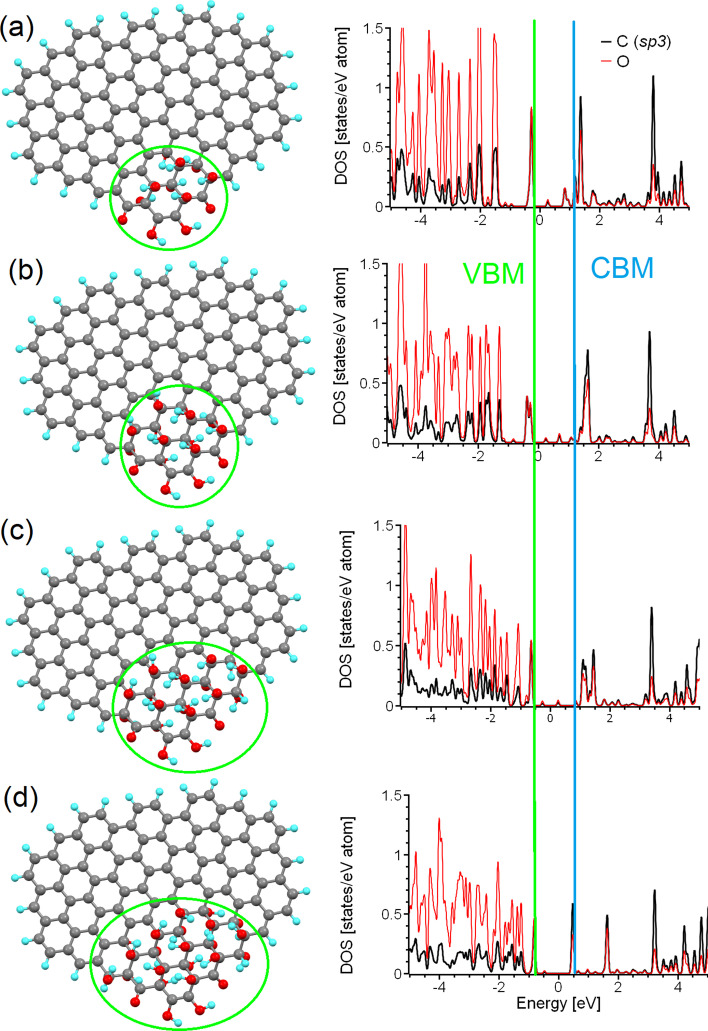
We propose and demonstrate a novel range of models to accurately determine the optical properties of nitrogen-free carbon quantum dots (CQDs) with ordered graphene layered structures. We confirm the results of our models against the full range of experimental results for CQDs available from an extensive review of the literature. The models can be equally applied to CQDs with varied sizes and with different oxygen contents in the basal planes of the constituent graphenic sheets. We demonstrate that the experimentally observed blue fluorescent emission of nitrogen-free CQDs can be associated with either small oxidised areas on the periphery of the graphenic sheets, or with sub-nanometre non-functionalised islands of sp-hybridised carbon with high symmetry confined in the centres of oxidised graphene sheets. Larger and/or less symmetric non-functionalised regions in the centre of functionalised graphene sheet are found to be sources of green and even red fluorescent emission from nitrogen-free CQDs. We also demonstrate an approach to simplify the modelling of the discussed sp-islands by substitution with equivalent strained polycyclic aromatic hydrocarbons. Additionally, we show that the bandgaps (and photoluminescence) of CQDs are not dependent on either out-of-plane corrugation of the graphene sheet or the spacing between sp-islands. Advantageously, our proposed models show that there is no need to involve light-emitting polycyclic aromatic molecules (nanographenes) with arbitrary structures grafted to the particle periphery to explain the plethora of optical phenomena observed for CQDs across the full range of experimental works.
我们提出并展示了一系列新型模型,用于准确确定具有有序石墨烯层状结构的无氮碳量子点(CQD)的光学性质。我们根据对大量文献进行广泛综述后可得的CQD的全系列实验结果,对我们模型的结果进行了验证。这些模型同样可应用于尺寸各异且组成石墨烯片基面中氧含量不同的CQD。我们证明,实验观察到的无氮CQD的蓝色荧光发射,可能与石墨烯片边缘的小氧化区域有关,或者与局限于氧化石墨烯片中心的具有高对称性的sp杂化碳的亚纳米非功能化岛有关。发现在功能化石墨烯片中心较大和/或对称性较低的非功能化区域是无氮CQD发出绿色甚至红色荧光的来源。我们还展示了一种通过用等效的应变多环芳烃替代来简化所讨论的sp岛建模的方法。此外,我们表明CQD的带隙(和光致发光)既不依赖于石墨烯片的面外波纹,也不依赖于sp岛之间的间距。有利的是,我们提出的模型表明,无需涉及具有任意结构且接枝到粒子周边的发光多环芳烃分子(纳米石墨烯)来解释在所有实验工作中观察到的CQD的大量光学现象。