Energy Technologies Area, Lawrence Berkeley National Laboratory, 1 Cyclotron Road, Berkeley, California 94720, United States.
Department of Civil and Environmental Engineering, University of California, Berkeley, Berkeley, California 94720, United States.
Environ Sci Technol. 2023 Feb 14;57(6):2235-2247. doi: 10.1021/acs.est.2c05846. Epub 2023 Jan 31.
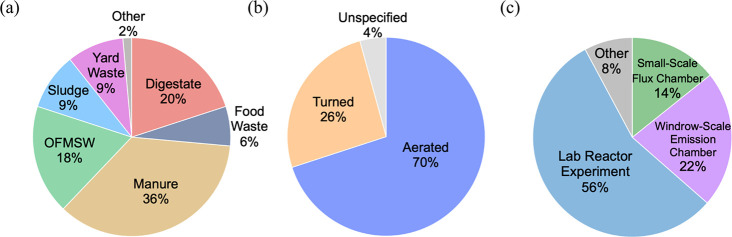
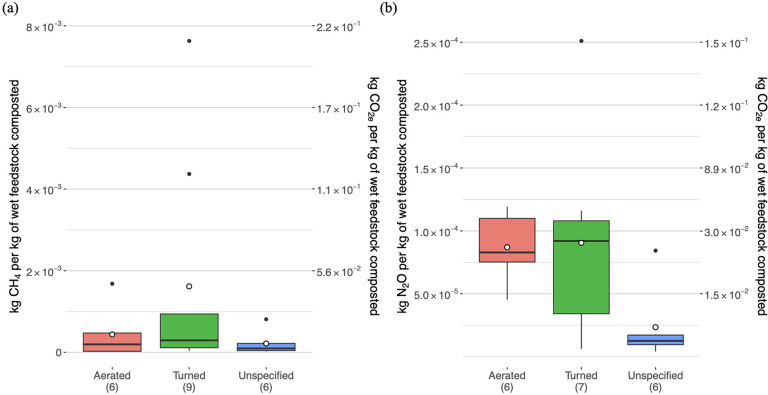
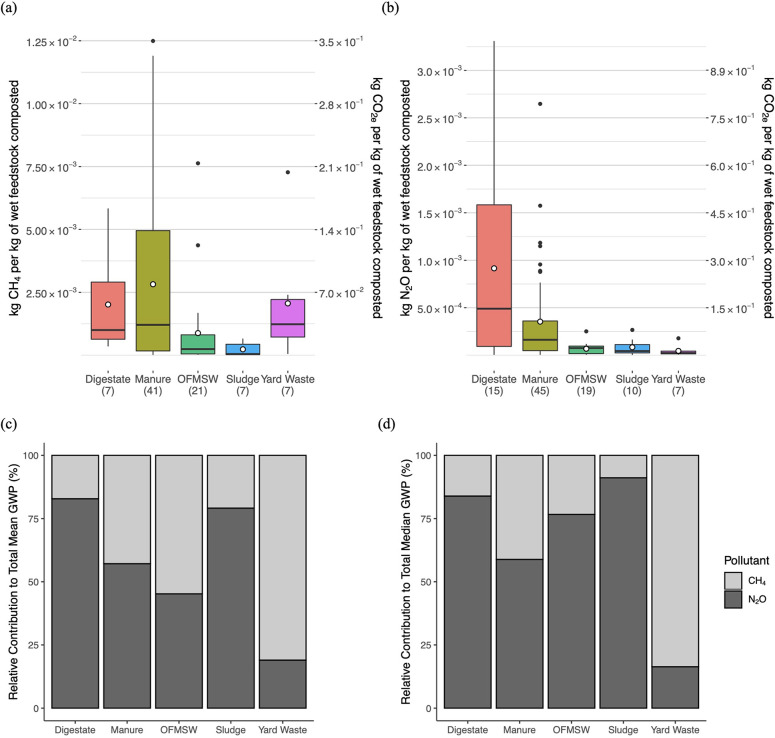
Composting can divert organic waste from landfills, reduce landfill methane emissions, and recycle nutrients back to soils. However, the composting process is also a source of greenhouse gas and air pollutant emissions. Researchers, regulators, and policy decision-makers all rely on emissions estimates to develop local emissions inventories and weigh competing waste diversion options, yet reported emission factors are difficult to interpret and highly variable. This review explores the impacts of waste characteristics, pretreatment processes, and composting conditions on CO, CH, NO, NH, and VOC emissions by critically reviewing and analyzing 388 emission factors from 46 studies. The values reported to date suggest that CH is the single largest contributor to 100-year global warming potential (GWP) for yard waste composting, comprising approximately 80% of the total GWP. For nitrogen-rich wastes including manure, mixed municipal organic waste, and wastewater treatment sludge, NO is the largest contributor to GWP, accounting for half to as much as 90% of the total GWP. If waste is anaerobically digested prior to composting, NO, NH, and VOC emissions tend to decrease relative to composting the untreated waste. Effective pile management and aeration are key to minimizing CH emissions. However, forced aeration can increase NH emissions in some cases.
堆肥可以将有机废物从垃圾填埋场转移出去,减少垃圾填埋场的甲烷排放,并将营养物质回收回土壤中。然而,堆肥过程也是温室气体和空气污染物排放的来源。研究人员、监管机构和政策决策者都依赖排放估计来制定当地排放清单,并权衡相互竞争的废物转移选择,但报告的排放因子难以解释且高度可变。本综述通过批判性地回顾和分析 46 项研究中的 388 个排放因子,探讨了废物特性、预处理过程和堆肥条件对 CO、CH、NO、NH 和 VOC 排放的影响。迄今为止报告的值表明,CH 是庭院垃圾堆肥 100 年全球变暖潜势 (GWP) 的最大单一贡献者,占总 GWP 的约 80%。对于富含氮的废物,包括粪便、混合城市有机废物和污水处理厂污泥,NO 是 GWP 的最大贡献者,占总 GWP 的一半到 90%。如果废物在堆肥前进行厌氧消化,相对于未处理的废物进行堆肥,NO、NH 和 VOC 排放往往会减少。有效的堆肥管理和曝气是最大限度减少 CH 排放的关键。然而,在某些情况下,强制曝气会增加 NH 的排放。