Kager Catharina Cm, Horsselenberg Maaike, Korevaar Joke C, Wagner Cordula, Hek Karin
Netherlands Institute for Health Services Research (NIVEL), Utrecht, The Netherlands
Netherlands Institute for Health Services Research (NIVEL), Utrecht, The Netherlands.
BJGP Open. 2023 Mar 21;7(1). doi: 10.3399/BJGPO.2022.0179. Print 2023 Mar.
In the Dutch atrial fibrillation (AF) guideline for GPs, vitamin K antagonists (VKAs) and direct oral anticoagulants (DOACs) are seen as equivalent, while in cardiology there is a preference for DOACs.
To describe the pattern of oral anticoagulant (OAC) prescribing for AF by GPs and assess whether GPs proactively convert between VKAs and DOACs in patients with AF.
DESIGN & SETTING: Observational study using routine practice data from 214 general practices, from 2017 until 2019.
Patients aged ≥60 years diagnosed with AF, who had been prescribed OACs by their GPs in 2018 were included. A distinction was made between starters, who were participants who did not use OACs in 2017, and prevalent users. It was observed and recorded whether patients switched between VKAs and DOACs.
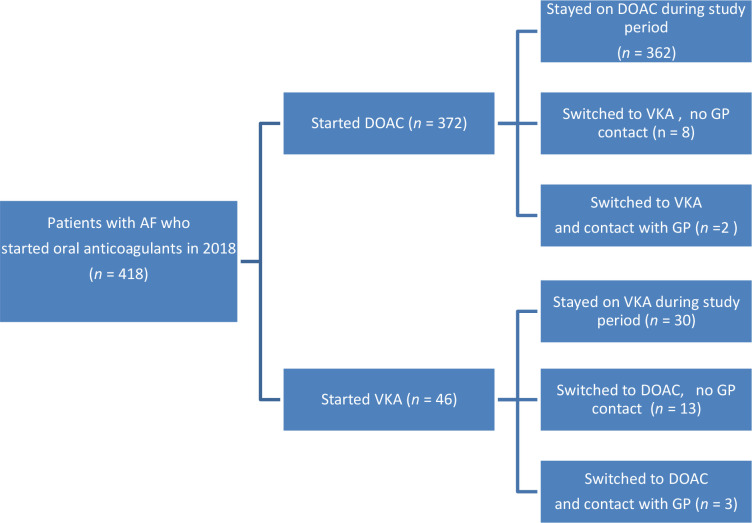
A total of 12 516 patients with AF were included. Four hundred and seventy-six patients (4%) started OACs in 2018; 12 040 patients were prevalent OAC users. When GPs started patients on OACs, DOACs were prescribed the most (88%). Among prevalent users, more than half of the patients used VKAs (60%). GPs switched between OACs for 1% of starters and 0.6% of prevalent users in 2018 and 2019.
Dutch GPs predominantly start with DOACs in newly diagnosed patients with AF. Prevalent patients predominantly use VKAs and switching from a DOAC to a VKA is unusual. Consequently, the number of patients using VKAs will decline in the upcoming years. This trend raises questions about the future of organising frequent international normalised ratio (INR) checks for VKA users.
在荷兰针对全科医生的房颤指南中,维生素K拮抗剂(VKAs)和直接口服抗凝剂(DOACs)被视为等效药物,而在心脏病学领域,更倾向于使用DOACs。
描述全科医生为房颤患者开具口服抗凝剂(OAC)的模式,并评估全科医生是否会主动为房颤患者在VKAs和DOACs之间进行转换。
利用2017年至2019年214家全科诊所的常规诊疗数据进行观察性研究。
纳入2018年由全科医生开具OACs的≥60岁房颤确诊患者。区分了起始使用者(即2017年未使用OACs的参与者)和现患使用者。观察并记录患者是否在VKAs和DOACs之间转换。
共纳入12516例房颤患者。2018年有476例患者(4%)开始使用OACs;12040例患者为OAC现患使用者。当全科医生为患者起始使用OACs时,DOACs的处方量最多(88%)。在现患使用者中,超过一半的患者使用VKAs(60%)。2018年和2019年,全科医生为1%的起始使用者和0.6%的现患使用者在OACs之间进行了转换。
荷兰全科医生在新诊断的房颤患者中主要起始使用DOACs。现患患者主要使用VKAs,从DOAC转换为VKA的情况并不常见。因此,未来几年使用VKAs的患者数量将会下降。这一趋势引发了关于为VKA使用者组织频繁的国际标准化比值(INR)检查的未来问题。