Swiss Paraplegic Centre, Nottwil, Switzerland.
Department of Health Sciences and Medicine, University of Lucerne, Lucerne, Switzerland.
BMC Health Serv Res. 2023 Jan 31;23(1):103. doi: 10.1186/s12913-023-09045-y.
Stage III and IV pressure injuries (PIs) in patients with spinal cord injury (SCI) require complex interdisciplinary and interprofessional treatment approaches that are difficult to implement. Practical aspects, such as information exchange and coordination, remain challenging. We investigated whether a computerized decision support system (CDSS) could increase treatment adherence and improve clinical outcomes and interprofessional collaboration.
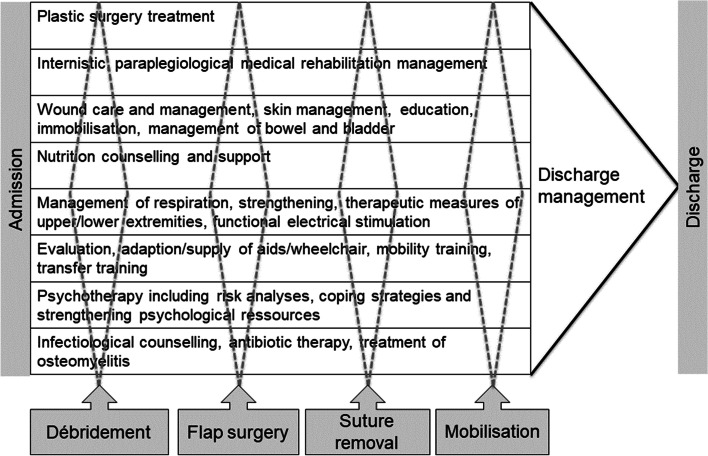
In this feasibility study, a core team developed the initial treatment process and adapted it based on several discussions with clinical experts and information technologists. The CDSS followed the Basel Decubitus Approach and was used in a clinic specializing in SCI. Thirty patients with SCI admitted for stage III/IV PI between July 2016 and May 2017 were randomly allocated to standard or CDSS-supported care. Between-group differences in treatment adherence, complication rates, length of stay, and costs were analyzed using descriptive statistics. The use of the CDSS and potential barriers and facilitators were evaluated through interprofessional focus groups, transcribed verbatim, and thematically analyzed (30 participants).
No differences in SCI characteristics, comorbidities, or PI characteristics (localization: ischium [number (n) = 19 PI, 63%], sacrum [n = 10 PI, 33%], recurrent PI [n = 21, 70%]) were found between the two groups. Furthermore, no statistically significant differences were observed in treatment adherence, frequency of major (20% vs. 13% between CDSS and control group) and minor (33% vs 27%) complications, and length of stay (98 [±28] vs 81 [±23] days). Healthcare professionals found the CDSS to be helpful for visualizing the treatment process. However, the high workload and difficulties in the information technology processes, such as missing reminders, slow computer performance and data processing, and poor accessibility, hindered the effective implementation of the CDSS.
The implementation of the CDSS to support the treatment of stage III/IV PI in patients with SCI was feasible and included definitions of milestones, interventions, and outcomes. However, to assess the impact of the CDSS, a longer observation period is required. Further, the technical difficulties must be addressed, and solid integration of the CDSS into the clinical information system is necessary.
This quality improvement project received a declaration of no objection from the Ethics Committee of Northwest and Central Switzerland (EKNZ UBE-16/003), and ethical approval was received for the focus groups (EKNZ Req-2017-00860).
脊髓损伤(SCI)患者的 III 期和 IV 期压力性损伤(PI)需要复杂的跨学科和跨专业治疗方法,这些方法难以实施。实际方面,如信息交流和协调,仍然具有挑战性。我们研究了计算机化决策支持系统(CDSS)是否可以提高治疗依从性并改善临床结果和跨专业协作。
在这项可行性研究中,一个核心团队制定了初始治疗流程,并根据与临床专家和信息技术专家的多次讨论进行了调整。CDSS 遵循巴塞尔压疮处理方法,并在专门治疗 SCI 的诊所中使用。2016 年 7 月至 2017 年 5 月期间,30 名患有 III/IV 期 PI 的 SCI 患者被随机分配到标准或 CDSS 支持的护理组。使用描述性统计分析治疗依从性、并发症发生率、住院时间和成本方面的组间差异。通过跨专业焦点小组评估 CDSS 的使用情况以及潜在的障碍和促进因素,小组讨论的内容被逐字转录并进行主题分析(30 名参与者)。
两组患者的 SCI 特征、合并症或 PI 特征(局部定位:坐骨[29 个 PI,63%]、骶骨[10 个 PI,33%]、复发性 PI[21 个 PI,70%])无差异。此外,治疗依从性、主要并发症(CDSS 组 20%,对照组 13%)和小并发症(CDSS 组 33%,对照组 27%)的发生频率以及住院时间(98[±28]天 vs. 81[±23]天)均无统计学差异。医疗保健专业人员认为 CDSS 有助于可视化治疗过程。然而,高工作量和信息技术流程中的困难,如缺少提醒、计算机性能和数据处理缓慢以及访问困难,阻碍了 CDSS 的有效实施。
实施 CDSS 支持 SCI 患者的 III/IV 期 PI 治疗是可行的,包括定义里程碑、干预措施和结果。但是,为了评估 CDSS 的影响,需要更长的观察期。此外,必须解决技术困难,并将 CDSS 牢固地整合到临床信息系统中。
本质量改进项目已获得瑞士西北和中部地区伦理委员会(EKNZ UBE-16/003)的无异议声明,并已获得伦理委员会对焦点小组的批准(EKNZ Req-2017-00860)。