Australian Centre for Health Services Innovation and Centre for Healthcare Transformation, School of Public Health and Social Work, Faculty of Health, Queensland University of Technology, Brisbane, QLD, Australia.
Biomedical Informatics and Digital Health, School of Medical Sciences, Faculty of Medicine and Health, The University of Sydney, Camperdown, Australia.
Implement Sci. 2023 Jul 26;18(1):32. doi: 10.1186/s13012-023-01287-y.
Successful implementation and utilization of Computerized Clinical Decision Support Systems (CDSS) in hospitals is complex and challenging. Implementation science, and in particular the Nonadoption, Abandonment, Scale-up, Spread and Sustainability (NASSS) framework, may offer a systematic approach for identifying and addressing these challenges. This review aimed to identify, categorize, and describe barriers and facilitators to CDSS implementation in hospital settings and map them to the NASSS framework. Exploring the applicability of the NASSS framework to CDSS implementation was a secondary aim.
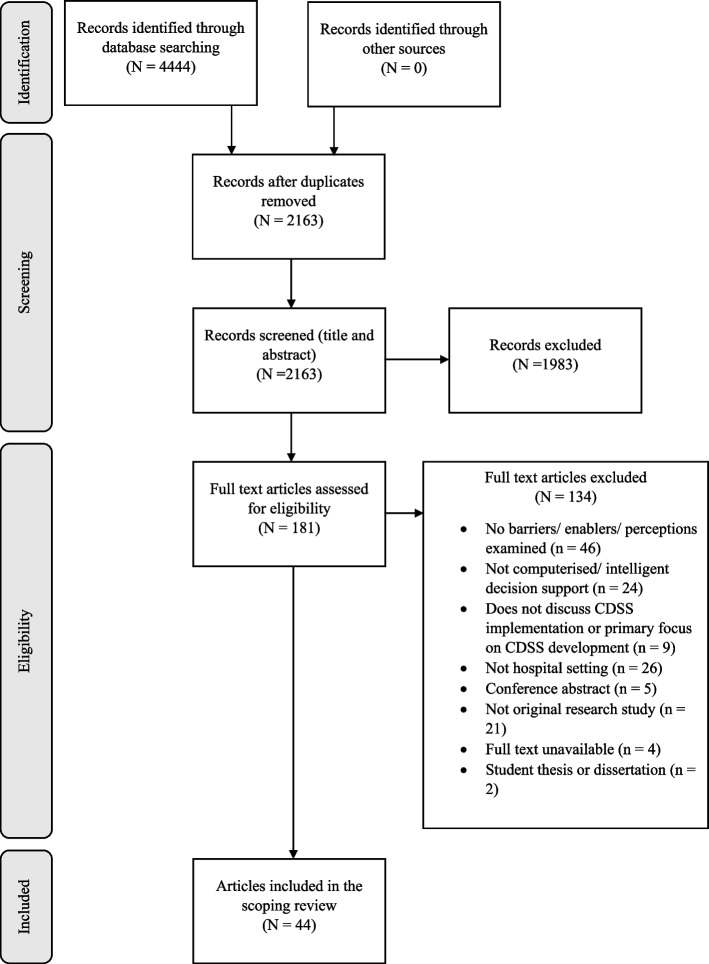
Electronic database searches were conducted (21 July 2020; updated 5 April 2022) in Ovid MEDLINE, Embase, Scopus, PyscInfo, and CINAHL. Original research studies reporting on measured or perceived barriers and/or facilitators to implementation and adoption of CDSS in hospital settings, or attitudes of healthcare professionals towards CDSS were included. Articles with a primary focus on CDSS development were excluded. No language or date restrictions were applied. We used qualitative content analysis to identify determinants and organize them into higher-order themes, which were then reflexively mapped to the NASSS framework.
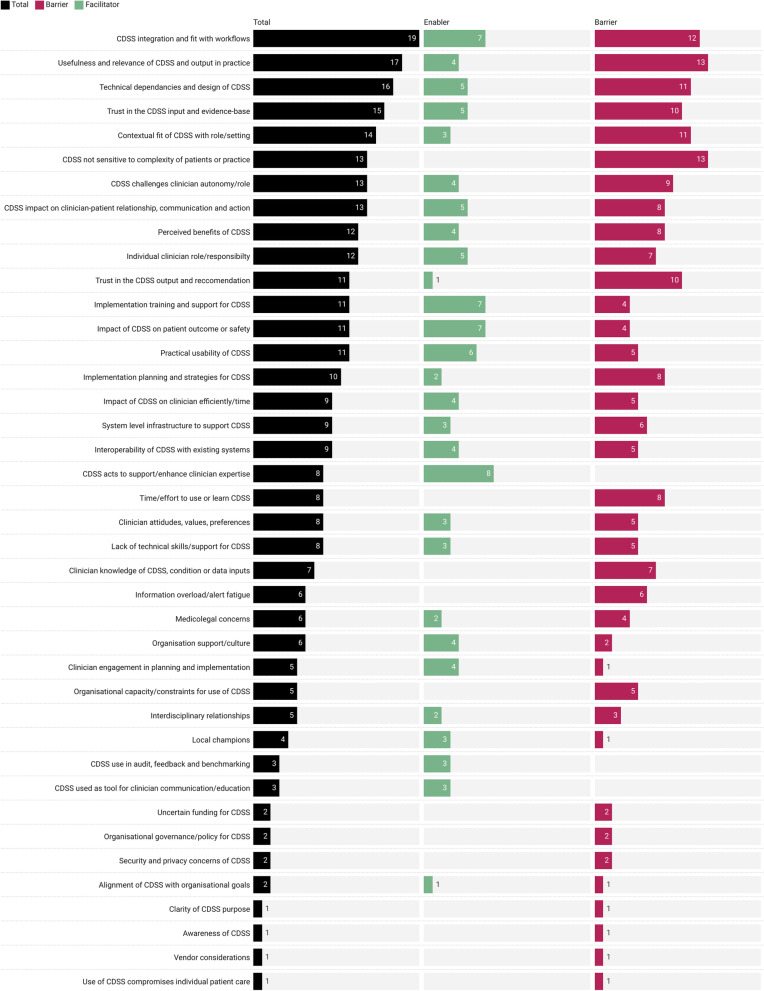
Forty-four publications were included. These comprised a range of study designs, geographic locations, participants, technology types, CDSS functions, and clinical contexts of implementation. A total of 227 individual barriers and 130 individual facilitators were identified across the included studies. The most commonly reported influences on implementation were fit of CDSS with workflows (19 studies), the usefulness of the CDSS output in practice (17 studies), CDSS technical dependencies and design (16 studies), trust of users in the CDSS input data and evidence base (15 studies), and the contextual fit of the CDSS with the user's role or clinical setting (14 studies). Most determinants could be appropriately categorized into domains of the NASSS framework with barriers and facilitators in the "Technology," "Organization," and "Adopters" domains most frequently reported. No determinants were assigned to the "Embedding and Adaptation Over Time" domain.
This review identified the most common determinants which could be targeted for modification to either remove barriers or facilitate the adoption and use of CDSS within hospitals. Greater adoption of implementation theory should be encouraged to support CDSS implementation.
在医院中成功实施和利用计算机化临床决策支持系统(CDSS)是复杂且具有挑战性的。实施科学,特别是未采用、放弃、扩大规模、传播和可持续性(NASSS)框架,可能为识别和解决这些挑战提供系统的方法。本综述旨在确定、分类和描述医院环境中 CDSS 实施的障碍和促进因素,并将其映射到 NASSS 框架中。探索 NASSS 框架在 CDSS 实施中的适用性是次要目标。
对 Ovid MEDLINE、Embase、Scopus、PyscInfo 和 CINAHL 电子数据库进行了检索(2020 年 7 月 21 日;2022 年 4 月 5 日更新)。纳入报告了医院环境中 CDSS 实施和采用的测量或感知障碍和/或促进因素,或医疗保健专业人员对 CDSS 态度的原始研究。主要关注 CDSS 开发的文章被排除在外。未应用语言或日期限制。我们使用定性内容分析来识别决定因素,并将其组织成更高阶的主题,然后将这些主题反射性地映射到 NASSS 框架中。
纳入了 44 篇文献。这些研究涵盖了各种研究设计、地理位置、参与者、技术类型、CDSS 功能以及实施的临床背景。在纳入的研究中,共确定了 227 个单独的障碍和 130 个单独的促进因素。对实施影响最大的因素包括 CDSS 与工作流程的匹配(19 项研究)、CDSS 输出在实践中的有用性(17 项研究)、CDSS 技术依赖性和设计(16 项研究)、用户对 CDSS 输入数据和证据基础的信任(15 项研究)以及 CDSS 与用户角色或临床环境的适配性(14 项研究)。大多数决定因素可以适当地归入 NASSS 框架的领域,其中“技术”、“组织”和“采用者”领域报告的障碍和促进因素最为常见。没有决定因素被分配到“随时间嵌入和适应”领域。
本综述确定了最常见的决定因素,这些因素可以作为目标进行修改,以消除障碍或促进医院内 CDSS 的采用和使用。应鼓励更多地采用实施理论,以支持 CDSS 的实施。