Rutenberg Michael S, Hoppe Bradford S, Starr Jason S, Awad Ziad, Thomas Mathew, Morris Christopher G, Johnson Perry, Henderson Randal H, Jones Jeremy C, Gharia Bharatsinh, Bowers Steven, Wolfsen Herbert C, Krishnan Sunil, Ko Stephen J, Babiker Hani M, Nichols Romaine C
Department of Radiation Oncology, Mayo Clinic, Jacksonville, FL, USA.
Division of Hematology/Oncology, Mayo Clinic, Jacksonville, FL, USA.
Int J Part Ther. 2022 Dec 19;9(3):18-29. doi: 10.14338/IJPT-22-00021.1. eCollection 2023 Winter.
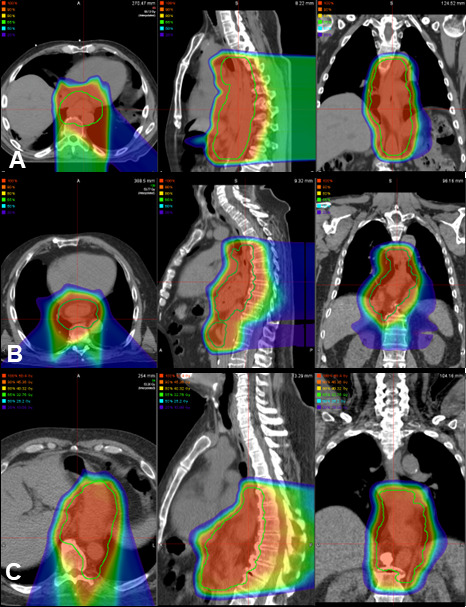
When treating esophageal cancer with radiation therapy, it is critical to limit the dose to surrounding structures, such as the lung and/or heart, as much as possible. Proton radiation therapy allows a reduced radiation dose to both the heart and lungs, potentially reducing the risk of cardiopulmonary toxicity. Here, we report disease control, survival, and toxicity outcomes among patients with esophageal cancer treated with proton radiation therapy and concurrent chemotherapy (chemoradiation therapy; CRT) with or without surgery.
We enrolled 17 patients with thoracic esophageal carcinoma on a prospective registry between 2010 and 2021. Patients received proton therapy to a median dose of 50.4-GyRBE (range, 50.4-64.8) in 1.8-Gy fractions.Acute and late toxicities were graded per the Common Terminology Criteria for Adverse Events, version 4.0 (US National Cancer Institute, Bethesda, Maryland). In addition, disease control, patterns of failure, and survival outcomes were collected.
Nine patients received preoperative CRT, and 8 received definitive CRT. Overall, 88% of patients had adenocarcinoma, and 12% had squamous cell carcinoma. With a median follow-up of 2.1 years (range, 0.5-9.4), the 3-year local progression-free, disease-free, and overall survival rates were 85%, 66%, and 55%, respectively. Two patients (1 with adenocarcinoma and 1 with squamous cell carcinoma) recurred at the primary site after refusing surgery after a complete clinical response to CRT. The most common acute nonhematologic and hematologic toxicities, respectively, were grades 1 to 3 esophagitis and grades 1 to 4 leukopenia, both affecting 82% of patients. No acute cardiopulmonary toxicities were observed in the absence of surgical resection. Reagarding surgical complications, 3 postoperative cardiopulmonary complications occurred as follows: 1 grade 1 pleural effusion, 1 grade 3 pleural effusion, and 1 grade 2 anastomotic leak. Two severe late CRT toxicities occurred: 1 grade 5 tracheoesophageal fistula and 1 grade 3 esophageal stenosis requiring a feeding tube.
Proton radiation therapy is a safe, effective treatment for esophageal cancer with increasing evidence supporting its role in reducing cardiopulmonary toxicity.
在采用放射治疗食管癌时,尽可能限制对周围结构(如肺和/或心脏)的剂量至关重要。质子放射治疗可降低心脏和肺部的放射剂量,有可能降低心肺毒性风险。在此,我们报告接受质子放射治疗并联合化疗(放化疗;CRT)且有或无手术治疗的食管癌患者的疾病控制、生存及毒性结果。
2010年至2021年期间,我们前瞻性登记了17例胸段食管癌患者。患者接受质子治疗,中位剂量为50.4 GyRBE(范围50.4 - 64.8),每次分割剂量为1.8 Gy。根据不良事件通用术语标准第4.0版(美国国立癌症研究所,马里兰州贝塞斯达)对急性和晚期毒性进行分级。此外,收集疾病控制、失败模式和生存结果。
9例患者接受术前CRT,8例接受根治性CRT。总体而言,88%的患者为腺癌,12%为鳞状细胞癌。中位随访2.1年(范围0.5 - 9.4),3年局部无进展生存率、无病生存率和总生存率分别为85%、66%和55%。2例患者(1例腺癌和1例鳞状细胞癌)在对CRT达到完全临床缓解后拒绝手术,原发部位复发。最常见的急性非血液学和血液学毒性分别为1至3级食管炎和1至4级白细胞减少,均影响82%的患者。在未进行手术切除的情况下,未观察到急性心肺毒性。关于手术并发症,发生了3例术后心肺并发症:1例1级胸腔积液、1例3级胸腔积液和1例2级吻合口漏。发生了2例严重的晚期CRT毒性:1例5级气管食管瘘和1例3级食管狭窄需要放置饲管。
质子放射治疗是一种安全、有效的食管癌治疗方法,越来越多的证据支持其在降低心肺毒性方面的作用。