Institute of German Dentists, Universitätsstr. 73, 50931, Cologne, Germany.
Department for Orthodontics, University Hospital Regensburg, Franz-Josef-Strauß-Allee 11, 93053, Regensburg, Germany.
J Orofac Orthop. 2023 Jan;84(Suppl 1):1-9. doi: 10.1007/s00056-022-00437-z. Epub 2023 Feb 1.
Current population-wide data on the prevalence of malocclusions in 8‑ and 9‑year-old children in Germany are not available. Therefore, the primary objective of this study was to collect data on the prevalence of malocclusions in 8‑ and 9‑year-old children in Germany. The secondary objective of this study was to use this information to derive the need for orthodontic care provision.
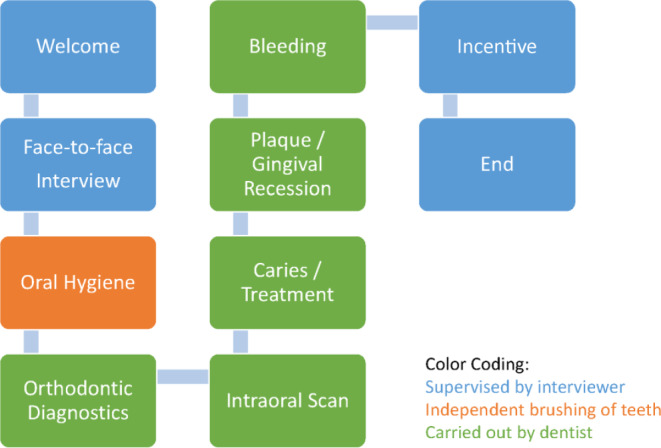
This is an oral-epidemiological investigation and social science survey at the national level with a focus on tooth and jaw misalignment. The investigation took place between January and March 2021 at 16 study centers across Germany. All relevant data were available for the 705 study participants and were included in the statistical analysis.
Overbite was the most common finding with 88.9%. Also widespread were crowding, with at least 60.9%, and lack of space, with a share of 30.9%. All other indication groups had a share below 10%. Rare (< 1%) were buccal and lingual occlusions and craniofacial abnormalities. The most severe forms of disease (Orthodontic Indication Group [Kieferorthopädische Indikationsgruppen, KIG] grade 5) were overbite (3.2%), open bite malocclusion (1.0%), undershot (0.6%), and craniofacial abnormalities (0.4%). The proportion of study participants who required orthodontic treatment, in accordance with statutory health insurance provider guidelines, was 40.4%. The proportion of study participants in principle requiring orthodontic treatment for medical reasons was 97.5%. Systemic differences in the need for orthodontic care provision relating to gender, region, or social status were not identified.
In general, the need for care provision identified in the orthodontic indication groups corresponds to that shown in previous studies. This suggests that the need for orthodontic treatment in Germany has remained stable over the years.
目前,德国 8 岁和 9 岁儿童错颌畸形的流行率尚无全面的人群数据。因此,本研究的主要目的是收集德国 8 岁和 9 岁儿童错颌畸形的流行率数据。本研究的次要目的是利用这些信息得出正畸治疗需求。
这是一项全国性的口腔流行病学调查和社会科学调查,重点关注牙齿和颌骨的错位。调查于 2021 年 1 月至 3 月在德国的 16 个研究中心进行。所有相关数据均可用于 705 名研究参与者,这些数据均包含在统计分析中。
深覆(牙合)是最常见的发现,占 88.9%。牙列拥挤也很普遍,至少占 60.9%,缺乏空间的占 30.9%。其他所有指征组的比例均低于 10%。罕见(<1%)的有颊舌向错(牙合)和颅面畸形。最严重的疾病形式(正畸指征组[Kieferorthopädische Indikationsgruppen,KIG] 5 级)为深覆(牙合)(3.2%)、开(牙合)畸形(1.0%)、深覆盖(0.6%)和颅面畸形(0.4%)。根据法定健康保险公司的指导原则,需要正畸治疗的研究参与者比例为 40.4%。从医学角度需要正畸治疗的研究参与者比例原则上为 97.5%。未发现与性别、地区或社会地位相关的正畸治疗需求的系统差异。
一般来说,正畸指征组确定的治疗需求与之前的研究结果一致。这表明德国的正畸治疗需求多年来一直保持稳定。