Department of Neurosurgery, The 902nd Hospital of The Chinese People's Liberation Army, Bengbu, China.
Front Endocrinol (Lausanne). 2023 Jan 16;13:1086936. doi: 10.3389/fendo.2022.1086936. eCollection 2022.
The purpose of this study was to examine the association between the VAI (visceral adiposity index) and stroke prevalence and age at stroke in US adults.
We examined the association between VAI and stroke prevalence and age at stroke using logistic regression, subgroup analysis, and dose-response curves using participants from the National Health and Nutrition Examination Survey (NHANES) database from 2007-2018.
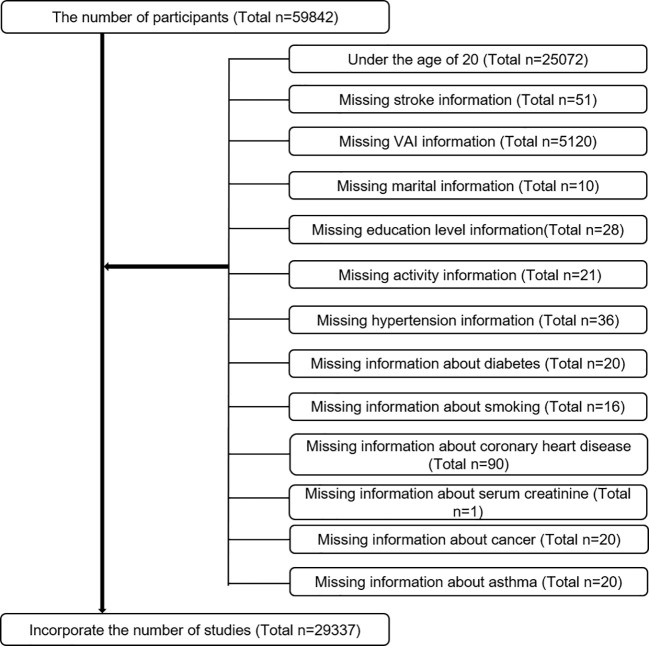
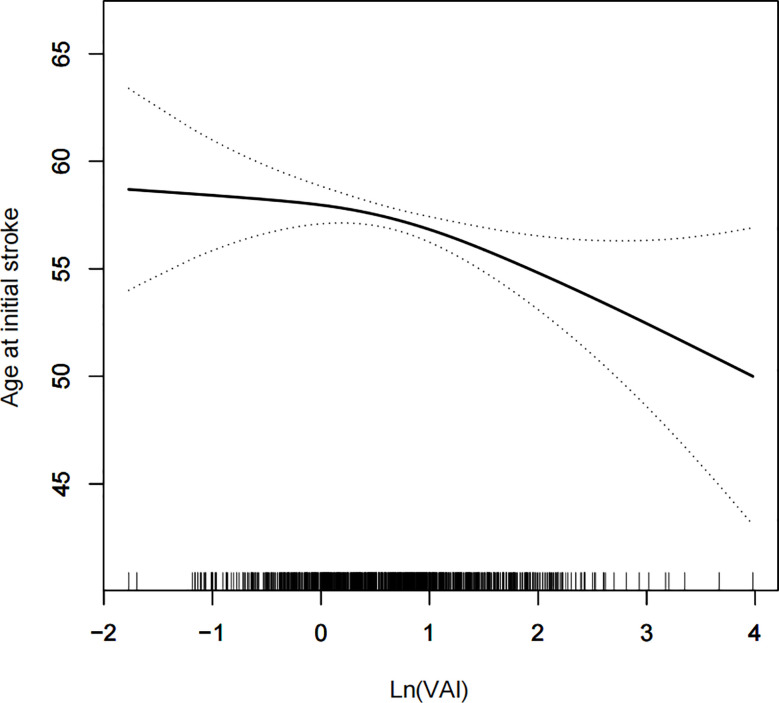
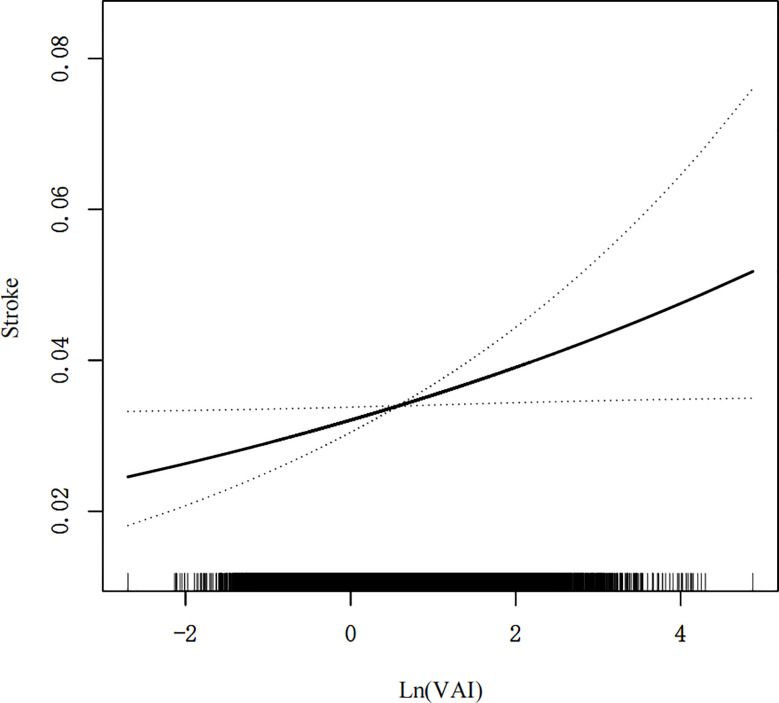
This study ultimately included 29,337 participants aged >20 years, of whom 1022 self-reported a history of stroke, and after adjusting for all confounders, each unit increase in corrected VAI was associated with a 12% increase in the prevalence of stroke (OR= 1.12, 95% CI: 1.01, 1.24) along with an earlier age at stroke 1.64 years (β= -1.64, 95% CI: -2.84, -0.45), stratified analysis showed that the prevalence of stroke was 20% higher in the female group (OR= 1.20, 95% CI: 1.04, 1.39), black group (OR= 1.22, 95% CI: 1.01, 1.48), age ≤60 years group (OR= 1.25, 95% CI: 1.05, 1.48), hypertensive group (OR=1.15, 95% CI:1.01, 1.31), and diabetic group (OR=1.23, 95% CI:1.02, 1.48) VAI increase was positively correlated with stroke prevalence increase. The dose-response curves showed a positive linear correlation between increased VAI and stroke prevalence, while a negative linear correlation was observed between increased VAI and age at stroke.
Although a causal relationship cannot be proven, higher VAI was positively associated with stroke prevalence and can lead to earlier stroke onset.
本研究旨在探讨美国成年人内脏脂肪指数(VAI)与卒中患病率和卒中发病年龄之间的关系。
我们使用逻辑回归、亚组分析和剂量-反应曲线,使用 2007 年至 2018 年国家健康和营养检查调查(NHANES)数据库中的参与者,研究了 VAI 与卒中患病率和卒中发病年龄之间的关系。
本研究最终纳入了 29337 名年龄>20 岁的参与者,其中 1022 人自述有卒中病史。在调整了所有混杂因素后,每个单位 VAI 的增加与卒中患病率增加 12%相关(OR=1.12,95%CI:1.01,1.24),并且卒中发病年龄提前 1.64 岁(β=-1.64,95%CI:-2.84,-0.45)。分层分析显示,女性组(OR=1.20,95%CI:1.04,1.39)、黑人组(OR=1.22,95%CI:1.01,1.48)、年龄≤60 岁组(OR=1.25,95%CI:1.05,1.48)、高血压组(OR=1.15,95%CI:1.01,1.31)和糖尿病组(OR=1.23,95%CI:1.02,1.48)中,VAI 增加与卒中患病率增加呈正相关。剂量-反应曲线显示,VAI 增加与卒中患病率呈正相关,而与卒中发病年龄呈负相关。
虽然不能证明因果关系,但较高的 VAI 与卒中患病率呈正相关,并可能导致卒中发病年龄更早。