Section 3/1 "Product testing of immunological biomedicines", Paul-Ehrlich-Institut, Langen.
Haematologica. 2023 Jun 1;108(6):1579-1589. doi: 10.3324/haematol.2022.281762.
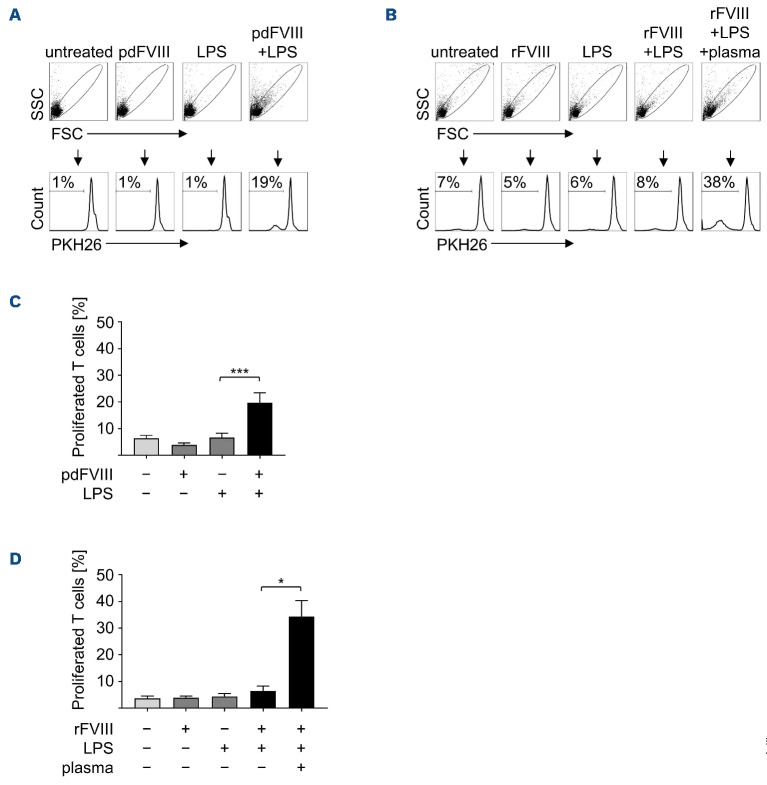
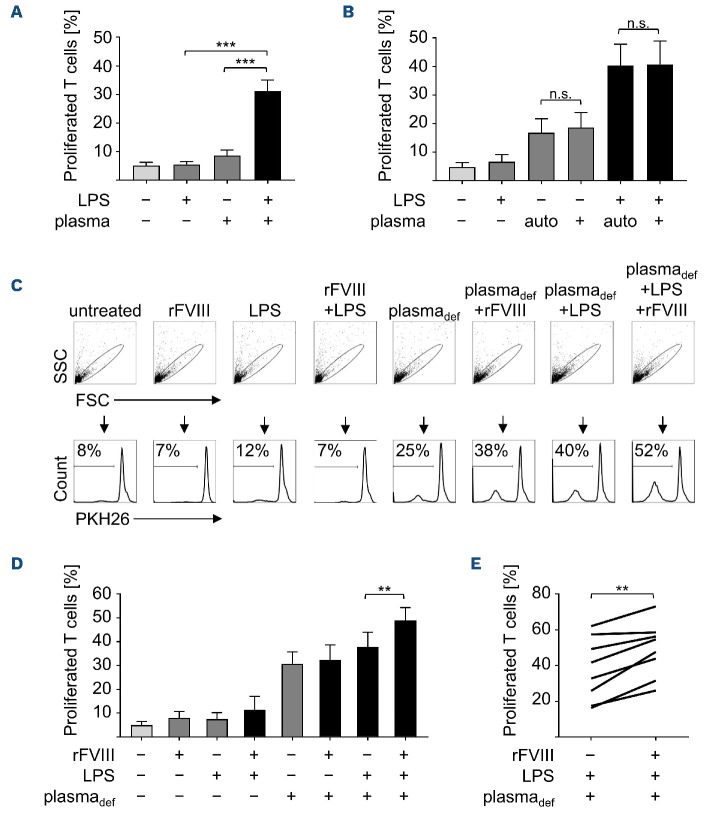
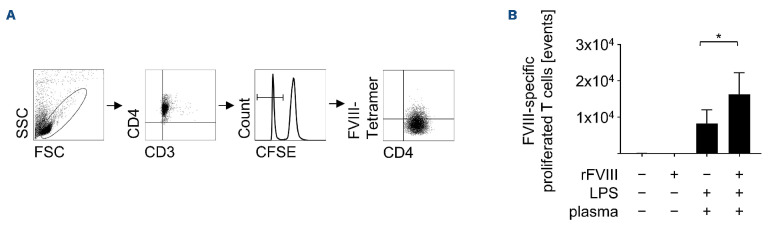
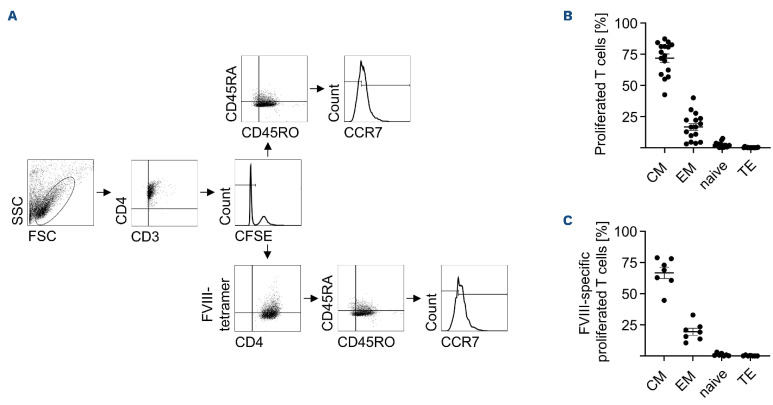
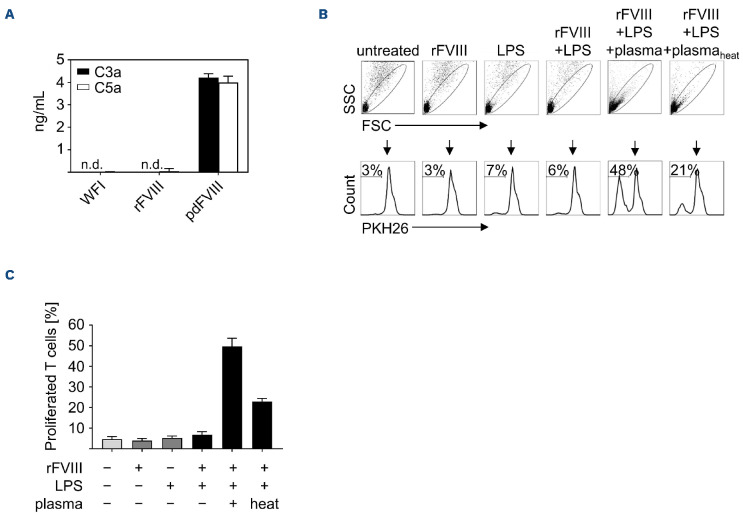
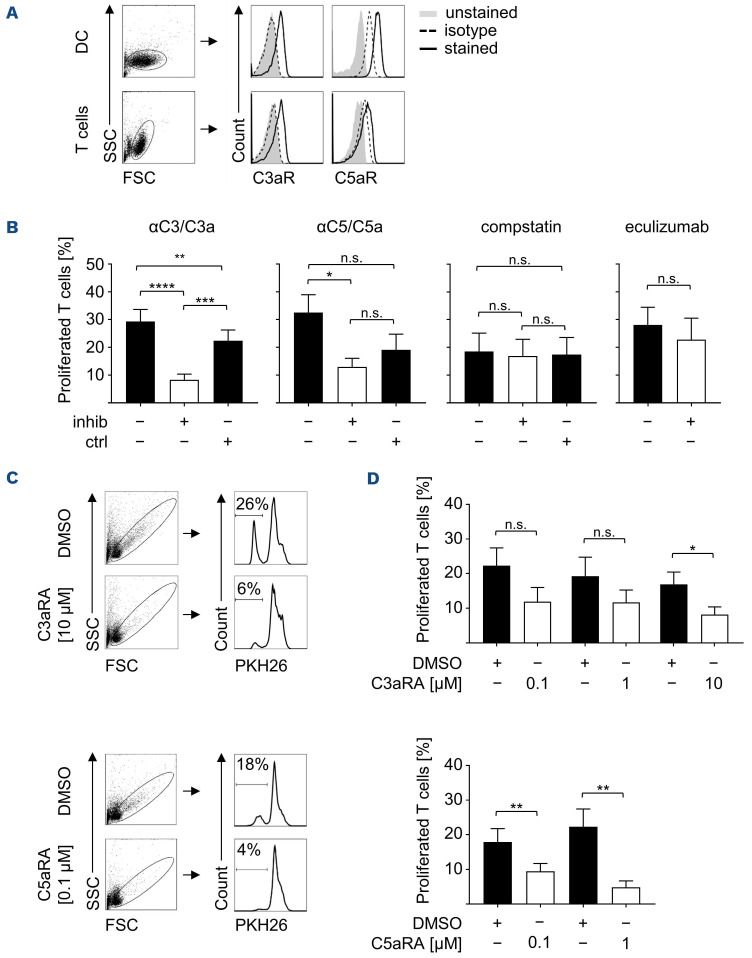
The most serious complication in the treatment of hemophilia A (HA) is the development of factor (F)VIII inhibitors or antidrug antibodies (ADA) occurring in 25-35% of patients with severe HA. The immunological mechanisms underlying the development of ADA against FVIII products have not been completely understood yet. Immunological danger signals associated with events such as infection or surgery have been suggested to play a critical role. In previous studies, we demonstrated that plasma-derived (pd)FVIII but not recombinant (r)FVIII can activate human monocyte-derived dendritic cells (DC) in a danger signal-dependent manner, which subsequently mediate the proliferation of autologous CD4+ T cells. In this study, we investigated the ability of plasma components, naturally present in pdFVIII products, to mediate T-cell responses. In fact, we show that addition of plasma to rFVIII plus lipopolysaccharide (LPS)-stimulated DC induces proliferation of autologous CD4+ T cells. Interestingly, although DC pulsed with LPS plus plasma induce T-cell proliferation upon co-culture, the addition of FVIII significantly increases the number of proliferating as well as FVIII-specific CD4+ T cells. Total proliferating CD4+ T cells and FVIII-specific subsets were identified mainly as central memory T cells. Experiments using blocking antibodies and receptor antagonists revealed that the complement proteins C3a and, to a lesser extent, C5a are critically involved in these LPS-mediated T-cell responses. Collectively, our results indicate that complement proteins are potent drivers of T-cell responses to FVIII. Data presented provide a model how event-related substitution of FVIII in HA patients might contribute to inhibitor development.
在治疗甲型血友病(HA)的过程中,最严重的并发症是出现因子(F)VIII 抑制剂或抗药物抗体(ADA),在 25-35%的重度 HA 患者中发生。ADA 针对 FVIII 产品的发展的免疫机制尚未完全了解。有人认为,与感染或手术等事件相关的免疫危险信号可能发挥关键作用。在之前的研究中,我们证明了血浆源性(pd)FVIII 而不是重组(r)FVIII 可以以危险信号依赖的方式激活人单核细胞衍生的树突状细胞(DC),随后介导自身 CD4+T 细胞的增殖。在这项研究中,我们研究了血浆成分(天然存在于 pdFVIII 产品中)介导 T 细胞反应的能力。事实上,我们表明,向 rFVIII 加脂多糖(LPS)刺激的 DC 中添加血浆可诱导自身 CD4+T 细胞增殖。有趣的是,尽管用 LPS 加血浆脉冲处理的 DC 在共培养时诱导 T 细胞增殖,但添加 FVIII 会显著增加增殖的以及 FVIII 特异性 CD4+T 细胞的数量。总增殖的 CD4+T 细胞和 FVIII 特异性亚群主要鉴定为中央记忆 T 细胞。使用阻断抗体和受体拮抗剂的实验表明,补体蛋白 C3a 和在较小程度上 C5a 对于这些 LPS 介导的 T 细胞反应至关重要。总之,我们的结果表明,补体蛋白是 T 细胞对 FVIII 反应的有效驱动因素。所提供的数据提供了一个模型,说明与事件相关的 HA 患者 FVIII 替代可能有助于抑制剂的发展。