Department of Epidemiology, Beijing An Zhen Hospital, Capital Medical University, Beijing Institute of Heart, Lung and Blood Vessel Diseases, Beijing 100029, China.
Chin Med J (Engl). 2022 Dec 5;135(23):2821-2828. doi: 10.1097/CM9.0000000000002257.
Reperfusion therapy is fundamental for ST-segment elevation myocardial infarction (STEMI). However, the details of contemporary practice and factors associated with reperfusion therapy in China are largely unknown. Therefore, this study aimed to explore reperfusion practice and its associated factors among hospitalized patients with STEMI in China.
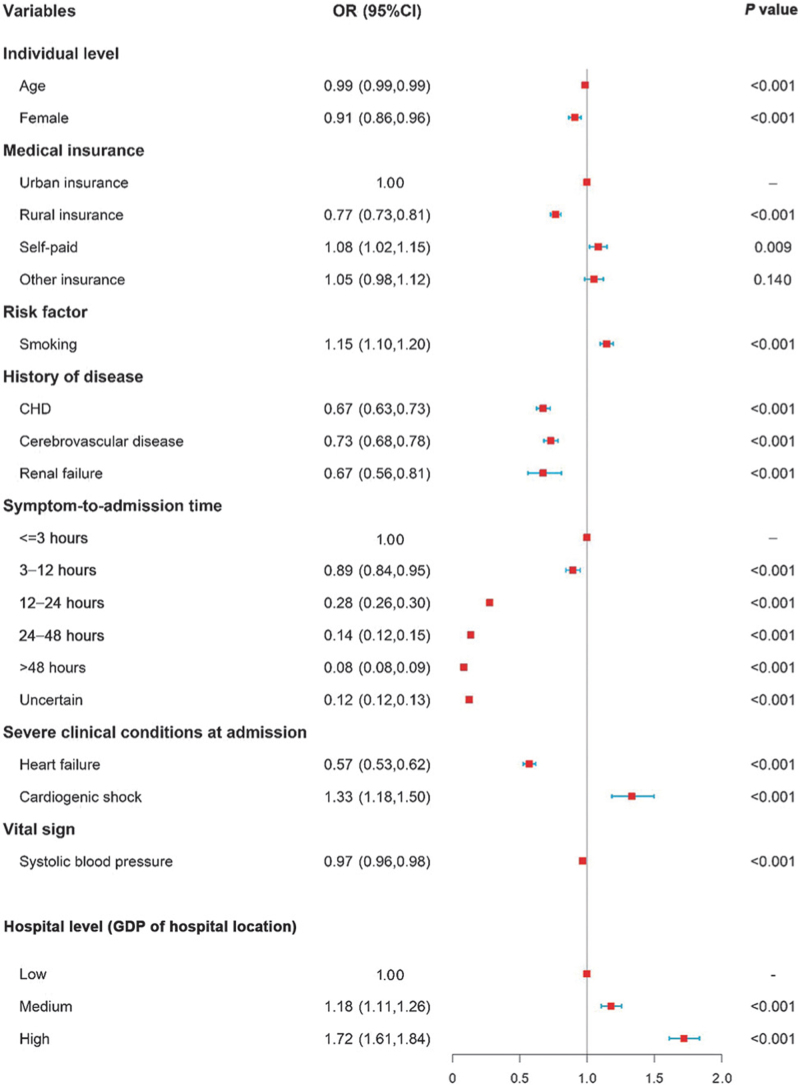
Patients with STEMI who were admitted to 159 tertiary hospitals from 30 provinces in China were included in the Improving Care for Cardiovascular Disease in China-Acute Coronary Syndrome project from November 2014 to December 2019. The associations of the characteristics of patients and hospitals with reperfusion were examined using hierarchical logistic regression. The associations between therapies and in-hospital major adverse cardiovascular events were examined with a mixed effects Cox regression model.
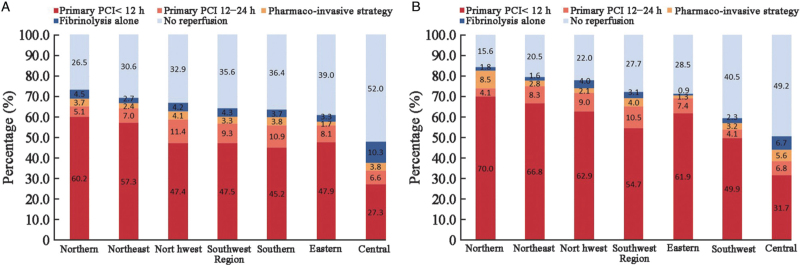
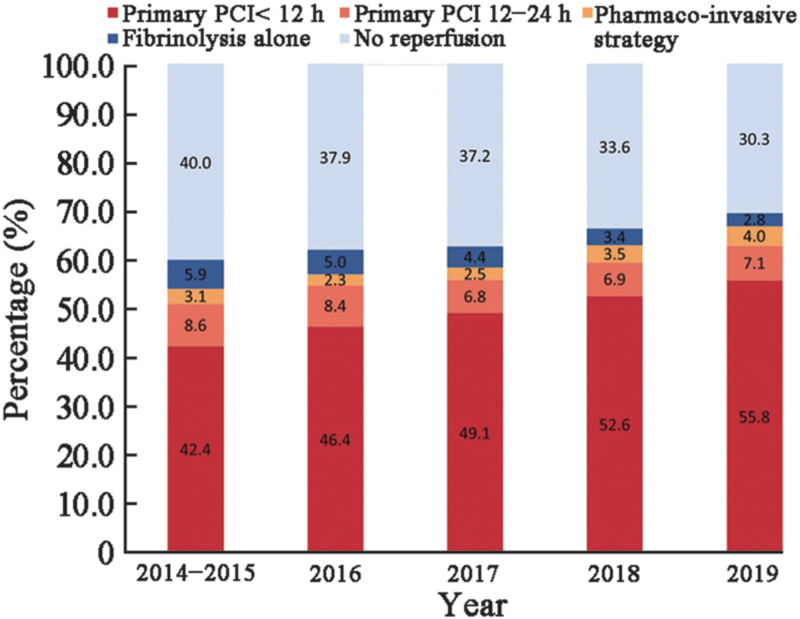
Among the 59,447 patients, 37,485 (63.1%) underwent reperfusion, including 4556 (7.7%) receiving fibrinolysis and 32,929 (55.4%) receiving primary percutaneous coronary intervention (PCI). The reperfusion rate varied across geographical regions (48.0%-73.5%). The overall rate increased from 60.0% to 69.7% from 2014 to 2019, mainly due to an increase in primary PCI within 12 h of symptom onset. Timely PCI, but not fibrinolysis alone, was associated with a decreased risk of in-hospital major adverse cardiovascular events compared with no reperfusion, with an adjusted hazard ratio (95% confidence interval) of 0.64 (0.54,0.76) for primary PCI at <12 h, 0.53 (0.37,0.74) for primary PCI at 12 to 24 h, 0.46 (0.25,0.82) for the pharmaco-invasive strategy, and 0.79 (0.54,1.15) for fibrinolysis alone.
Nationwide quality improvement initiatives should be strengthened to increase the reperfusion rate and reduce inequality in China.
www.ClinicalTrials.gov , NCT02306616.
再灌注治疗是 ST 段抬高型心肌梗死(STEMI)的基础。然而,中国当代实践的细节和与再灌注治疗相关的因素在很大程度上尚不清楚。因此,本研究旨在探讨中国 STEMI 住院患者的再灌注治疗实践及其相关因素。
2014 年 11 月至 2019 年 12 月,在中国 30 个省的 159 家三级医院纳入了改善中国心血管疾病护理-急性冠状动脉综合征项目中的 STEMI 患者。使用分层逻辑回归分析患者和医院特征与再灌注的相关性。使用混合效应 Cox 回归模型检验治疗方法与住院期间主要不良心血管事件的相关性。
在 59447 例患者中,37485 例(63.1%)接受了再灌注治疗,包括 4556 例(7.7%)接受了纤溶治疗和 32929 例(55.4%)接受了直接经皮冠状动脉介入治疗(PCI)。再灌注率在不同地理区域之间存在差异(48.0%-73.5%)。2014 年至 2019 年,总体再灌注率从 60.0%增加到 69.7%,主要是由于症状发作后 12 小时内直接 PCI 的增加。与无再灌注治疗相比,及时的 PCI(而非单独纤溶)与住院期间主要不良心血管事件的风险降低相关,直接 PCI <12 小时的校正危害比(95%置信区间)为 0.64(0.54,0.76),直接 PCI 12 至 24 小时的为 0.53(0.37,0.74),药物介入策略的为 0.46(0.25,0.82),单独纤溶的为 0.79(0.54,1.15)。
应加强全国范围的质量改进措施,以提高再灌注率并减少中国的不平等。
www.ClinicalTrials.gov ,NCT02306616。