Medical Oncology, Hospital General Universitario Gregorio Marañón, Madrid, Spain.
Cancer and Thrombosis Working Section, Spanish Society of Medical Oncology (SEOM), Madrid, Spain.
J Clin Oncol. 2023 Jun 1;41(16):2911-2925. doi: 10.1200/JCO.22.00255. Epub 2023 Feb 2.
Venous thromboembolism (VTE) is a leading cause of death among patients with cancer. The Khorana score was developed for assessing the risk of VTE in outpatients with cancer receiving chemotherapy, but its accuracy in identifying patients at high risk has been questioned. The aim of this study was to develop and validate a clinical-genetic score that improves the assessment of VTE risk in oncology outpatients within 6 months of diagnosis.
The new score was developed using the data of 364 outpatients belonging to the Spanish ONCOTHROMB 12-01 population. In this cohort, clinical data associated with the risk of VTE were collected at the time of diagnosis, including the Khorana score. These patients were also genotyped for the 51 genetic variants known to be associated with VTE. Multivariate logistic regression was performed to determine the weight of each genetic and clinical variable in relation to VTE risk, allowing a clinical-genetic risk score (the ONCOTHROMB score) to be developed. The Khorana and the ONCOTHROMB scores were then compared via the area under the receiver operating characteristic curve (AUC), calibration, and the number of patients needed to treat. The new score was then validated in a study of 263 patients in the Vienna Cancer and Thrombosis Study population.
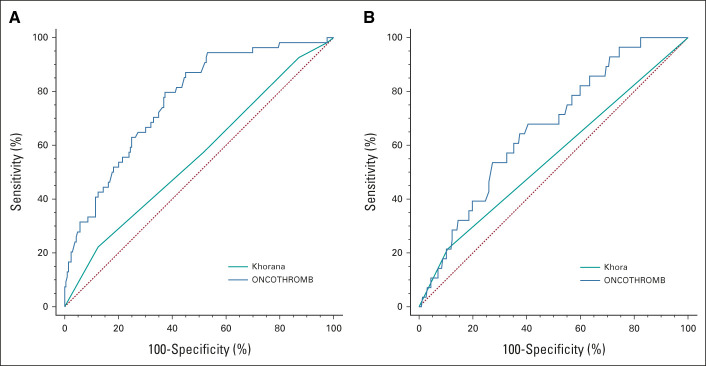
Nine genetic variants, tumor site, TNM stage, and a body mass index of > 25 kg/m were found to be associated with VTE and were used to build the ONCOTHROMB score, which better predicted the overall risk of VTE than did the Khorana score (AUC, 0.781 0.580; < .001). Similar AUC results were recorded in the validation study the Vienna Cancer and Thrombosis Study cohort involving patients with the same type of tumor (AUC for the ONCOTHROMB score the Khorana score: 0.686 0.577; < .001) and with all type of tumors (AUC for the ONCOTHROMB score the Khorana score: 0.720 0.561; < .0001).
The ONCOTHROMB score for VTE risk in outpatients with cancer, which takes into account both clinical and genetic variables, better identifies patients who might benefit from primary thromboprophylaxis than does the Khorana score.
静脉血栓栓塞症(VTE)是癌症患者死亡的主要原因。Khorana 评分用于评估接受化疗的门诊癌症患者发生 VTE 的风险,但人们对其识别高危患者的准确性提出了质疑。本研究旨在开发和验证一种临床-遗传评分,以提高癌症门诊患者在诊断后 6 个月内 VTE 风险评估的准确性。
新评分使用来自西班牙 ONCOTHROMB 12-01 人群的 364 名门诊患者的数据开发。在该队列中,在诊断时收集与 VTE 风险相关的临床数据,包括 Khorana 评分。这些患者还针对已知与 VTE 相关的 51 种遗传变异进行了基因分型。采用多变量逻辑回归确定每个遗传和临床变量与 VTE 风险的关系权重,从而开发出临床-遗传风险评分(ONCOTHROMB 评分)。然后通过接收者操作特征曲线下面积(AUC)、校准和需要治疗的患者数量对 Khorana 和 ONCOTHROMB 评分进行比较。然后在维也纳癌症和血栓形成研究人群中的 263 名患者的研究中对新评分进行了验证。
发现 9 种遗传变异、肿瘤部位、TNM 分期和 BMI 大于 25kg/m2 与 VTE 相关,并用于构建 ONCOTHROMB 评分,该评分较 Khorana 评分更好地预测了总体 VTE 风险(AUC,0.781 0.580; <.001)。在维也纳癌症和血栓形成研究队列中对新评分进行了验证,该队列涉及具有相同肿瘤类型的患者(ONCOTHROMB 评分的 AUC 为 Khorana 评分:0.686 0.577; <.001)和所有类型的肿瘤(ONCOTHROMB 评分的 AUC 为 Khorana 评分:0.720 0.561; <.0001),也获得了类似的 AUC 结果。
考虑到临床和遗传变量的癌症门诊患者 VTE 风险的 ONCOTHROMB 评分,比 Khorana 评分更好地识别出可能受益于初级血栓预防的患者。