National Institute of Water and Atmospheric Research (NIWA), Hataitai, Wellington, 6021, New Zealand.
Scripps Institution of Oceanography, University of California at San Diego, San Diego, CA, 92093, USA.
Nat Commun. 2023 Feb 2;14(1):425. doi: 10.1038/s41467-022-35204-6.
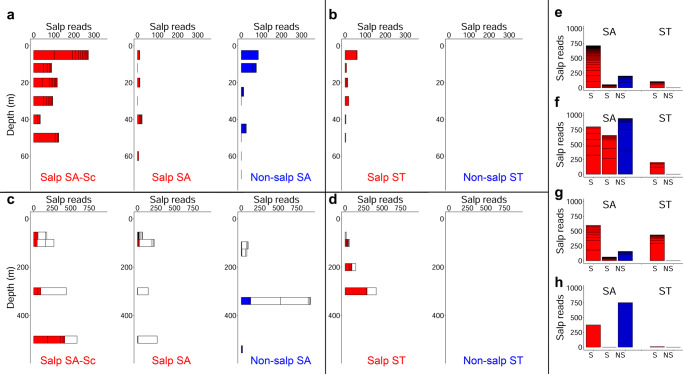
The Southern Ocean contributes substantially to the global biological carbon pump (BCP). Salps in the Southern Ocean, in particular Salpa thompsoni, are important grazers that produce large, fast-sinking fecal pellets. Here, we quantify the salp bloom impacts on microbial dynamics and the BCP, by contrasting locations differing in salp bloom presence/absence. Salp blooms coincide with phytoplankton dominated by diatoms or prymnesiophytes, depending on water mass characteristics. Their grazing is comparable to microzooplankton during their early bloom, resulting in a decrease of ~1/3 of primary production, and negative phytoplankton rates of change are associated with all salp locations. Particle export in salp waters is always higher, ranging 2- to 8- fold (average 5-fold), compared to non-salp locations, exporting up to 46% of primary production out of the euphotic zone. BCP efficiency increases from 5 to 28% in salp areas, which is among the highest recorded in the global ocean.
南大洋对全球生物碳泵(BCP)有重要贡献。南大洋中的樽海鞘,特别是索氏樽海鞘,是重要的摄食者,它们产生大量快速下沉的粪便颗粒。在这里,我们通过对比有/无樽海鞘爆发的地点,量化了樽海鞘爆发对微生物动态和 BCP 的影响。樽海鞘爆发与以硅藻或甲藻为主的浮游植物同时发生,这取决于水体特征。在早期爆发期间,它们的摄食与微型浮游动物相当,导致初级生产力下降约 1/3,所有樽海鞘存在的地方浮游植物的变化率均为负值。与非樽海鞘地点相比,樽海鞘水域的颗粒外排量总是更高,范围为 2 到 8 倍(平均 5 倍),高达 46%的初级生产力从透光带输出。在樽海鞘区域,BCP 效率从 5%增加到 28%,这是全球海洋中记录到的最高值之一。