Department of Earth, Ocean, and Atmospheric Science, Florida State University, Tallahassee, FL, USA.
Center for Ocean-Atmospheric Prediction Studies, Florida State University, Tallahassee, FL, USA.
Commun Biol. 2024 Aug 23;7(1):1039. doi: 10.1038/s42003-024-06717-1.
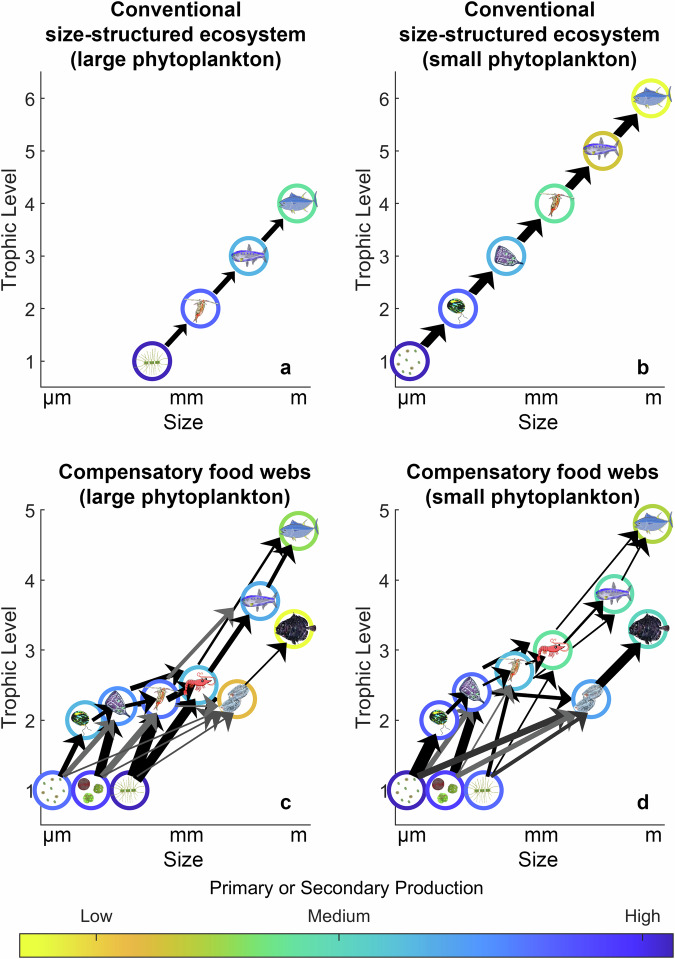
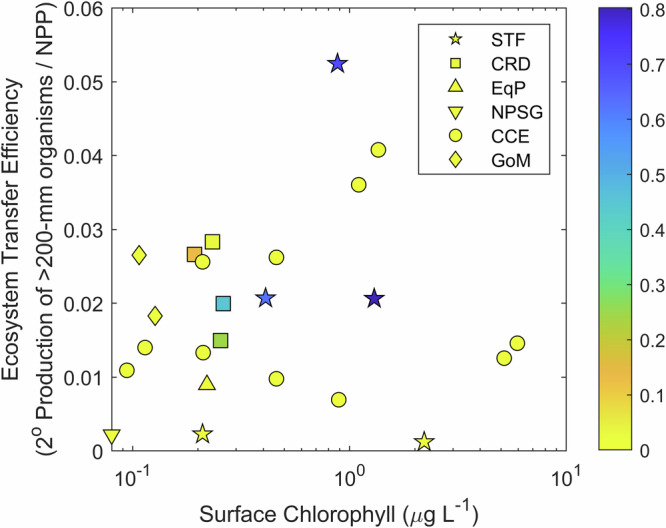
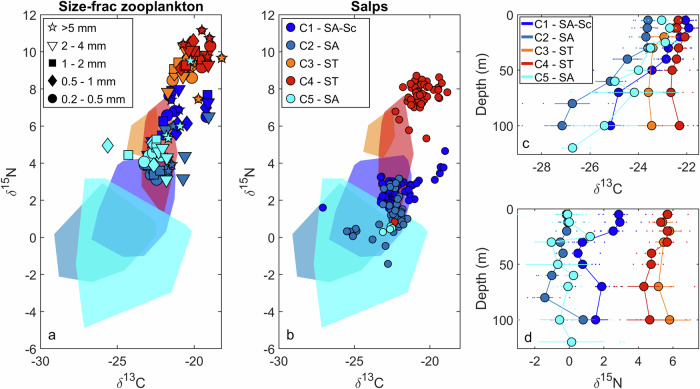
Gelatinous filter feeders (e.g., salps, doliolids, and pyrosomes) have high filtration rates and can feed at predator:prey size ratios exceeding 10,000:1, yet are seldom included in ecosystem or climate models. We investigated foodweb and trophic dynamics in the presence and absence of salp blooms using traditional productivity and grazing measurements combined with compound-specific isotopic analysis of amino acids estimation of trophic position during Lagrangian framework experiments in the Southern Ocean. Trophic positions of salps ranging 10-132 mm in size were 2.2 ± 0.3 (mean ± std) compared to 2.6 ± 0.4 for smaller (mostly crustacean) mesozooplankton. The mostly herbivorous salp trophic position was maintained despite biomass dominance of ~10-µm-sized primary producers. We show that potential energy flux to >10-cm organisms increases by approximately an order of magnitude when salps are abundant, even without substantial alteration to primary production. Comparison to a wider dataset from other marine regions shows that alterations to herbivore communities are a better predictor of ecosystem transfer efficiency than primary-producer dynamics. These results suggest that diverse consumer communities and intraguild predation complicate climate change predictions (e.g., trophic amplification) based on linear food chains. These compensatory foodweb dynamics should be included in models that forecast marine ecosystem responses to warming and reduced nutrient supply.
凝胶状滤食动物(例如,樽海鞘、磷虾和海鞘纲)具有很高的过滤率,并且可以在捕食者与猎物大小比超过 10,000:1 的情况下进食,但它们很少被纳入生态系统或气候模型中。我们使用传统的生产力和放牧测量方法,并结合氨基酸的特定化合物同位素分析,在南大洋的拉格朗日框架实验中,研究了有和没有樽海鞘爆发时的食物网和营养动态。大小在 10-132 毫米之间的樽海鞘的营养位置为 2.2±0.3(平均值±标准差),而较小的(主要是甲壳类)中型浮游动物的营养位置为 2.6±0.4。尽管主要以 10-µm 大小的初级生产者为优势,但樽海鞘的主要食草性营养位置得以维持。我们表明,当樽海鞘丰富时,即使对初级生产力没有实质性改变,流向>10-cm 生物的潜在能量通量也会增加约一个数量级。与来自其他海洋区域的更广泛数据集的比较表明,食草动物群落的改变是预测生态系统转移效率的一个更好指标,而不是初级生产者动态。这些结果表明,多样化的消费者群落和种内捕食使基于线性食物链的气候变化预测(例如,营养级放大)变得复杂。这些补偿性食物网动态应该被纳入预测海洋生态系统对变暖和减少养分供应的响应的模型中。