• 文献检索
  • 文档翻译
  • 深度研究
  • 学术资讯
  • Suppr Zotero 插件Zotero 插件
  • 邀请有礼
  • 套餐&价格
  • 历史记录
应用&插件
Suppr Zotero 插件Zotero 插件浏览器插件Mac 客户端Windows 客户端微信小程序
定价
高级版会员购买积分包购买API积分包
服务
文献检索文档翻译深度研究API 文档MCP 服务
关于我们
关于 Suppr公司介绍联系我们用户协议隐私条款
关注我们

Suppr 超能文献

核心技术专利:CN118964589B侵权必究
粤ICP备2023148730 号-1Suppr @ 2026

文献检索

告别复杂PubMed语法,用中文像聊天一样搜索,搜遍4000万医学文献。AI智能推荐,让科研检索更轻松。

立即免费搜索

文件翻译

保留排版,准确专业,支持PDF/Word/PPT等文件格式,支持 12+语言互译。

免费翻译文档

深度研究

AI帮你快速写综述,25分钟生成高质量综述,智能提取关键信息,辅助科研写作。

立即免费体验

使用社交媒体的青少年:攻击行为与网络欺凌

Adolescents on Social Media: Aggression and Cyberbullying.

作者信息

Sobkin Vladimir S, Fedotova Aleksandra V

机构信息

Center for Sociology of Education, The Federal State Budget Scientific Institution Institute of Education Management of the Russian Academy of Education, Moscow, Russia.

Faculty of Psychology, Lomonosov Moscow State University, Moscow, Russia.

出版信息

Psychol Russ. 2021 Jul 12;14(4):186-201. doi: 10.11621/pir.2021.0412. eCollection 2021.

DOI:10.11621/pir.2021.0412
PMID:36733812
原文链接:https://pmc.ncbi.nlm.nih.gov/articles/PMC9888041/
Abstract

BACKGROUND

The aggressiveness of social networking is a significant component of the risk modern teenagers face during socialization, and cyberbullying is one of the most controversial forms of aggressive behavior on social media.

OBJECTIVE

This paper deals with the study of secondary school students' behavior on social media. The parameters characterizing teenagers' usage of social media - their activity, intensity, motives, and self-presentation - are analyzed with respect to gender, age, and social psychological factors. The main focus is teenagers' personal experience dealing with aggressive situations on social media: their role in aggressive situations (as aggressor, victim, or witness); the form of aggression (public or private); the aggressor's characteristics (acquaintances or strangers, persons, or groups); and their views on what action victims should take (ignoring it, confronting it, or asking for help).

DESIGN

This article is based on data obtained by researchers at the Center for Sociology of Education of the Institute of Education Management of the Russian Academy of Education in 2020-2021. Using a specially developed questionnaire, we collected responses from 40,575 students from grades 7-11 in 17 regions of Russian Federation through an anonymous online survey. Mathematical statistical methods were used for data processing, specifically, the chi-square test in the "Basic statistics-Difference tests" module of the "StatSoft Statistica 7.0" package.

RESULTS

The data showed that the adolescents with high status among their classmates ("leaders") used social media as an important educational resource, while those with low status ("loners") used it to compensate for their poor real-life experience. Aggression on social media appears to be quite common among adolescents. The traditional differences between male and female subcultures appeared in the choice between private or public forms of aggression. The increase in aggressive interactions with strangers as the youth aged indicated that the realization of the teenage distinctive basic need for "expanding one's social environment" in online interaction comes with the risks of encountering unfriendly, aggressive reactions.

CONCLUSION

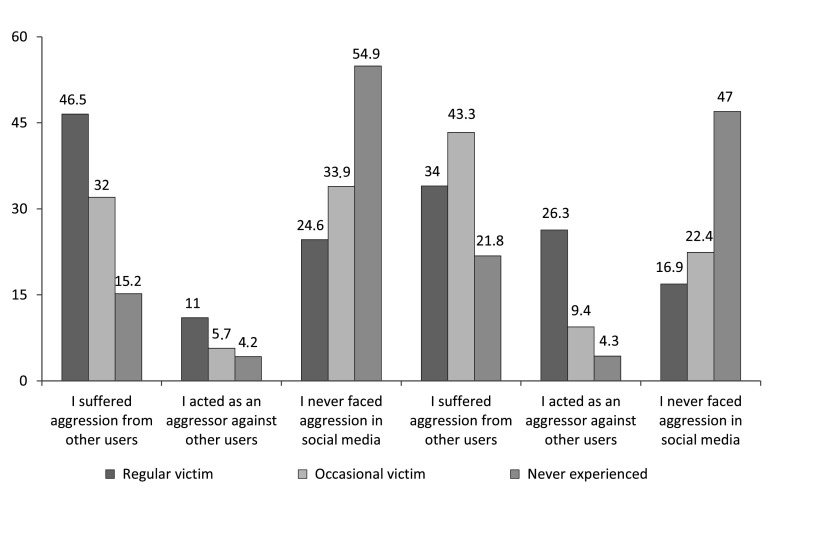
Communication on social media reflects an adolescent's real-life interaction in school: those who have experienced psychological or physical bullying are more likely to become both victims and offenders in aggressive situations on social media. Th is transfer of group bullying from real life to the virtual can be seen as the main feature of adolescent cyberbullying.

摘要

背景

社交网络的攻击性是现代青少年在社交过程中面临的风险的重要组成部分,而网络欺凌是社交媒体上最具争议性的攻击行为形式之一。

目的

本文探讨对中学生在社交媒体上的行为的研究。从性别、年龄和社会心理因素方面分析表征青少年使用社交媒体情况的参数——他们的活跃度、强度、动机和自我呈现。主要关注点是青少年在社交媒体上应对攻击性行为的个人经历:他们在攻击性行为中的角色(攻击者、受害者或目击者);攻击形式(公开或私下);攻击者的特征(熟人或陌生人、个人或群体);以及他们对受害者应采取何种行动的看法(忽视、对抗或寻求帮助)。

设计

本文基于俄罗斯教育科学院教育管理研究所教育社会学中心的研究人员在2020年至2021年期间获得的数据。通过使用专门设计的问卷,我们通过匿名在线调查从俄罗斯联邦17个地区的40575名7至11年级的学生中收集了回复。使用数学统计方法进行数据处理,具体而言,使用“StatSoft Statistica 7.0”软件包的“基本统计-差异检验”模块中的卡方检验。

结果

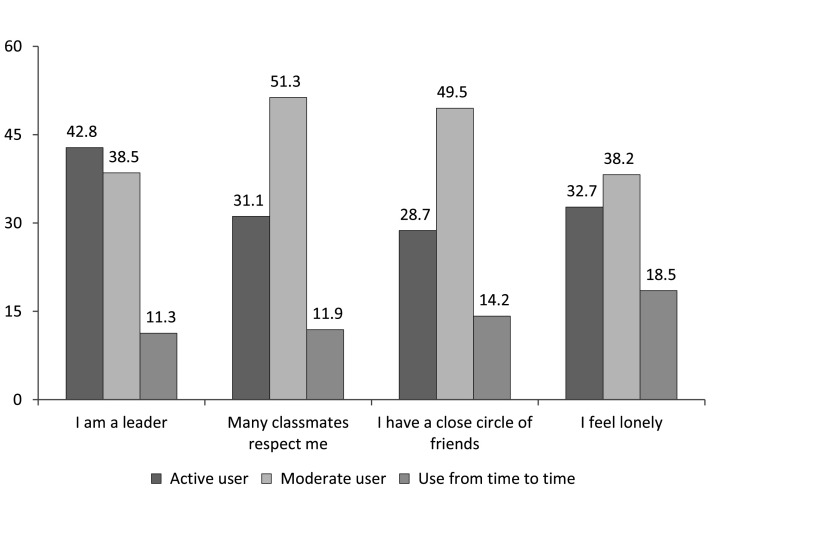
数据表明,在同学中地位较高的青少年(“领导者”)将社交媒体用作重要的教育资源,而地位较低的青少年(“孤独者”)则用它来弥补其糟糕的现实生活体验。社交媒体上的攻击行为在青少年中似乎相当普遍。在私下或公开攻击形式的选择上出现了传统的男女亚文化差异。随着青少年年龄增长,与陌生人的攻击性互动增加,这表明青少年在网络互动中实现“扩大社交环境”这一独特基本需求的同时,伴随着遭遇不友好、攻击性反应的风险。

结论

社交媒体上的交流反映了青少年在学校的现实生活互动:那些经历过心理或身体欺凌的人在社交媒体上的攻击性行为中更有可能既成为受害者也成为攻击者。这种群体欺凌从现实生活向虚拟世界的转移可被视为青少年网络欺凌的主要特征。
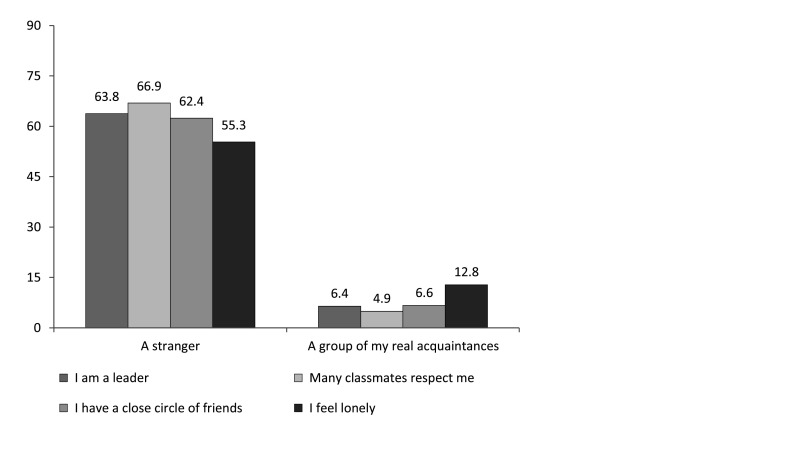
https://cdn.ncbi.nlm.nih.gov/pmc/blobs/a0b2/9888041/c9fa876a4b4c/pir-14-04-12-g003.jpg
https://cdn.ncbi.nlm.nih.gov/pmc/blobs/a0b2/9888041/9261e753eac1/pir-14-04-12-g001.jpg
https://cdn.ncbi.nlm.nih.gov/pmc/blobs/a0b2/9888041/052956918a79/pir-14-04-12-g002.jpg
https://cdn.ncbi.nlm.nih.gov/pmc/blobs/a0b2/9888041/c9fa876a4b4c/pir-14-04-12-g003.jpg
https://cdn.ncbi.nlm.nih.gov/pmc/blobs/a0b2/9888041/9261e753eac1/pir-14-04-12-g001.jpg
https://cdn.ncbi.nlm.nih.gov/pmc/blobs/a0b2/9888041/052956918a79/pir-14-04-12-g002.jpg
https://cdn.ncbi.nlm.nih.gov/pmc/blobs/a0b2/9888041/c9fa876a4b4c/pir-14-04-12-g003.jpg

相似文献

1
Adolescents on Social Media: Aggression and Cyberbullying.使用社交媒体的青少年:攻击行为与网络欺凌
Psychol Russ. 2021 Jul 12;14(4):186-201. doi: 10.11621/pir.2021.0412. eCollection 2021.
2
Identifying and Addressing Bullying识别与应对霸凌
3
Exploring Social Media Rumination: Associations With Bullying, Cyberbullying, and Distress.探索社交媒体反刍:与欺凌、网络欺凌和困扰的关联。
J Interpers Violence. 2022 Mar;37(5-6):NP3041-NP3061. doi: 10.1177/0886260520946826. Epub 2020 Aug 6.
4
Exploring the Importance of Gender, Family Affluence, Parenting Style and Loneliness in Cyberbullying Victimization and Aggression among Romanian Adolescents.探究性别、家庭富裕程度、教养方式和孤独感在罗马尼亚青少年网络欺凌受害与攻击行为中的重要性。
Behav Sci (Basel). 2022 Nov 17;12(11):457. doi: 10.3390/bs12110457.
5
Cyberbullying Victimization in WhatsApp Classmate Groups among Israeli Elementary, Middle, and High School Students.以色列中小学生在 WhatsApp 同学群中遭受网络欺凌的情况。
J Interpers Violence. 2021 Aug;36(15-16):NP8498-NP8519. doi: 10.1177/0886260519842860. Epub 2019 Apr 22.
6
Cyberbullying, Aggressiveness, and Emotional Intelligence in Adolescence.青少年中的网络欺凌、攻击性和情绪智力。
Int J Environ Res Public Health. 2019 Dec 12;16(24):5079. doi: 10.3390/ijerph16245079.
7
Adolescent Involvement in Cybergossip: Influence on Social Adjustment, Bullying and Cyberbullying.青少年参与网络八卦:对社交适应、欺凌和网络欺凌的影响。
Span J Psychol. 2022 Feb 2;25:e6. doi: 10.1017/SJP.2022.3.
8
[Cyber-bullying in adolescents: associated psychosocial problems and comparison with school bullying].青少年网络欺凌:相关的心理社会问题及与校园欺凌的比较
Encephale. 2013 Apr;39(2):77-84. doi: 10.1016/j.encep.2012.01.008. Epub 2012 May 28.
9
Social Media Use and Cyber-Bullying: A Cross-National Analysis of Young People in 42 Countries.社交媒体使用与网络欺凌:对 42 个国家青少年的跨国分析。
J Adolesc Health. 2020 Jun;66(6S):S100-S108. doi: 10.1016/j.jadohealth.2020.03.006.
10
Predictive Model of The Factors Involved in Cyberbullying of Adolescent Victims.青少年受害者网络欺凌相关因素的预测模型
Front Psychol. 2022 Jan 5;12:798926. doi: 10.3389/fpsyg.2021.798926. eCollection 2021.

引用本文的文献

1
The Effects of Emotional States and World Assumptions on Moral Disengagement in Adolescents from Combat Zones.战区青少年的情绪状态和世界观假设对道德脱离的影响。
Psychol Russ. 2025 Jun 1;18(2):97-112. doi: 10.11621/pir.2025.0206. eCollection 2025.
2
Social media usage and cyberbullying: the moderating role of tie strength.社交媒体使用与网络欺凌:关系强度的调节作用。
Front Psychol. 2025 Feb 11;16:1490022. doi: 10.3389/fpsyg.2025.1490022. eCollection 2025.
3
Adolescents and Trust in Online Social Interactions: A Qualitative Exploratory Study.

本文引用的文献

1
The associations between problematic Facebook use, psychological distress and well-being among adolescents and young adults: A systematic review and meta-analysis.青少年和年轻人中问题性 Facebook 使用、心理困扰和幸福感之间的关联:系统评价和荟萃分析。
J Affect Disord. 2018 Jan 15;226:274-281. doi: 10.1016/j.jad.2017.10.007. Epub 2017 Oct 3.
2
Bullying in schools: the state of knowledge and effective interventions.学校欺凌:知识现状与有效干预。
Psychol Health Med. 2017 Mar;22(sup1):240-253. doi: 10.1080/13548506.2017.1279740. Epub 2017 Jan 24.
3
Psychological, physical, and academic correlates of cyberbullying and traditional bullying.
青少年与对在线社交互动的信任:一项定性探索性研究。
Children (Basel). 2023 Aug 18;10(8):1408. doi: 10.3390/children10081408.
网络欺凌和传统欺凌的心理、生理和学业相关性。
J Adolesc Health. 2013 Jul;53(1 Suppl):S13-20. doi: 10.1016/j.jadohealth.2012.09.018.
4
Bullying, cyberbullying, and suicide.欺凌、网络欺凌与自杀。
Arch Suicide Res. 2010;14(3):206-21. doi: 10.1080/13811118.2010.494133.
5
Cyberbullying: its nature and impact in secondary school pupils.网络欺凌:其本质及对中学生的影响。
J Child Psychol Psychiatry. 2008 Apr;49(4):376-85. doi: 10.1111/j.1469-7610.2007.01846.x.
6
Involvement in traditional and electronic bullying among adolescents.青少年参与传统欺凌和电子欺凌的情况。
Dev Psychol. 2007 May;43(3):564-75. doi: 10.1037/0012-1649.43.3.564.
7
Psychology of computer use: XLVII. Parameters of Internet use, abuse and addiction: the first 90 days of the Internet Usage Survey.计算机使用心理学:XLVII. 互联网使用、滥用和成瘾的参数:互联网使用调查的前90天
Psychol Rep. 1997 Jun;80(3 Pt 1):879-82. doi: 10.2466/pr0.1997.80.3.879.