Department of Oral and Maxillofacial-Head Neck Oncology, Shanghai Ninth People's Hospital, College of Stomatology, Shanghai Jiao Tong University School of Medicine, Shanghai, China.
National Center for Stomatology, Shanghai, China.
Cancer Med. 2023 Apr;12(8):9144-9155. doi: 10.1002/cam4.5653. Epub 2023 Feb 3.
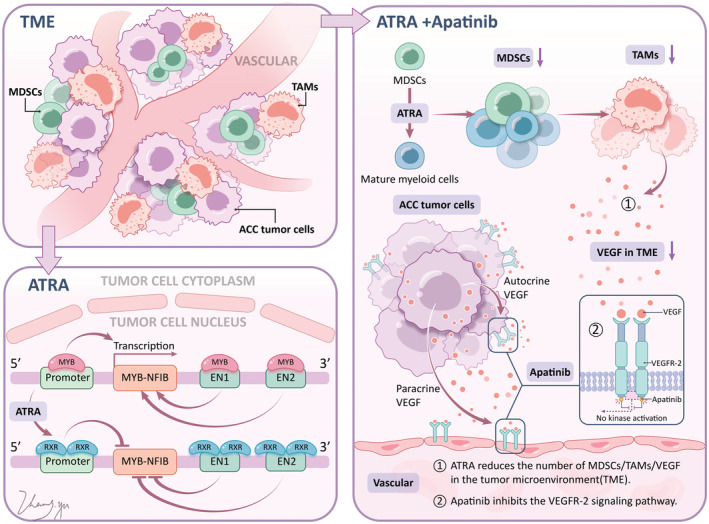
Treatment options are limited for recurrent/metastatic adenoid cystic carcinoma of the head and neck (R/M ACCHN). We aimed to evaluate the preliminary results of the efficacy and safety of all-trans retinoic acid (ATRA) combined with low-dose apatinib in patients with R/M ACCHN according to a secondary analysis of a phase II study.
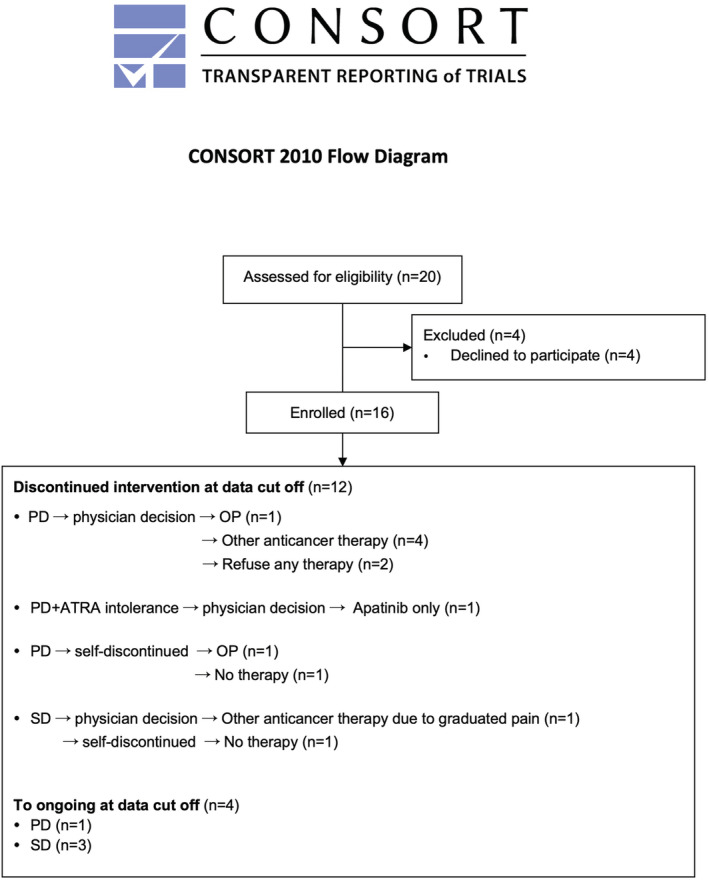
Patients from a phase II study (NCT02775370) who orally administered 500 milligram (mg) apatinib daily until treatment-related adverse events (AEs) intolerance or progression occurred were eligible for inclusion. Patients were further treated with combination therapy of ATRA (25 mg/m /day) and apatinib (250 mg/day) between March 2019 and October 2021 until progression of disease (PD).
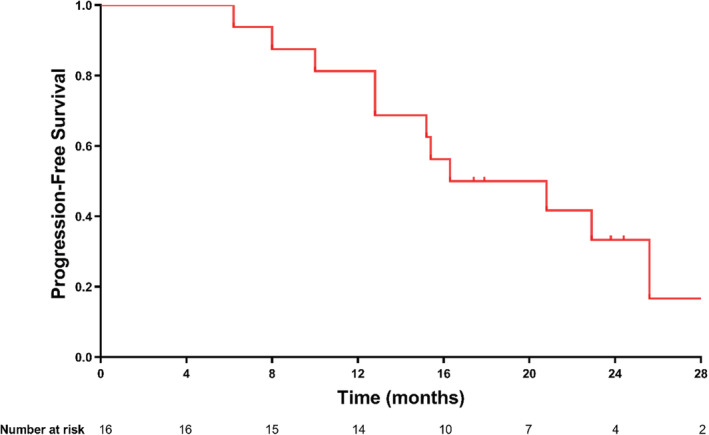
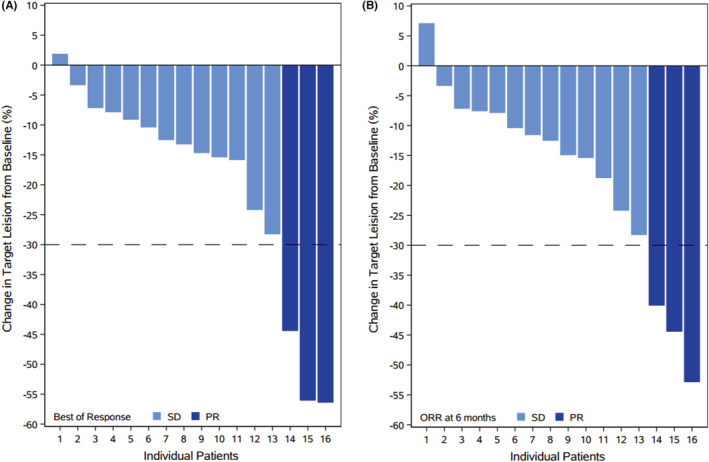
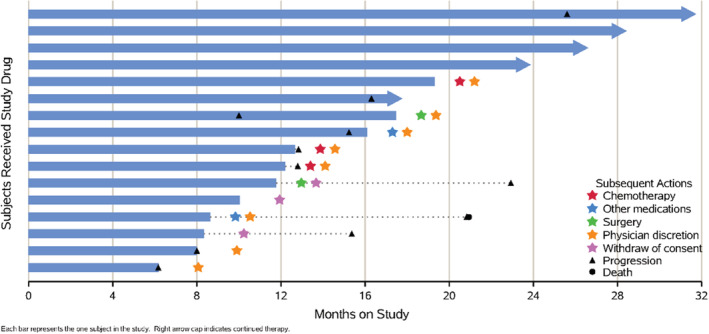
A total of 16 patients were included with nine (56.3%) males and aged 35-69 years old. All recruited patients previously received anti-angiogenic therapy then withdrew due to toxicities or progression occurred. The objective response rate (ORR) and disease control rate (DCR) were 18.8% and 100%, respectively. During a median follow-up of 23.9 months (range:17.8-31.7 months), 11 (68.8%) patients developed PD and one of them died in 20.9 months. The median of progression-free survival (PFS) was 16.3 months (95% CI: 7.2-25.4 months), and the 6-month, 12-month, and 24-month PFS rates were 100%, 81.3%, and 33.3%, respectively. The grade 3 adverse events were albuminuria (n = 2, 12.5%) and hand-foot syndrome (n = 1, 6.25%).
All-trans retinoic acid combined with low-dose apatinib might be a potential efficacy therapeutic option for patients with R/M ACCHN. This finding will be further confirmed by our registered ongoing trial, the APLUS study (NCT04433169).
头颈部腺样囊性癌(R/M ACCHN)的治疗选择有限。我们旨在根据一项 II 期研究的二次分析,评估全反式维甲酸(ATRA)联合低剂量阿帕替尼治疗 R/M ACCHN 患者的疗效和安全性的初步结果。
来自 II 期研究(NCT02775370)的患者,每天口服 500 毫克(mg)阿帕替尼,直至出现与治疗相关的不良反应(AE)不耐受或进展,符合入组条件。然后,患者于 2019 年 3 月至 2021 年 10 月期间,在阿帕替尼(250mg/天)联合 ATRA(25mg/m /天)的联合治疗下,直至疾病进展(PD)。
共纳入 16 例患者,其中 9 例(56.3%)为男性,年龄 35-69 岁。所有入组患者既往均接受过抗血管生成治疗,随后因毒性或进展而停药。客观缓解率(ORR)和疾病控制率(DCR)分别为 18.8%和 100%。在中位随访 23.9 个月(范围:17.8-31.7 个月)期间,11 例(68.8%)患者发生 PD,其中 1 例在 20.9 个月时死亡。中位无进展生存期(PFS)为 16.3 个月(95%CI:7.2-25.4 个月),6 个月、12 个月和 24 个月的 PFS 率分别为 100%、81.3%和 33.3%。3 级不良事件为蛋白尿(n=2,12.5%)和手足综合征(n=1,6.25%)。
全反式维甲酸联合低剂量阿帕替尼可能是 R/M ACCHN 患者的一种潜在有效治疗选择。这一发现将通过我们正在进行的注册研究 APLUS 研究(NCT04433169)进一步证实。