Medical Division, Our Blood Institute, Oklahoma City, Oklahoma, USA.
Department of Pathology and Laboratory Medicine, University of Arkansas for Medical Sciences, Little Rock, Arkansas, USA.
Vox Sang. 2023 Apr;118(4):281-287. doi: 10.1111/vox.13407. Epub 2023 Feb 3.
Research in low-resource settings is inherently challenging. We sought to assess the factors that have impeded or facilitated transfusion medicine (TM) research in various African settings.
A qualitative case study was conducted of selected investigators in Africa; selection was based on productivity-spanning publication, leadership and research in TM. We designed a questionnaire to explore the factors impeding or facilitating TM research to understand the impact on the investigators' careers. Written responses were independently coded and double-checked for precision. Qualitative analysis was conducted, whereby responses were grouped thematically and clustered by relationship. The initial findings were discussed with respondents to validate and refine the interpretations. The recorded transcript was analysed and incorporated into the final analysis.
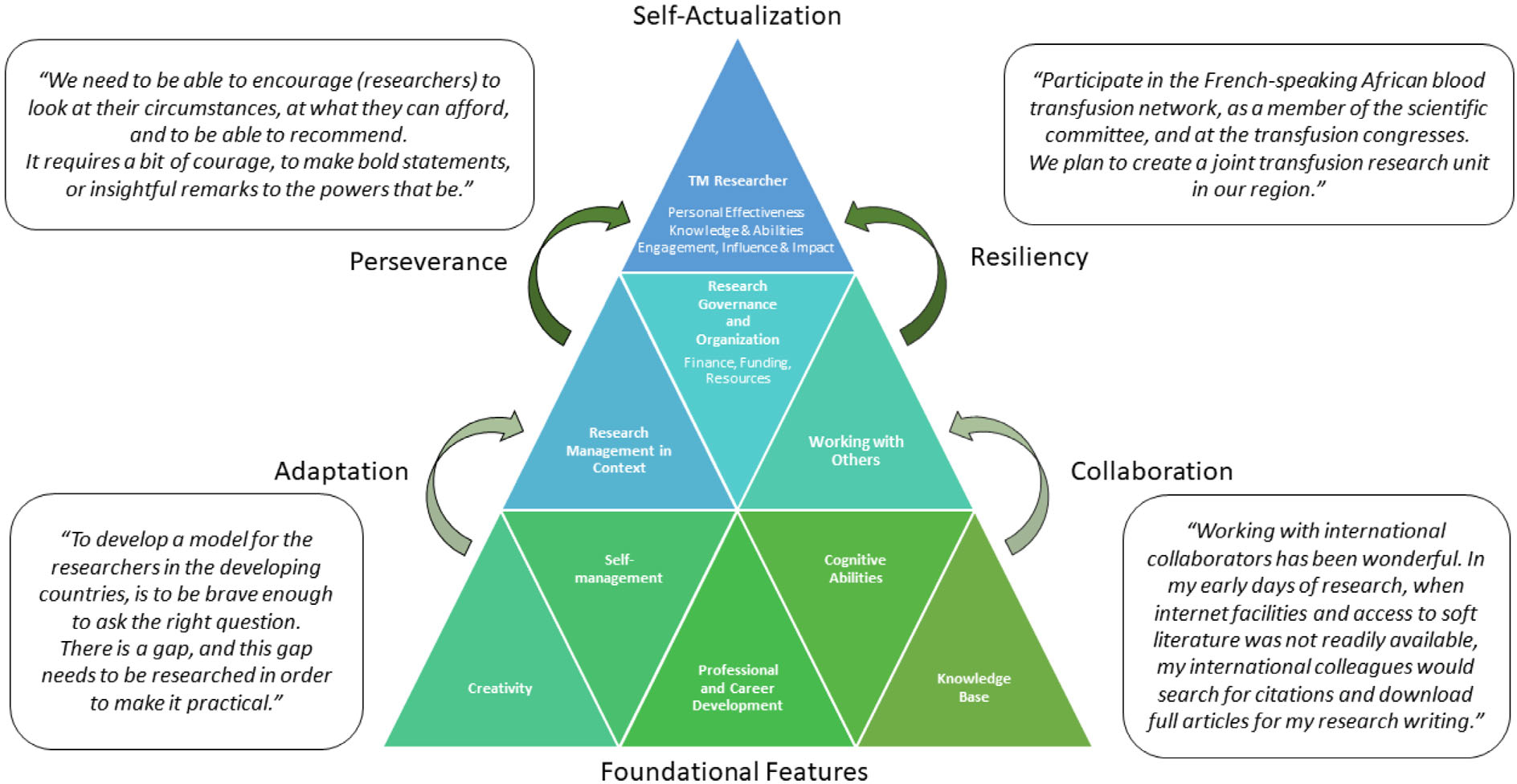
Six investigators participated in the study. Their responses yielded 471 coded comments: 389 from the questionnaires and 82 from the ensuing discussion. The most frequently cited factors described included knowledge and intellectual abilities (n = 104), personal effectiveness (n = 99), research and governance structure (n = 97), and engagement, influence and impact (n = 75). Four relationship clusters emerged from the facilitators (n = 42), barriers (n = 28), and common approaches (n = 26) to research, informing summary themes of adaptation, collaboration, perseverance, and resiliency.
Individual attributes were found to be central to a successful TM research career in African settings. However, given other public health priorities and constraints, interpersonal relationships, organizational structures and the broader research context were important to TM researchers. Overcoming complexities demands adaptation, collaboration, perseverance and resiliency.
在资源匮乏的环境中开展研究具有固有挑战性。我们旨在评估在各种非洲环境中阻碍或促进输血医学(TM)研究的因素。
对非洲的选定研究者进行了定性案例研究;选择是基于跨越出版物、TM 领导力和研究的生产力。我们设计了一份问卷,以探讨阻碍或促进 TM 研究的因素,以了解其对研究者职业的影响。书面答复由独立编码并进行双重检查以确保准确性。进行了定性分析,即将答复按主题分组并按关系聚类。最初的发现与受访者进行了讨论,以验证和完善解释。分析了记录的转录本并将其纳入最终分析。
有 6 名研究者参与了这项研究。他们的答复产生了 471 条编码评论:389 条来自问卷,82 条来自随后的讨论。最常提到的因素包括知识和智力能力(n=104)、个人效能(n=99)、研究和治理结构(n=97)以及参与、影响力和影响(n=75)。从促进因素(n=42)、障碍(n=28)和常见方法(n=26)中得出了四个关系群集,为适应、合作、坚持和弹性提供了总结主题。
在非洲环境中,个人属性被认为是成功开展 TM 研究事业的核心。然而,鉴于其他公共卫生重点和限制,人际关系、组织结构和更广泛的研究背景对 TM 研究人员也很重要。克服复杂性需要适应、合作、坚持和弹性。