Division of Emergency Medicine, Department of Medicine, McMaster University, Hamilton, Ontario, Canada.
PLoS One. 2023 Feb 3;18(2):e0266579. doi: 10.1371/journal.pone.0266579. eCollection 2023.
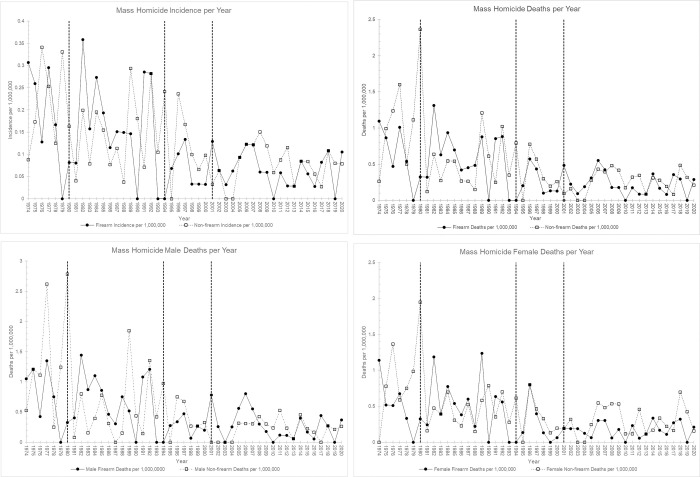
Canada implemented a series of laws regulating firearms including background checks and licensing, references, psychological questionnaires, prohibition of paramilitary style rifles, and magazine capacity restrictions in order to decrease the incidences and deaths from mass shootings. The associated effects of these laws were examined over the years 1974 to 2020. A model was constructed using difference-in-differences analysis of firearms and non-firearms mass homicide incidences and death rates. Mass homicides were defined as a homicide due to one event involving three or more deaths. Incidence rates of mass homicide by firearm were found to be 0.11 (95%CI 0.08, 0.14) per million compared to a non-firearm mass homicide rate of 0.12 (95% CI 0.10, 0.15) per million. Mass homicide death rates by firearm were found to be 0.39 (95% CI 0.29, 0.49) per million compared to a non-firearm mass homicide rate of 0.47 (95% CI 0.34, 0.61) per million. Overall, there is a gradual declining trend in the incidence of mass homicide by firearm (IRR 0.97 (95% CI 0.96, 0.98)) and by non-firearm (IRR 0.97 (95% CI 0.97, 0.98)). The decline in mass homicide death rate by firearm and non-firearm is IRR 0.96 (95% CI 0.95, 0.97), and IRR 0.97 (95% CI 0.96, 0.98) respectively. No specific associated decrease in mass homicide incidence rates or death rates with firearms legislation was found after the implementation of background checks and prohibition of full auto firearms in 1980, by the implementation of references and psychological questionnaires in 1994, by the restriction of magazine capacity in 1994, the prohibition of paramilitary rifles in 1994, or licensing in 2001.
加拿大实施了一系列枪支管理法律,包括背景调查和许可、参考资料、心理问卷、禁止准军事风格的步枪以及限制杂志容量,以减少大规模枪击事件的发生率和死亡人数。这些法律的相关影响在 1974 年至 2020 年期间进行了研究。使用差异分析对枪支和非枪支大规模杀人案发生率和死亡率进行了模型构建。大规模杀人案被定义为由于一起事件导致三人或三人以上死亡的杀人案。通过枪支造成的大规模杀人案发生率为每百万 0.11(95%CI 0.08,0.14),而非枪支大规模杀人案发生率为每百万 0.12(95%CI 0.10,0.15)。通过枪支造成的大规模杀人案死亡率为每百万 0.39(95%CI 0.29,0.49),而非枪支大规模杀人案死亡率为每百万 0.47(95%CI 0.34,0.61)。总体而言,枪支造成的大规模杀人案发生率呈逐渐下降趋势(IRR 0.97(95%CI 0.96,0.98)),而非枪支造成的大规模杀人案发生率也呈下降趋势(IRR 0.97(95%CI 0.97,0.98))。枪支和非枪支造成的大规模杀人案死亡率呈下降趋势,IRR 分别为 0.96(95%CI 0.95,0.97)和 0.97(95%CI 0.96,0.98)。1980 年实施背景调查和禁止全自动枪支、1994 年实施参考资料和心理问卷、1994 年限制杂志容量、1994 年禁止准军事风格步枪、2001 年实施许可后,并未发现与枪支立法相关的大规模杀人案发生率或死亡率的特定下降。