Université Lille, Inserm, CHU Lille, U1192, Laboratoire Protéomique, Réponse Inflammatoire Et Spectrométrie de Masse (PRISM), Lille, France.
OCR (Oncovet Clinical Research), Parc Eurasanté Lille Métropole, 80 Rue du Dr Yersin, 59120, Loos, France.
BMC Biol. 2023 Feb 3;21(1):23. doi: 10.1186/s12915-023-01516-2.
Cancer heterogeneity is a main obstacle for the development of effective therapies, as its replication in in vitro preclinical models is challenging. Around 96% of developed drugs are estimated to fail from discovery to the clinical trial phase probably because of the unsuitability and unreliability of current preclinical models (Front Pharmacol 9:6, 2018; Nat Rev Cancer 8: 147-56, 2008) in replicating the overall biology of tumors, for instance the tumor microenvironment. Breast cancer is the most frequent cancer among women causing the greatest number of cancer-related deaths. Breast cancer can typically be modeled in vitro through the use of tumoroids; however, current approaches using mouse tumoroids fail to reproduce crucial aspect of human breast cancer, while access to human cells is limited and the focus of ethical concerns. New models of breast cancer, such as companion dogs, have emerged given the resemblance of developed spontaneous mammary tumors to human breast cancer in many clinical and molecular aspects; however, they have so far failed to replicate the tumor microenvironment. The present work aimed at developing a robust canine mammary tumor model in the form of tumoroids which recapitulate the tumor diversity and heterogeneity.
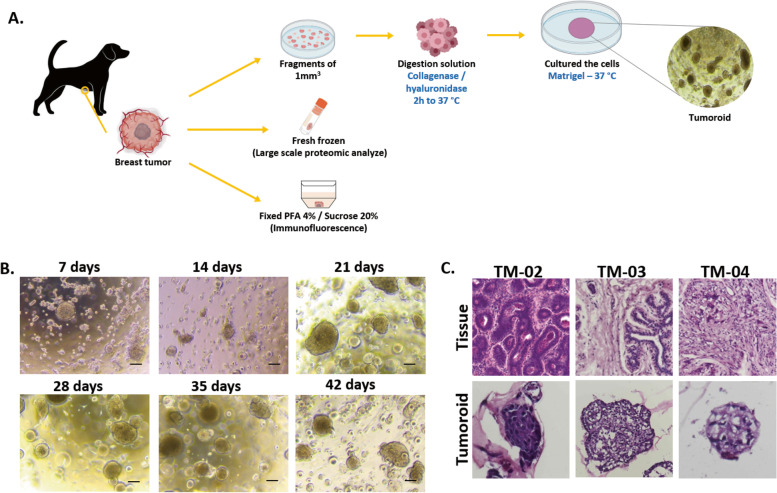
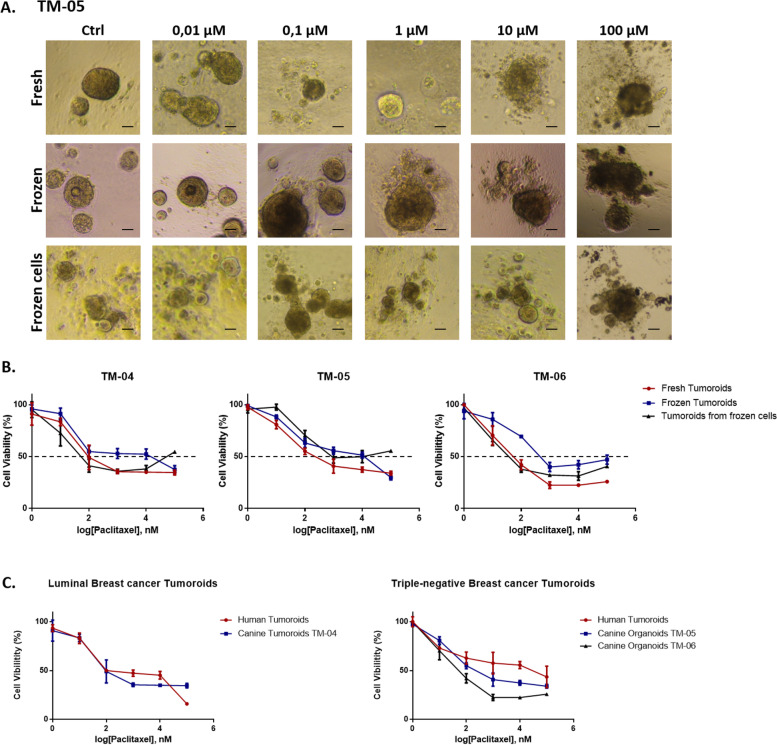
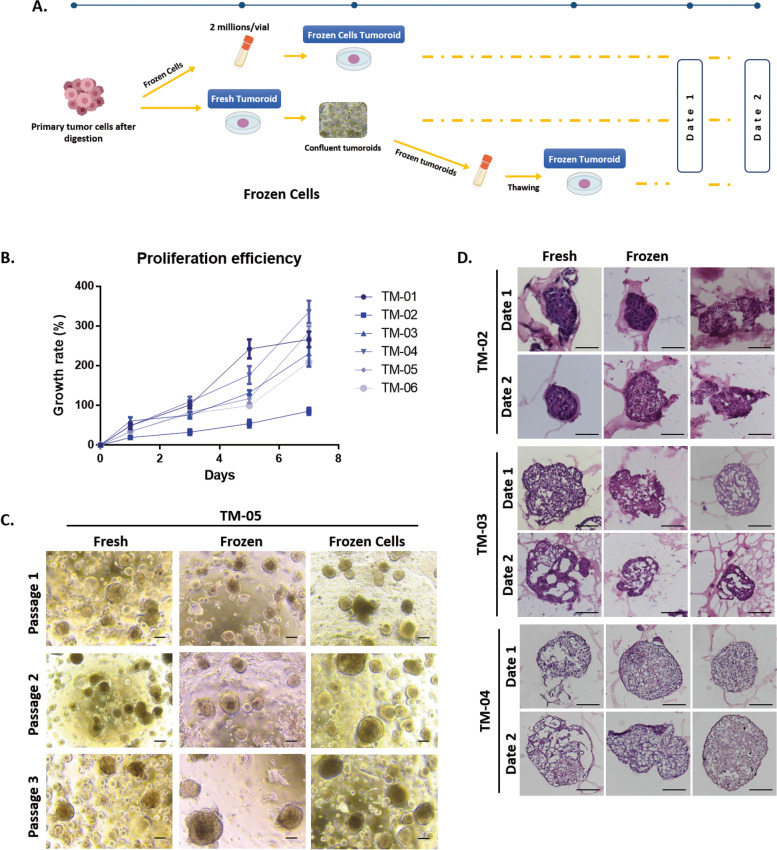
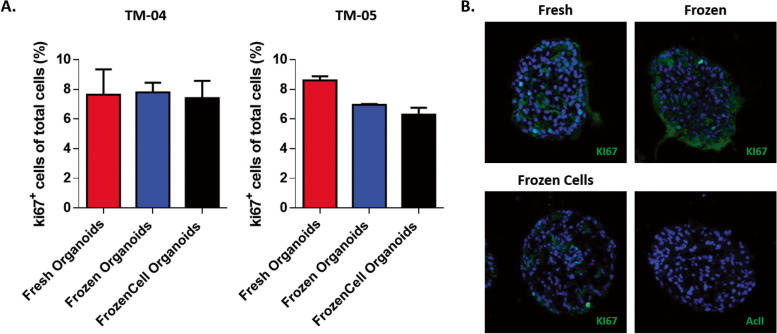
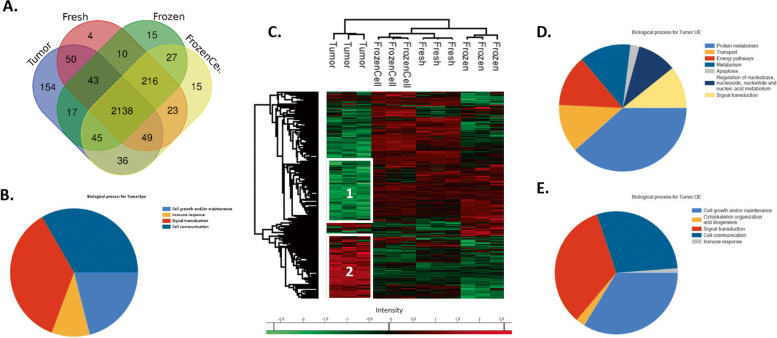
We conducted a complete characterization of canine mammary tumoroids through histologic, molecular, and proteomic analysis, demonstrating their strong similarity to the primary tumor. We demonstrated that these tumoroids can be used as a drug screening model. In fact, we showed that paclitaxel, a human chemotherapeutic, could kill canine tumoroids with the same efficacy as human tumoroids with 0.1 to 1 μM of drug needed to kill 50% of the cells. Due to easy tissue availability, canine tumoroids can be produced at larger scale and cryopreserved to constitute a biobank. We have demonstrated that cryopreserved tumoroids keep the same histologic and molecular features (ER, PR, and HER2 expression) as fresh tumoroids. Furthermore, two cryopreservation techniques were compared from a proteomic point of view which showed that tumoroids made from frozen material allowed to maintain the same molecular diversity as from freshly dissociated tumor.
These findings revealed that canine mammary tumoroids can be easily generated and may provide an adequate and more reliable preclinical model to investigate tumorigenesis mechanisms and develop new treatments for both veterinary and human medicine.
癌症异质性是开发有效疗法的主要障碍,因为在体外临床前模型中复制它具有挑战性。据估计,大约 96%的已开发药物在从发现到临床试验阶段都会失败,这可能是由于当前临床前模型(Front Pharmacol 9:6, 2018; Nat Rev Cancer 8: 147-56, 2008)不适用于复制肿瘤的整体生物学,例如肿瘤微环境。乳腺癌是女性中最常见的癌症,也是导致癌症相关死亡人数最多的癌症。乳腺癌通常可以通过使用肿瘤球进行体外建模;然而,当前使用小鼠肿瘤球的方法无法再现人类乳腺癌的关键方面,而获得人类细胞受到限制,并且存在道德问题。鉴于已开发的自发性乳腺肿瘤在许多临床和分子方面与人类乳腺癌相似,新的乳腺癌模型,如伴侣犬已经出现;然而,它们迄今未能复制肿瘤微环境。本研究旨在开发一种稳健的犬乳腺肿瘤模型,其形式为肿瘤球,可再现肿瘤的多样性和异质性。
我们通过组织学、分子和蛋白质组学分析对犬乳腺肿瘤球进行了全面表征,证明它们与原发性肿瘤具有很强的相似性。我们证明这些肿瘤球可用作药物筛选模型。事实上,我们表明紫杉醇,一种人类化疗药物,可杀死犬肿瘤球,其效果与人类肿瘤球相同,需要 0.1 至 1 μM 的药物才能杀死 50%的细胞。由于组织容易获得,犬肿瘤球可以大规模生产并冷冻保存,以构成生物库。我们已经证明冷冻保存的肿瘤球保持与新鲜肿瘤球相同的组织学和分子特征(ER、PR 和 HER2 表达)。此外,从蛋白质组学的角度比较了两种冷冻保存技术,结果表明,从冷冻材料中制备的肿瘤球可以保持与从新鲜分离的肿瘤相同的分子多样性。
这些发现表明,犬乳腺肿瘤球易于生成,可能为研究肿瘤发生机制和开发兽医和人类医学的新治疗方法提供一个充分且更可靠的临床前模型。