Robert Koch Institute, Department for Infectious Disease Epidemiology, Berlin, Germany.
Robert Koch Institute, Department for Infectious Disease Epidemiology, Berlin, Germany.
J Hosp Infect. 2023 Apr;134:108-120. doi: 10.1016/j.jhin.2023.01.011. Epub 2023 Feb 3.
Outbreaks in healthcare facilities played a pivotal role in the course of the coronavirus (COVID-19) pandemic.
To investigate severe acute respiratory syndrome coronavirus 2 (SARS-CoV-2) outbreaks in hospitals, outpatient care, and rehabilitation facilities in Germany from March 2020 to May 2022.
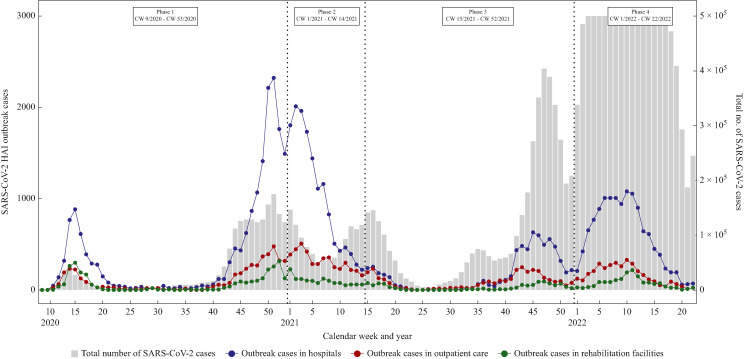
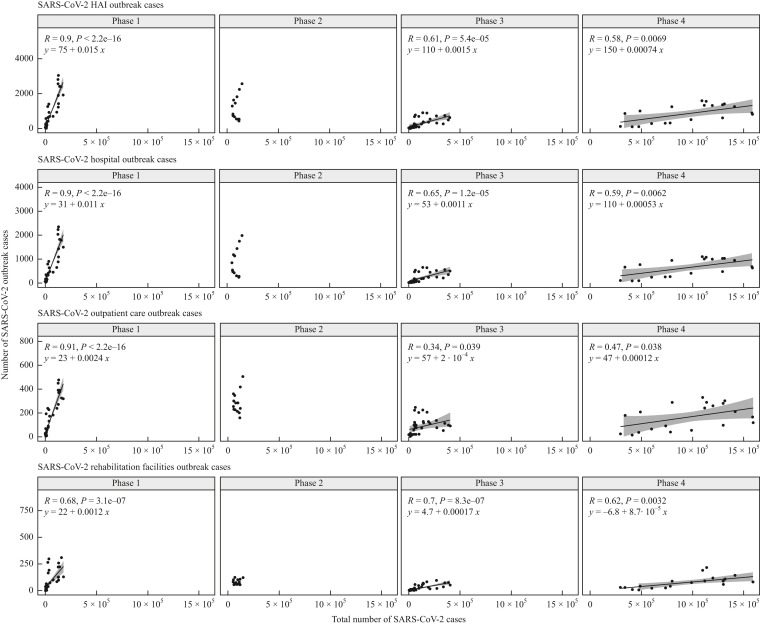
Data from the German mandatory notification system were used to describe outbreaks by number of cases and case fatality ratio (CFR), and outbreak cases by age and gender. Using Pearson correlation, the dynamics of cases in the general population were compared with cases in healthcare-associated infection (HAI) SARS-CoV-2 outbreaks before and after the start of the vaccination campaign. Additionally, a counterfactual scenario was used to estimate numbers of prevented HAI cases, using the phase before vaccination as baseline.
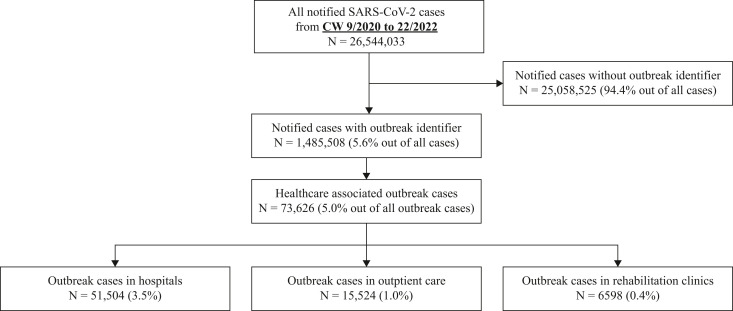
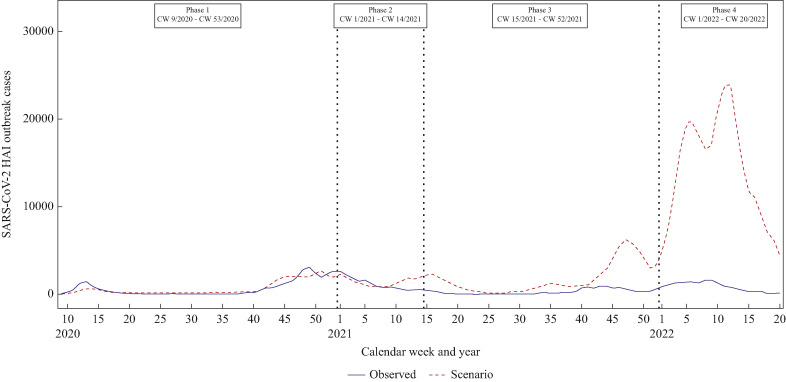
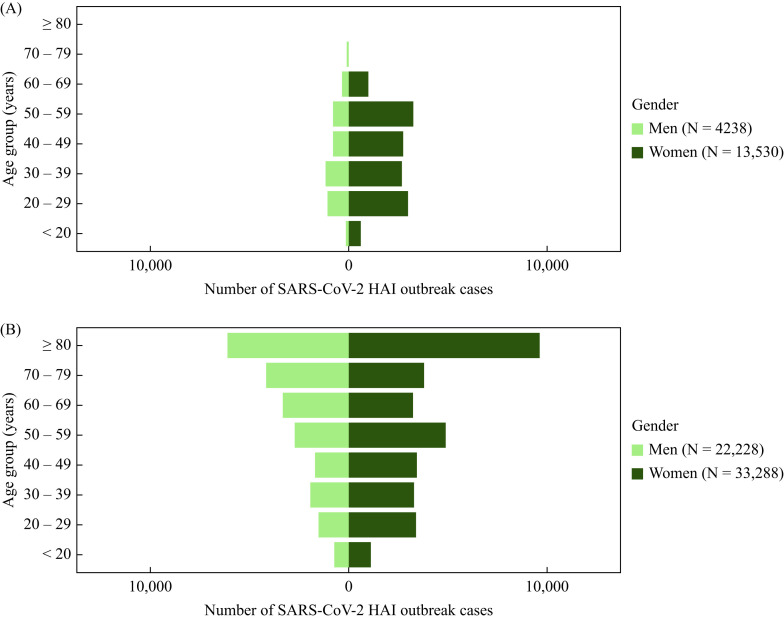
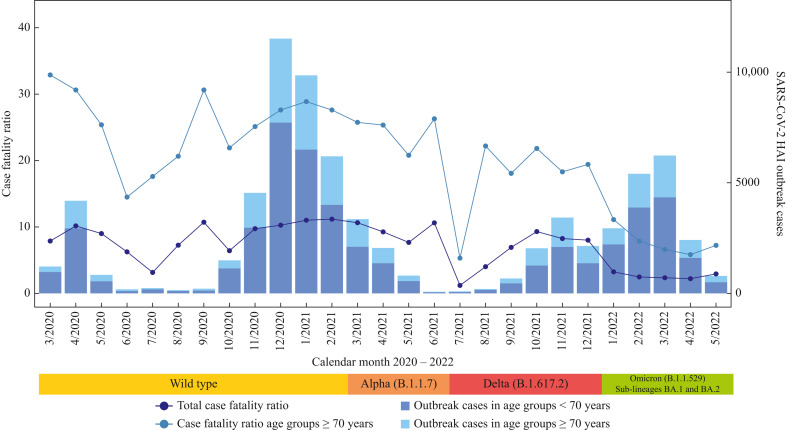
By the end of May 2022, 8941 healthcare-associated outbreaks were observed with 73,626 cases: 51,504 in hospitals, 15,524 in outpatient care, and 6598 in rehabilitation facilities. Median number of cases per outbreak was 4 (range: 2-342) and cases were more frequently reported in women with 46,818 (63.6%). Overall CFR was 8.1%, higher in men (12.4%) than in women (5.7%). After the vaccination campaign was fully introduced, the association between increasing incidence in the general population and consecutive outbreak cases was decreased by a factor of 10. Furthermore, our counterfactual analysis suggests that more than 55,000 outbreak cases could have been prevented until the end of 2021.
The vaccination campaign in combination with non-pharmaceutical measures was key to reduce number, size and CFR of healthcare-associated outbreaks.
医疗机构中的疫情爆发在冠状病毒(COVID-19)大流行的进程中发挥了关键作用。
调查 2020 年 3 月至 2022 年 5 月德国医院、门诊护理和康复设施中严重急性呼吸系统综合征冠状病毒 2(SARS-CoV-2)疫情爆发的情况。
使用德国强制性报告系统的数据,按病例数和病死率(CFR)描述疫情,并按年龄和性别描述疫情病例。使用皮尔逊相关系数比较接种疫苗前后普通人群和与医疗保健相关感染(HAI)SARS-CoV-2 疫情中病例的动态。此外,还使用接种疫苗前的阶段作为基线,使用反事实情景来估计可预防的 HAI 病例数。
截至 2022 年 5 月底,共观察到 8941 起与医疗保健相关的疫情爆发,共发生 73626 例病例:医院 51504 例,门诊护理 15524 例,康复设施 6598 例。每起疫情的平均病例数为 4 例(范围:2-342 例),且更多的病例报告发生在女性(46818 例,占 63.6%)。总病死率为 8.1%,男性(12.4%)高于女性(5.7%)。接种疫苗活动全面开展后,普通人群发病率上升与连续发生疫情病例之间的相关性降低了 10 倍。此外,我们的反事实分析表明,到 2021 年底,超过 55000 例疫情病例可以得到预防。
接种疫苗活动与非药物措施相结合是减少与医疗保健相关的疫情爆发数量、规模和病死率的关键。