Wang Fan, Li Shichen, Kong Fanjiang, Lin Xiaoya, Lu Sijia
Guangdong Key Laboratory of Plant Adaptation and Molecular Design, Guangzhou Key Laboratory of Crop Gene Editing, Innovative Center of Molecular Genetic and Evolution, School of Life Science, Guangzhou University, Guangzhou, China.
Front Plant Sci. 2023 Jan 19;14:1094411. doi: 10.3389/fpls.2023.1094411. eCollection 2023.
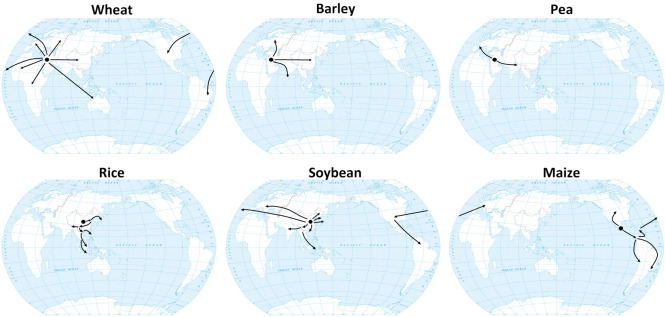
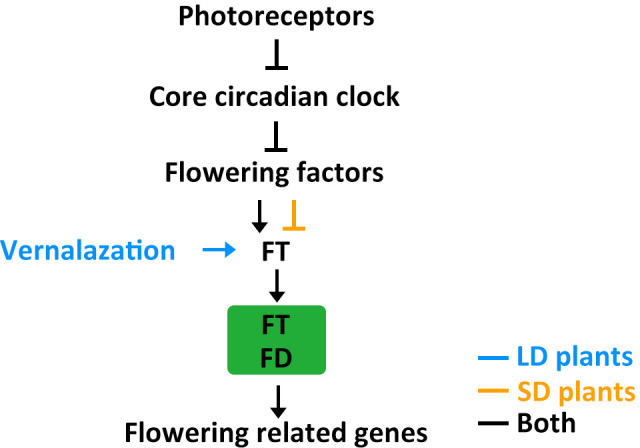
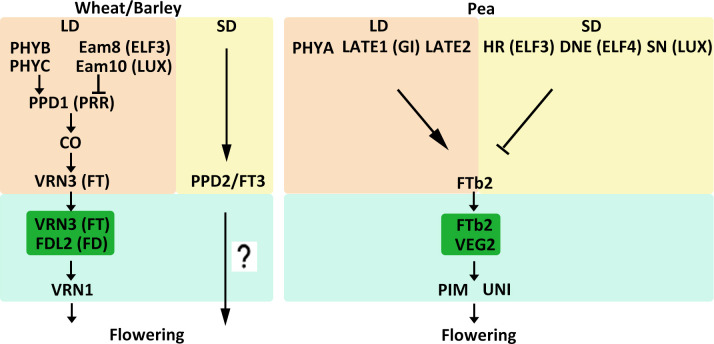
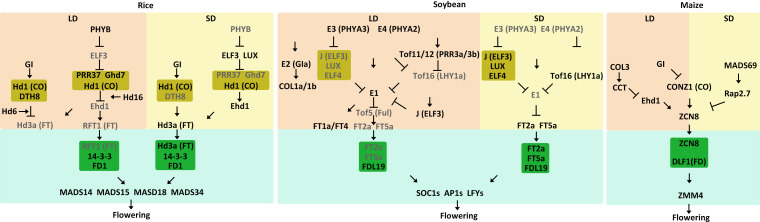
Flowering time influences reproductive success in plants and has a significant impact on yield in grain crops. Flowering time is regulated by a variety of environmental factors, with daylength often playing an important role. Crops can be categorized into different types according to their photoperiod requirements for flowering. For instance, long-day crops include wheat (), barley (), and pea (), while short-day crops include rice (), soybean (), and maize (). Understanding the molecular regulation of flowering and genotypic variation therein is important for molecular breeding and crop improvement. This paper reviews the regulation of flowering in different crop species with a particular focus on how photoperiod-related genes facilitate adaptation to local environments.
开花时间影响植物的繁殖成功率,并对谷类作物的产量有重大影响。开花时间受多种环境因素调控,其中日照长度通常起着重要作用。作物可根据其开花的光周期需求分为不同类型。例如,长日照作物包括小麦、大麦和豌豆,而短日照作物包括水稻、大豆和玉米。了解开花的分子调控及其基因型变异对于分子育种和作物改良很重要。本文综述了不同作物物种中开花的调控,特别关注光周期相关基因如何促进对当地环境的适应。