Center for Children and Families, Department of Psychology, Florida International University, Miami, FL, USA.
Departments of Psychiatry and Psychology, University of Michigan, Ann Arbor, MI, USA.
Dev Psychopathol. 2024 Feb;36(1):454-466. doi: 10.1017/S0954579422001328. Epub 2023 Feb 6.
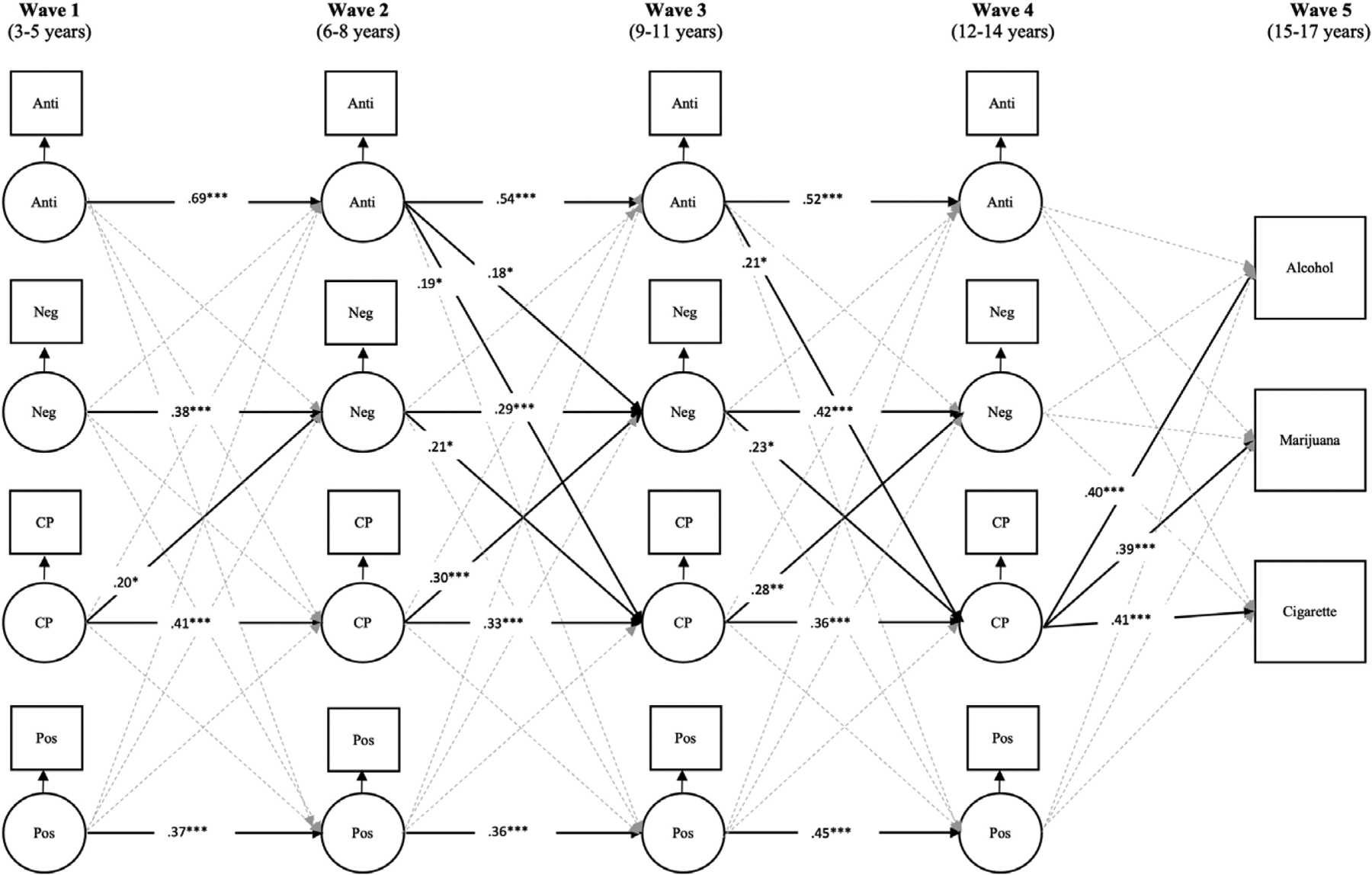
While many studies have identified risk and protective factors of substance use (SU), few have assessed the reciprocal associations of child conduct problems (CP) and parenting practices and behaviors in the prediction of SU across development. A greater understanding of how these factors relate over time is needed to improve the timing of targeted prevention efforts. This study examined how child CP, parenting behaviors, and parents' own antisocial behavior relate from preschool to adolescence and eventuate in SU. Participants included 706 youth (70.6% male; 89.7% white) enrolled in the Michigan Longitudinal Study. Data from waves 1 (ages 3-5), 2 (ages 6-8), 3 (ages 9-11), 4 (ages 12-14), and 5 (ages 15-17) were included. A random intercept cross-lagged panel model (RI-CLPM) examined reciprocal associations between parenting practices, parents' antisocial behavior, and child CP over time (waves 1-4) and how these factors contribute to adolescent alcohol, cigarette, and marijuana use (wave 5). At the within-person level, negative parenting and parents' own antisocial behavior had a strong influence in late childhood/early adolescence. Only child CP emerged as a significant predictor of SU. Results highlight the importance of early intervention and the potential influence of parenting and child factors throughout development in the prevention of SU.
虽然许多研究已经确定了物质使用(SU)的风险和保护因素,但很少有研究评估儿童行为问题(CP)和养育实践和行为在整个发展过程中对 SU 的预测中的相互关联。为了改善有针对性的预防措施的时机,需要更好地了解这些因素随时间的变化关系。本研究探讨了儿童 CP、养育行为以及父母自身的反社会行为如何从学龄前到青春期发展,并最终导致 SU。参与者包括参加密歇根纵向研究的 706 名青少年(70.6%为男性;89.7%为白人)。包括来自第 1 波(年龄 3-5 岁)、第 2 波(年龄 6-8 岁)、第 3 波(年龄 9-11 岁)、第 4 波(年龄 12-14 岁)和第 5 波(年龄 15-17 岁)的数据。随机截距交叉滞后面板模型(RI-CLPM)考察了养育实践、父母的反社会行为和儿童 CP 在时间上(第 1-4 波)的相互关系,以及这些因素如何导致青少年饮酒、吸烟和大麻使用(第 5 波)。在个体内水平上,消极的养育方式和父母自身的反社会行为在儿童后期/青春期早期有很大的影响。只有儿童 CP 成为 SU 的一个重要预测因素。研究结果强调了早期干预的重要性,以及在预防 SU 方面,整个发展过程中养育和儿童因素的潜在影响。