Department of Mechanical Engineering, Auckland University of Technology, Private Bag 92006, Auckland, 1142, New Zealand.
Institute of Biomedical Technologies, Auckland University of Technology, Auckland, New Zealand.
Ann Biomed Eng. 2023 Jun;51(6):1256-1269. doi: 10.1007/s10439-022-03129-2. Epub 2023 Feb 6.
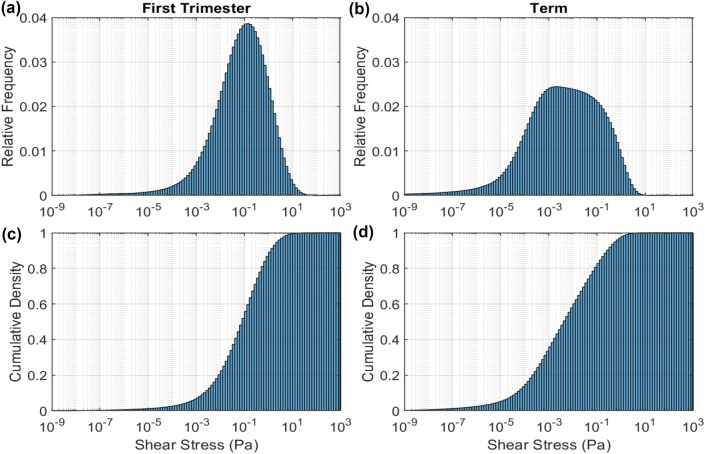
The placenta is a critical fetal exchange organ, with a complex branching tree-like structure. Its surface is covered by a single multinucleated cell, the syncytiotrophoblast, which bathes in maternal blood for most of pregnancy. Mechanosensing protein expression by the syncytiotrophoblast at term suggests that shear stress exerted by maternal blood flow may modulate placental development and function. However, it is not known how the mechanosensitive capacity of the syncytiotrophoblast, or the shear stress it experiences, change across gestation. Here, we show that the syncytiotrophoblast expresses both mechanosensitive ion channels (Piezo 1, Polycystin 2, TRPV6) and motor proteins associated with primary cilia (Dynein 1, IFT88, Kinesin 2), with higher staining for all these proteins seen in late first trimester placentae than at term. MicroCT imaging of placental tissue was then used to inform computational models of blood flow at the placentone scale (using a porous media model), and at the villous scale (using explicit flow simulations). These two models are then linked to produce a combined model that allows the variation of shear stress across both these scales simultaneously. This combined model predicts that the range of shear stress on the syncytiotrophoblast is higher in the first-trimester than at term (0.8 dyne/cm median stress compared to 0.04 dyne/cm) when considering both these scales. Together, this suggests that the nature of blood flow through the intervillous space, and the resulting shear stress on the syncytiotrophoblast have important influences on placental morphogenesis and function from early in pregnancy.
胎盘是胎儿重要的交换器官,具有复杂的分支树状结构。它的表面覆盖着一层单一的多核细胞,即合体滋养层,在妊娠的大部分时间里都浸泡在母体血液中。足月时合体滋养层表达机械感受蛋白,这表明母体血流产生的切应力可能调节胎盘的发育和功能。然而,尚不清楚合体滋养层的机械敏感性,或它所经历的切应力,在妊娠期间是如何变化的。在这里,我们表明合体滋养层表达机械敏感离子通道(Piezo1、多晶蛋白 2、TRPV6)和与初级纤毛相关的运动蛋白(动力蛋白 1、IFT88、驱动蛋白 2),所有这些蛋白在第一个三分之一孕期的胎盘上的染色都比足月时更高。然后,使用胎盘组织的 microCT 成像来告知胎盘绒毛模型(使用多孔介质模型)和绒毛模型(使用显式流动模拟)的血流计算模型。然后将这两个模型链接起来,生成一个组合模型,允许在这两个尺度上同时改变切应力。该组合模型预测,在考虑这两个尺度时,第一个三分之一孕期胎盘合体滋养层上的切应力范围高于足月时(中位数为 0.8 达因/厘米,而 0.04 达因/厘米)。总的来说,这表明从妊娠早期开始,穿过绒毛间空间的血流性质以及对合体滋养层的切应力对胎盘形态发生和功能有重要影响。