Mirbod Parisa
Department of Mechanical and Aeronautical Engineering, Clarkson University, Potsdam, NY, USA.
R Soc Open Sci. 2018 Apr 11;5(4):180219. doi: 10.1098/rsos.180219. eCollection 2018 Apr.
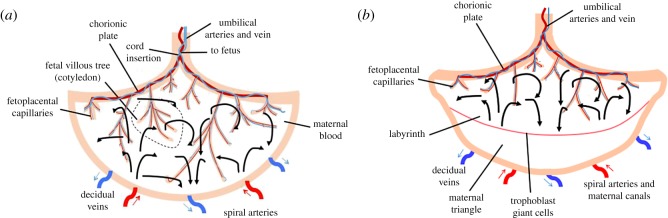
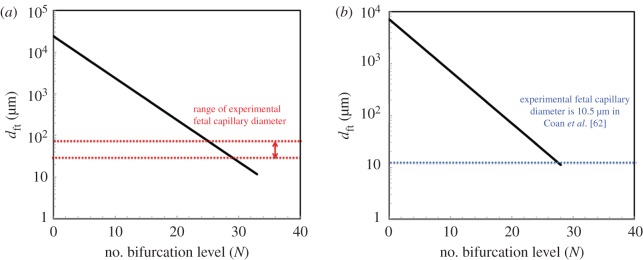
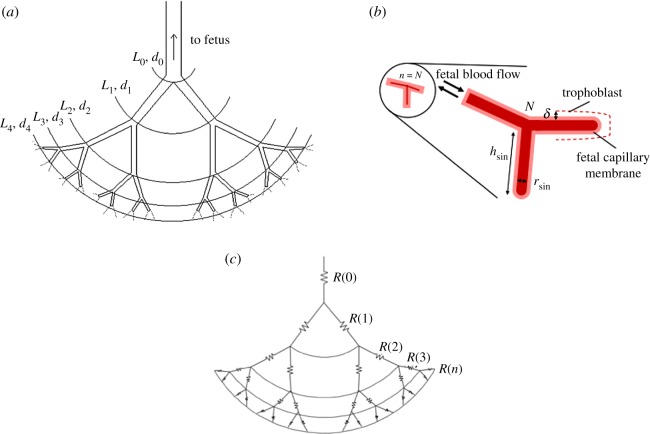
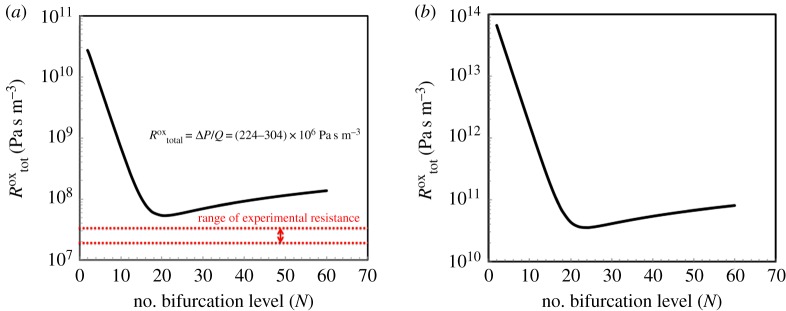
The placenta is a transient vascular organ that enables nutrients and blood gases to be exchanged between fetal and maternal circulations. Herein, the structure and oxygen diffusion across the trophoblast membrane between the fetal and maternal red blood cells in the feto-placental vasculature system in both human and mouse placentas are presented together as a functional unit. Previous models have claimed that the most efficient fetal blood flow relies upon structures containing a number of 'conductive' symmetrical branches, offering a path of minimal resistance that maximizes blood flow to the terminal villi, where oxygen diffusion occurs. However, most of these models have disregarded the actual descriptions of the exchange at the level of the intermediate and terminal villi. We are proposing a 'mixed model' whereby both 'conductive' and 'terminal' villi are presumed to be present at the end of single (in human) or multiple (in mouse) pregnancies. We predict an optimal number of 18 and 22 bifurcation levels in the human and the mouse placentas, respectively. Wherever possible, we have compared our model's predictions with experimental results reported in the literature and found close agreement between them.
胎盘是一个临时性的血管器官,它能使营养物质和血气在胎儿循环与母体循环之间进行交换。在此,人和小鼠胎盘的胎儿 - 胎盘血管系统中,胎盘的结构以及胎儿和母体红细胞之间跨滋养层膜的氧气扩散被作为一个功能单元呈现出来。以往的模型认为,最有效的胎儿血流依赖于包含许多“传导性”对称分支的结构,这些分支提供了一条阻力最小的路径,使流向终末绒毛的血流最大化,而氧气扩散就在终末绒毛处发生。然而,这些模型大多忽略了中间绒毛和终末绒毛水平上交换的实际描述。我们提出一种“混合模型”,据此推测在单胎(人类)或多胎(小鼠)妊娠末期同时存在“传导性”绒毛和“终末”绒毛。我们预测人类胎盘和小鼠胎盘的最佳分支水平数分别为18和22。只要有可能,我们就将模型的预测结果与文献中报道的实验结果进行了比较,发现二者非常吻合。