Institute of Cell and Tissue Culture Technologies, Department of Biotechnology, University of Natural Resources and Life Sciences BOKU Vienna, Muthgasse 18, 1190 Vienna, Austria.
Department of Life Science Engineering, University of Applied Sciences Technikum Vienna, Höchstädtplatz 6, 1200 Vienna, Austria.
ACS Appl Bio Mater. 2023 Feb 20;6(2):543-551. doi: 10.1021/acsabm.2c00854. Epub 2023 Feb 6.
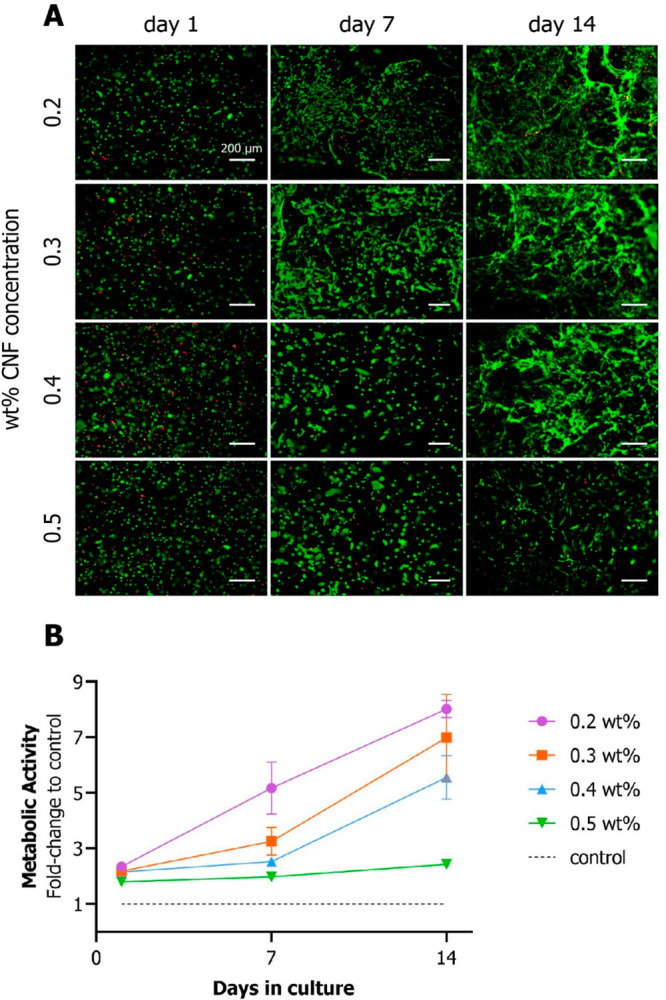
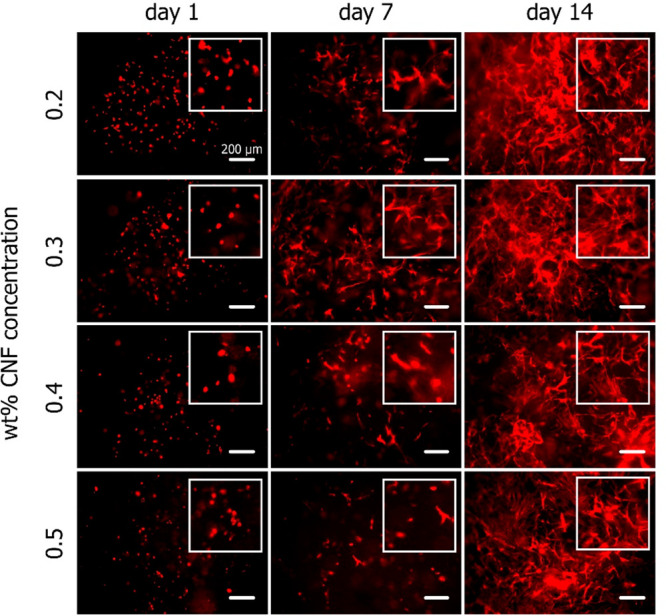
Mesenchymal stem cells (MSCs) are the most prominent type of adult stem cells for clinical applications. Three-dimensional (3D) cultivation of MSCs in biomimetic hydrogels provides a more physiologically relevant cultivation microenvironment for testing and modeling, thus overcoming the limitations of traditional planar cultivation methods. Cellulose nanofibers are an excellent candidate biomaterial for synthesis of hydrogels for this application, due to their biocompatibility, tunable properties, availability, and low cost. Herein, we demonstrate the capacity of hydrogels prepared from 2,2,6,6-tetramethylpiperidine-1-oxyl -oxidized and subsequently individualized cellulose-nanofibrils to support physiologically relevant 3D cultivation of human MSCs at low solid contents (0.2-0.5 wt %). Our results show that MSCs can spread, proliferate, and migrate inside the cellulose hydrogels, while the metabolic activity and proliferative capacity of the cells as well as their morphological characteristics benefit more in the lower bulk cellulose concentration hydrogels.
间充质干细胞(MSCs)是临床应用中最主要的成人干细胞类型。将 MSCs 在仿生水凝胶中进行三维(3D)培养,为测试和建模提供了更接近生理的培养微环境,从而克服了传统平面培养方法的局限性。由于纤维素纳米纤维具有生物相容性、可调节性能、可用性和低成本,因此是用于合成水凝胶的理想生物材料。本文中,我们展示了由 2,2,6,6-四甲基哌啶-1-氧自由基氧化并随后个体化的纤维素纳米纤维制备的水凝胶的能力,可在低固体含量(0.2-0.5wt%)下支持生理相关的人 MSCs 3D 培养。我们的结果表明,MSCs 可在纤维素水凝胶内扩散、增殖和迁移,而细胞的代谢活性和增殖能力以及它们的形态特征在低浓度纤维素的水凝胶中获益更多。