Department of Earth Sciences, University of Oxford, Oxford, UK.
Department of Plant Sciences, University of Oxford, Oxford, UK.
ISME J. 2023 Apr;17(4):630-640. doi: 10.1038/s41396-023-01365-5. Epub 2023 Feb 6.
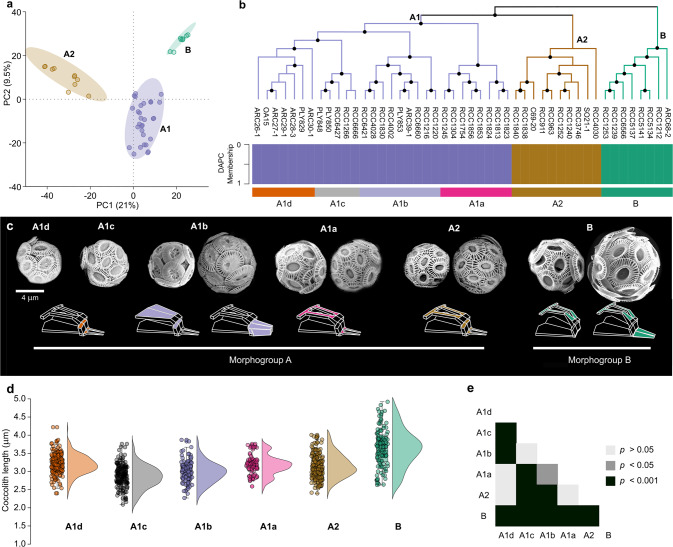
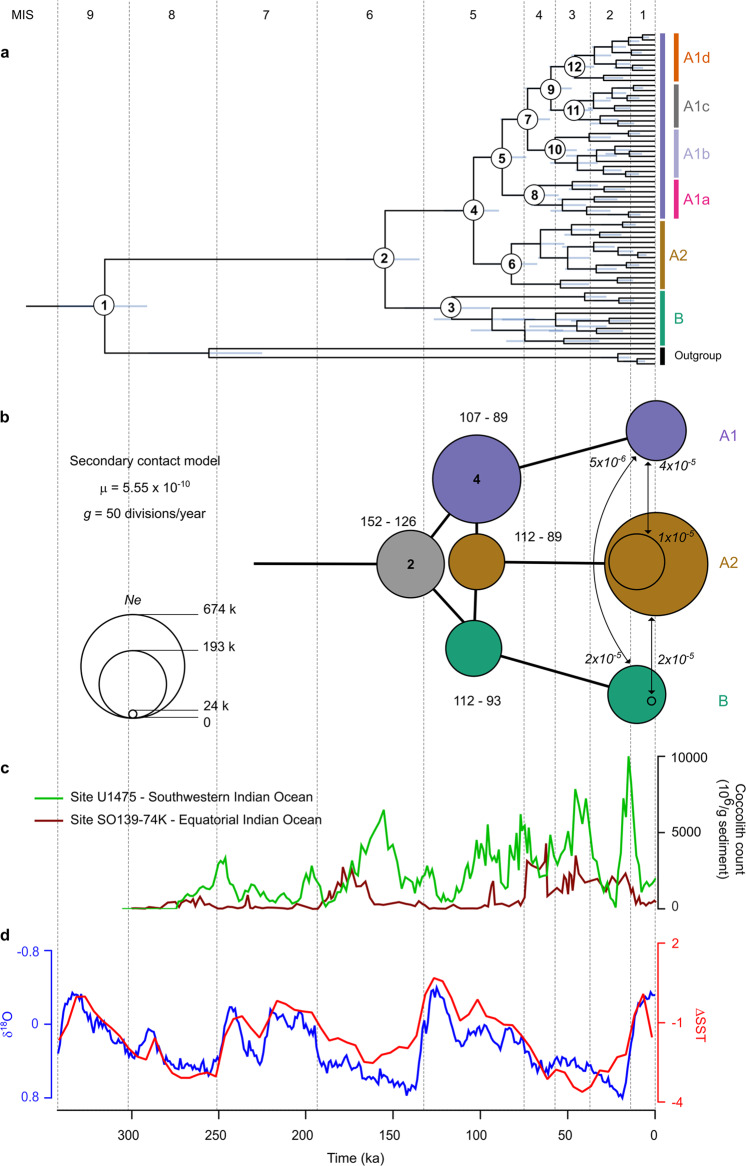
Marine phytoplankton play important roles in the global ecosystem, with a limited number of cosmopolitan keystone species driving their biomass. Recent studies have revealed that many of these phytoplankton are complexes composed of sibling species, but little is known about the evolutionary processes underlying their formation. Gephyrocapsa huxleyi, a widely distributed and abundant unicellular marine planktonic algae, produces calcified scales (coccoliths), thereby significantly affects global biogeochemical cycles via sequestration of inorganic carbon. This species is composed of morphotypes defined by differing degrees of coccolith calcification, the evolutionary ecology of which remains unclear. Here, we report an integrated morphological, ecological and genomic survey across globally distributed G. huxleyi strains to reconstruct evolutionary relationships between morphotypes in relation to their habitats. While G. huxleyi has been considered a single cosmopolitan species, our analyses demonstrate that it has evolved to comprise at least three distinct species, which led us to formally revise the taxonomy of the G. huxleyi complex. Moreover, the first speciation event occurred before the onset of the last interglacial period (~140 ka), while the second followed during this interglacial. Then, further rapid diversifications occurred during the most recent ice-sheet expansion of the last glacial period and established morphotypes as dominant populations across environmental clines. These results suggest that glacial-cycle dynamics contributed to the isolation of ocean basins and the segregations of oceans fronts as extrinsic drivers of micro-evolutionary radiations in extant marine phytoplankton.
海洋浮游植物在全球生态系统中发挥着重要作用,少数世界性的关键物种驱动着它们的生物量。最近的研究表明,许多浮游植物是由姐妹物种组成的复合体,但它们形成的进化过程知之甚少。广泛分布且丰富的单细胞海洋浮游植物钙板金藻(Gephyrocapsa huxleyi)会产生钙化鳞片(颗石藻),通过将无机碳固定下来,从而显著影响全球生物地球化学循环。该物种由不同程度钙化的形态型组成,其进化生态学尚不清楚。在这里,我们对全球分布的 G. huxleyi 菌株进行了综合形态、生态和基因组调查,以重建形态型与栖息地之间的进化关系。虽然 G. huxleyi 被认为是一个单一的世界性物种,但我们的分析表明,它已经进化为至少三个不同的物种,这促使我们正式修订了 G. huxleyi 复合体的分类法。此外,第一次物种形成事件发生在上一个间冰期(约 14 万年前)之前,而第二次则发生在这个间冰期期间。然后,在最近的冰期冰盖扩张期间,又发生了进一步的快速多样化,使形态型成为整个环境梯度上的主要种群。这些结果表明,冰川周期动态导致了海洋盆地的隔离和海洋锋面的分离,这是现存海洋浮游植物微观进化辐射的外在驱动因素。