Caelers I J M H, Berendsen R C M, Droeghaag R, Pecasse N J J, Rijkers K, Van Hemert W L W, De Bie R A, Van Santbrink H
CAPHRI School for Public Health and Primary Care, Maastricht University, Maastricht, the Netherlands.
Department of Neurosurgery, Zuyderland Medical Center, Sittard-Geleen/Heerlen, the Netherlands.
N Am Spine Soc J. 2023 Jan 14;13:100199. doi: 10.1016/j.xnsj.2023.100199. eCollection 2023 Mar.
Fluoroscopic devices can be used to visualize subcutaneous and osseous tissue, a useful feature during pedicle screw insertion in lumbar fusion surgery. It is important that both patient and surgeon are exposed as little as possible, since these devices use potential harmful ionizing radiation.
This study aims to compare radiation exposure of different image-guided techniques in lumbar fusion surgery with pedicle screw insertion.
Systematic review.
Cochrane, Embase, PubMed and Web of Science databases were used to acquire relevant studies. Eligibility criteria were lumbar and/or sacral spine, pedicle screw, mGray and/or Sievert and/or mrem, radiation dose and/or radiation exposure. Image-guided techniques were divided in five groups: conventional C-arm, C-arm navigation, C-arm robotic, O-arm navigation and O-arm robotic. Comparisons were made based on effective dose for patients and surgeons, absorbed dose for patients and surgeons and exposure. Risk of bias was assessed using the 2017 Cochrane Risk of Bias tool on RCTs and the Cochrane ROBINS-I tool on NRCTs. Level of evidence was assessed using the guidelines of Oxford Centre for Evidence-based Medicine 2011.
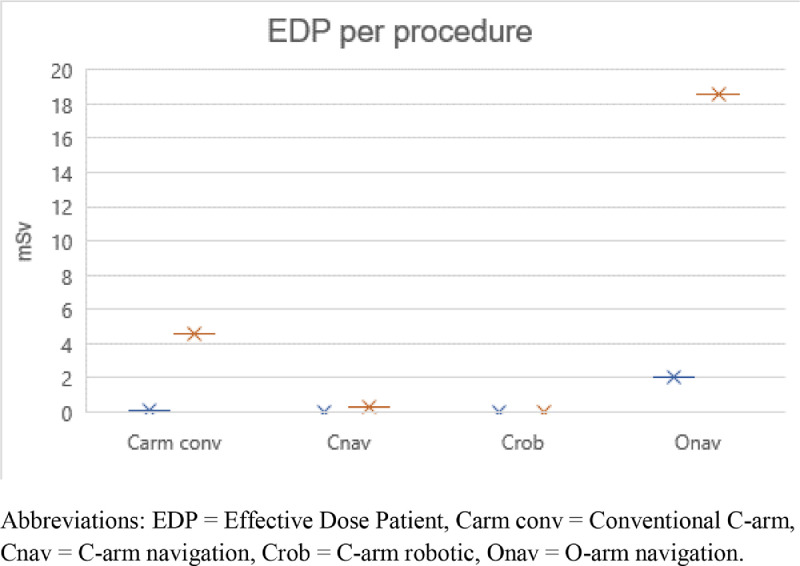
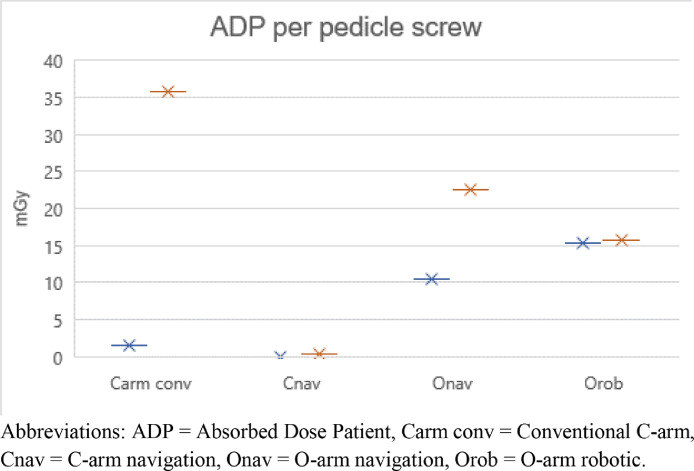
A total of 1423 studies were identified of which 38 were included in the analysis and assigned to one of the five groups. Results of radiation dose per procedure and per pedicle screw were described in dose ranges. Conventional C-arm appeared to result in higher effective dose for surgeons, higher absorbed dose for patients and higher exposure, compared to C-arm navigation/robotic and O-arm navigation/robotic. Level of evidence was 3 to 4 in 29 studies. Risk of bias of RCTs was intermediate, mostly due to inadequate blinding. Overall risk of bias score in NRCTs was determined as 'serious'.
Ranges of radiation doses using different modalities during pedicle screw insertion in lumbar fusion surgery are wide. Based on the highest numbers in the ranges, conventional C-arm tends to lead to a higher effective dose for surgeons, higher absorbed dose for patients and higher exposure, compared to C-arm-, and O-arm navigation/robotic. The level of evidence is low and risk of bias is fairly high. In future studies, heterogeneity should be limited by standardizing measurement methods and thoroughly describing the image-guided technique settings.
荧光透视设备可用于观察皮下和骨组织,这在腰椎融合手术中椎弓根螺钉置入过程中是一项有用的功能。由于这些设备使用潜在有害的电离辐射,因此尽量减少患者和外科医生的暴露至关重要。
本研究旨在比较腰椎融合手术中使用椎弓根螺钉置入的不同图像引导技术的辐射暴露情况。
系统评价。
使用Cochrane、Embase、PubMed和Web of Science数据库获取相关研究。纳入标准为腰椎和/或骶椎、椎弓根螺钉、毫戈瑞和/或希沃特和/或毫雷姆、辐射剂量和/或辐射暴露。图像引导技术分为五组:传统C形臂、C形臂导航、C形臂机器人、O形臂导航和O形臂机器人。基于患者和外科医生的有效剂量、患者和外科医生的吸收剂量以及暴露情况进行比较。使用2017年Cochrane随机对照试验偏倚风险工具和Cochrane非随机对照试验ROBINS-I工具评估偏倚风险。使用牛津循证医学中心2011年指南评估证据水平。
共识别出1423项研究,其中38项纳入分析并分配到五组之一。每个手术和每个椎弓根螺钉的辐射剂量结果以剂量范围描述。与C形臂导航/机器人和O形臂导航/机器人相比,传统C形臂似乎导致外科医生的有效剂量更高、患者的吸收剂量更高以及暴露更高。29项研究的证据水平为3至4级。随机对照试验的偏倚风险为中等,主要是由于盲法不足。非随机对照试验的总体偏倚风险评分为“严重”。
腰椎融合手术中使用不同方式进行椎弓根螺钉置入时的辐射剂量范围较宽。基于范围内的最高数值,与C形臂和O形臂导航/机器人相比,传统C形臂往往导致外科医生的有效剂量更高、患者的吸收剂量更高以及暴露更高。证据水平较低且偏倚风险相当高。在未来的研究中,应通过标准化测量方法和全面描述图像引导技术设置来限制异质性。