Liu Yu-Yan, Li Yun, Wang Lu, Zhao Yan, Yuan Rui, Yang Meng-Meng, Chen Ying, Zhang Hao, Zhou Fei-Hu, Qian Zhi-Rong, Kang Hong-Jun
Medical School of Chinese PLA; Department of Critical Care Medicine, the First Medical Center, Chinese PLA General Hospital, Beijing, China.
Department of Critical Care Medicine, the First Medical Center, Chinese PLA General Hospital, Beijing, China.
Neural Regen Res. 2023 Aug;18(8):1657-1665. doi: 10.4103/1673-5374.363819.
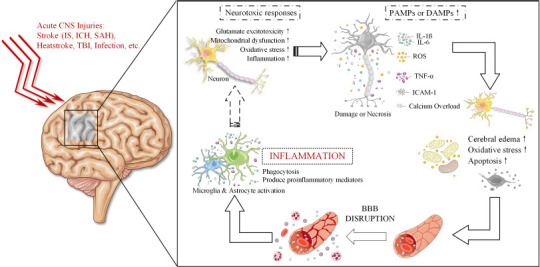
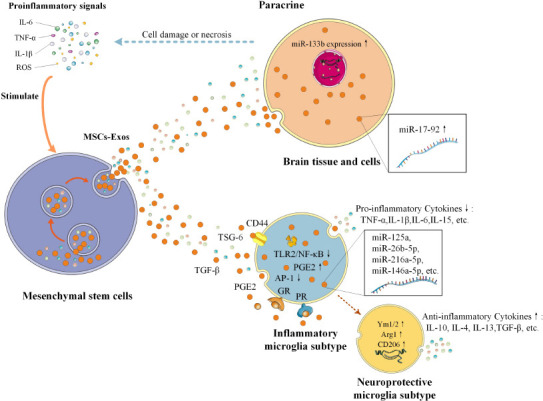
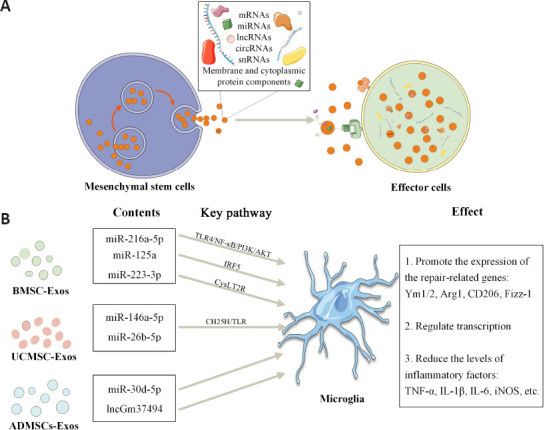
There is growing evidence that long-term central nervous system (CNS) inflammation exacerbates secondary deterioration of brain structures and functions and is one of the major determinants of disease outcome and progression. In acute CNS injury, brain microglia are among the first cells to respond and play a critical role in neural repair and regeneration. However, microglial activation can also impede CNS repair and amplify tissue damage, and phenotypic transformation may be responsible for this dual role. Mesenchymal stem cell (MSC)-derived exosomes (Exos) are promising therapeutic agents for the treatment of acute CNS injuries due to their immunomodulatory and regenerative properties. MSC-Exos are nanoscale membrane vesicles that are actively released by cells and are used clinically as circulating biomarkers for disease diagnosis and prognosis. MSC-Exos can be neuroprotective in several acute CNS models, including for stroke and traumatic brain injury, showing great clinical potential. This review summarized the classification of acute CNS injury disorders and discussed the prominent role of microglial activation in acute CNS inflammation and the specific role of MSC-Exos in regulating pro-inflammatory microglia in neuroinflammatory repair following acute CNS injury. Finally, this review explored the potential mechanisms and factors associated with MSC-Exos in modulating the phenotypic balance of microglia, focusing on the interplay between CNS inflammation, the brain, and injury aspects, with an emphasis on potential strategies and therapeutic interventions for improving functional recovery from early CNS inflammation caused by acute CNS injury.
越来越多的证据表明,长期的中枢神经系统(CNS)炎症会加剧脑结构和功能的继发性恶化,并且是疾病结局和进展的主要决定因素之一。在急性中枢神经系统损伤中,脑小胶质细胞是最早做出反应的细胞之一,在神经修复和再生中起关键作用。然而,小胶质细胞的激活也会阻碍中枢神经系统的修复并放大组织损伤,表型转化可能是造成这种双重作用的原因。间充质干细胞(MSC)衍生的外泌体(Exos)因其免疫调节和再生特性,是治疗急性中枢神经系统损伤的有前景的治疗剂。MSC-Exos是细胞主动释放的纳米级膜囊泡,在临床上用作疾病诊断和预后的循环生物标志物。MSC-Exos在几种急性中枢神经系统模型中具有神经保护作用,包括中风和创伤性脑损伤,显示出巨大的临床潜力。本文综述总结了急性中枢神经系统损伤疾病的分类,讨论了小胶质细胞激活在急性中枢神经系统炎症中的突出作用以及MSC-Exos在调节急性中枢神经系统损伤后神经炎症修复中促炎性小胶质细胞方面的具体作用。最后,本文综述探讨了与MSC-Exos调节小胶质细胞表型平衡相关的潜在机制和因素,重点关注中枢神经系统炎症、脑和损伤方面之间的相互作用,强调了改善急性中枢神经系统损伤引起的早期中枢神经系统炎症功能恢复的潜在策略和治疗干预措施。