Gruber Marius, Mauritz Marco, Meinert Susanne, Grotegerd Dominik, de Lange Siemon C, Grumbach Pascal, Goltermann Janik, Winter Nils Ralf, Waltemate Lena, Lemke Hannah, Thiel Katharina, Winter Alexandra, Breuer Fabian, Borgers Tiana, Enneking Verena, Klug Melissa, Brosch Katharina, Meller Tina, Pfarr Julia-Katharina, Ringwald Kai Gustav, Stein Frederike, Opel Nils, Redlich Ronny, Hahn Tim, Leehr Elisabeth J, Bauer Jochen, Nenadić Igor, Kircher Tilo, van den Heuvel Martijn P, Dannlowski Udo, Repple Jonathan
Institute for Translational Psychiatry, University of Münster, 48149 Münster, Germany.
Department of Psychiatry, Psychosomatic Medicine and Psychotherapy, University Hospital Frankfurt, Goethe University, 60528 Frankfurt, Germany.
Psychol Med. 2023 Oct;53(14):6611-6622. doi: 10.1017/S0033291722004007. Epub 2023 Feb 8.
Cognitive dysfunction and brain structural connectivity alterations have been observed in major depressive disorder (MDD). However, little is known about their interrelation. The present study follows a network approach to evaluate alterations in cognition-related brain structural networks.
Cognitive performance of = 805 healthy and = 679 acutely depressed or remitted individuals was assessed using 14 cognitive tests aggregated into cognitive factors. The structural connectome was reconstructed from structural and diffusion-weighted magnetic resonance imaging. Associations between global connectivity strength and cognitive factors were established using linear regressions. Network-based statistics were applied to identify subnetworks of connections underlying these global-level associations. In exploratory analyses, effects of depression were assessed by evaluating remission status-related group differences in subnetwork-specific connectivity. Partial correlations were employed to directly test the complete triad of cognitive factors, depressive symptom severity, and subnetwork-specific connectivity strength.
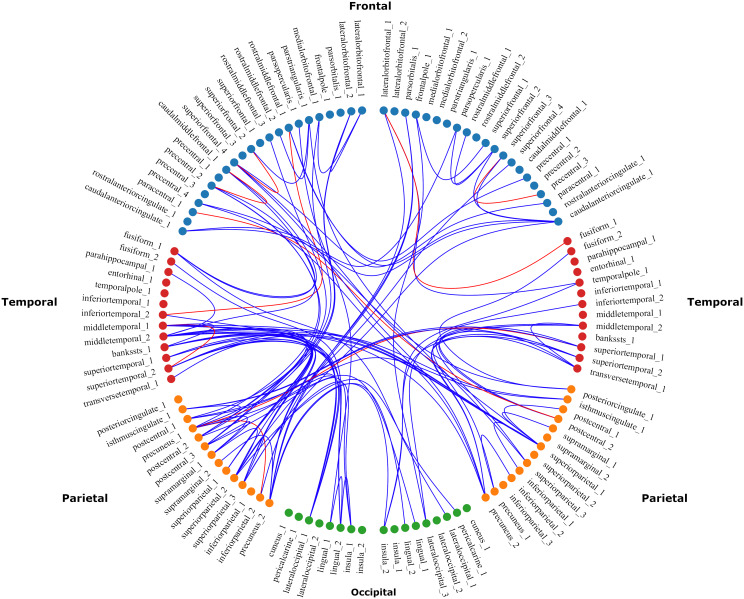
All cognitive factors were associated with global connectivity strength. For each cognitive factor, network-based statistics identified a subnetwork of connections, revealing, for example, a subnetwork positively associated with processing speed. Within that subnetwork, acutely depressed patients showed significantly reduced connectivity strength compared to healthy controls. Moreover, connectivity strength in that subnetwork was associated to current depressive symptom severity independent of the previous disease course.
Our study is the first to identify cognition-related structural brain networks in MDD patients, thereby revealing associations between cognitive deficits, depressive symptoms, and reduced structural connectivity. This supports the hypothesis that structural connectome alterations may mediate the association of cognitive deficits and depression severity.
在重度抑郁症(MDD)中已观察到认知功能障碍和脑结构连接改变。然而,它们之间的相互关系却鲜为人知。本研究采用网络方法来评估与认知相关的脑结构网络的改变。
使用汇总为认知因素的14项认知测试评估了805名健康个体和679名急性抑郁或缓解期个体的认知表现。从结构和扩散加权磁共振成像重建结构连接组。使用线性回归建立全局连接强度与认知因素之间的关联。应用基于网络的统计方法来识别这些全局水平关联背后的连接子网络。在探索性分析中,通过评估缓解状态相关的子网络特定连接中的组间差异来评估抑郁症的影响。采用偏相关直接检验认知因素、抑郁症状严重程度和子网络特定连接强度的完整三元组。
所有认知因素均与全局连接强度相关。对于每个认知因素,基于网络的统计方法确定了一个连接子网络,例如,揭示了一个与处理速度呈正相关的子网络。在该子网络中,与健康对照组相比,急性抑郁患者的连接强度显著降低。此外,该子网络中的连接强度与当前抑郁症状严重程度相关,独立于先前的病程。
我们的研究首次在MDD患者中识别出与认知相关的脑结构网络,从而揭示了认知缺陷、抑郁症状和结构连接性降低之间的关联。这支持了结构连接组改变可能介导认知缺陷与抑郁严重程度之间关联的假设。