Kamp Alexandra, Andersson Martin, Leide-Svegborn Sigrid, Noβke Dietmar, Mattsson Sören, Giussani Augusto
Department of Medical and Occupational Radiation Protection, Federal Office for Radiation Protection (BfS), Ingolstaedter Landstrasse 1, 85764, Neuherberg, Germany.
Department of Radiation Physics, Institute of Clinical Sciences, Sahlgrenska Cancer Center, Sahlgrenska Academy, University of Gothenburg, Gothenburg, Sweden.
EJNMMI Phys. 2023 Feb 8;10(1):10. doi: 10.1186/s40658-023-00528-9.
The aim was to review available biokinetic data, collect own experimental data, and propose an updated compartmental model for 2-[F]FDG in the frame of the revision of the ICRP report on dose coefficients for radiopharmaceuticals used in diagnostic nuclear medicine.
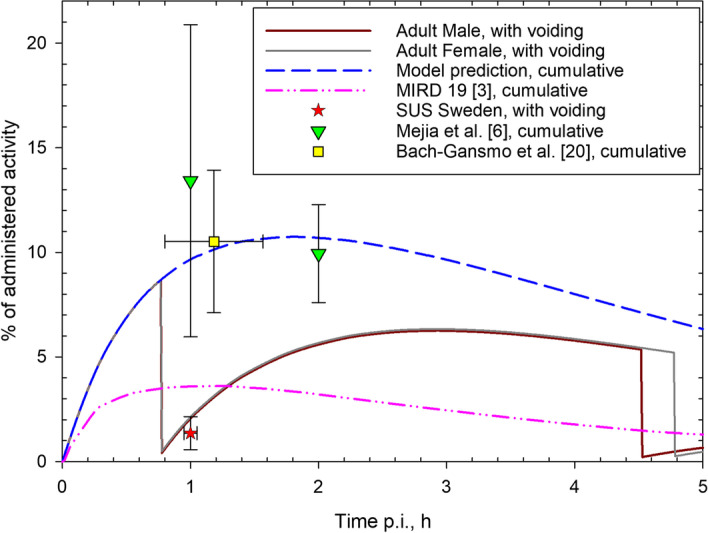
The compartmental model was developed based on published biokinetic data for 2-[F]FDG. Additional data on urinary excretion in 23 patients (11 males, 12 females) undergoing whole-body PET/CT examinations were obtained within this study. The unknown biokinetic model parameters were derived using the software SAAM II and verified with a modified version of IDAC-Iodide. Dose coefficients for reference adults were calculated with the programme IDAC-Dose 2.1. A dynamic bladder model was employed for urinary bladder dosimetry.
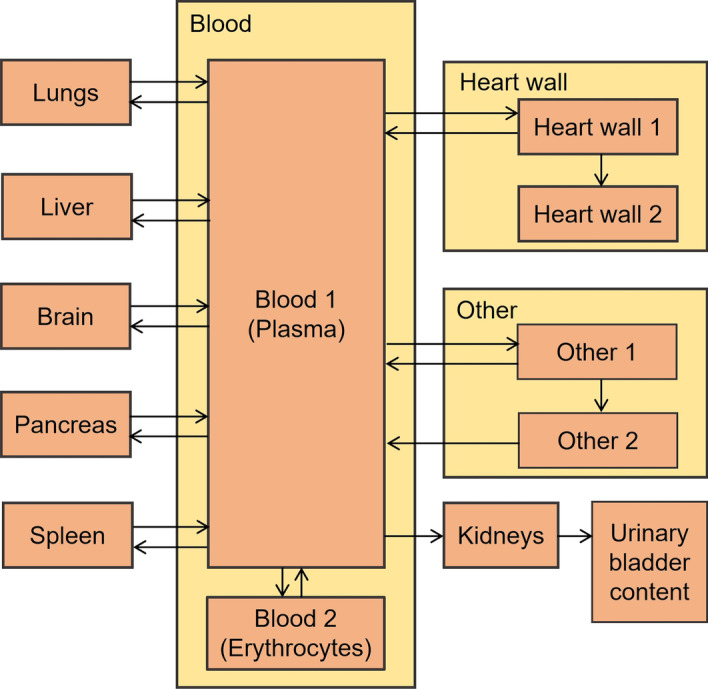
The proposed model consists of following compartments: blood, heart wall, brain, liver, lungs, pancreas, spleen, kidneys, urinary bladder content and a generic pool compartment "Other". The latter was introduced to account for 2-[F]FDG in body organ and tissues besides the explicitly modelled ones. The model predictions showed a good agreement with experimental data. Urinary bladder wall received the highest absorbed dose coefficient of 7.5E-02 mGy/MBq under the assumption of initial urine volume of 100 ml, first voiding at 45 min p.i. and 3.75 h voiding intervals thereafter. The effective dose coefficient calculated according to the current dosimetry framework of ICRP amounted to 1.7E-02 mSv/MBq, compared to 1.9E-02 mSv/MBq in ICRP Publication 128.
A compartmental model for 2-[F]FDG was proposed and will be used to replace the descriptive biokinetic model of ICRP Publication 128. The revised model and the provided dose coefficients are expected to improve reference dosimetry for patients administered with 2-[F]FDG.
目的是回顾现有的生物动力学数据,收集自身实验数据,并在国际辐射防护委员会(ICRP)关于诊断性核医学中使用的放射性药物剂量系数报告修订框架内,提出一个更新的2-[F]FDG房室模型。
基于已发表的2-[F]FDG生物动力学数据开发房室模型。本研究中获取了23例接受全身PET/CT检查患者(11例男性,12例女性)的尿排泄额外数据。使用SAAM II软件推导未知的生物动力学模型参数,并用IDAC-碘化物的修改版本进行验证。使用IDAC-Dose 2.1程序计算参考成年人的剂量系数。采用动态膀胱模型进行膀胱剂量测定。
所提出的模型由以下房室组成:血液、心壁、脑、肝、肺、胰腺、脾、肾、膀胱内容物以及一个通用库房室“其他”。引入后者是为了说明除明确建模的器官和组织外,身体其他器官和组织中的2-[F]FDG。模型预测结果与实验数据吻合良好。在初始尿量为100 ml、注射后45分钟首次排尿且此后排尿间隔为3.75小时的假设下,膀胱壁接受的吸收剂量系数最高,为7.5E-02 mGy/MBq。根据ICRP当前剂量测定框架计算的有效剂量系数为1.7E-02 mSv/MBq,而ICRP第128号出版物中的为1.9E-02 mSv/MBq。
提出了一个2-[F]FDG房室模型,将用于替代ICRP第128号出版物中的描述性生物动力学模型。预期修订后的模型和提供的剂量系数将改善接受2-[F]FDG治疗患者的参考剂量测定。