Department of Chemistry and Technology of Drugs, Department of Excellence 2018-2022, Sapienza─University of Rome, P.le Aldo Moro 5, 00185 Rome, Italy.
Bioconjug Chem. 2023 Mar 15;34(3):529-537. doi: 10.1021/acs.bioconjchem.2c00605. Epub 2023 Feb 8.
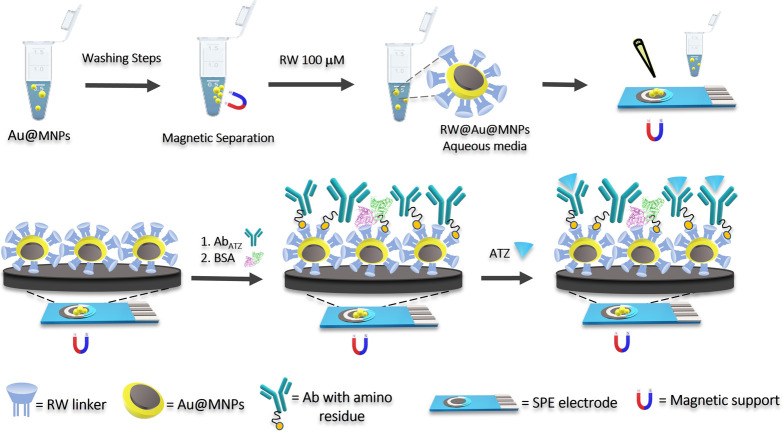
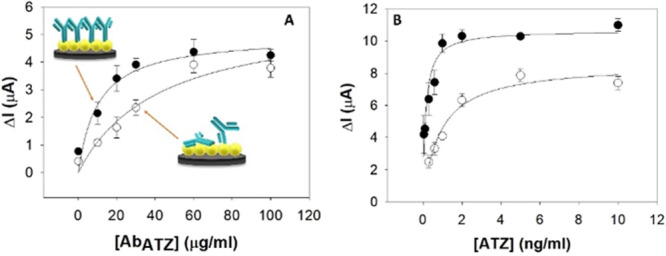
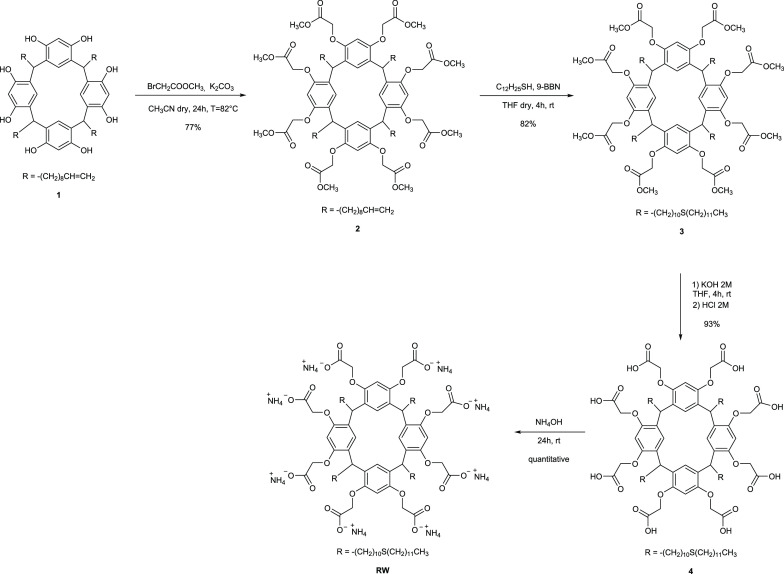
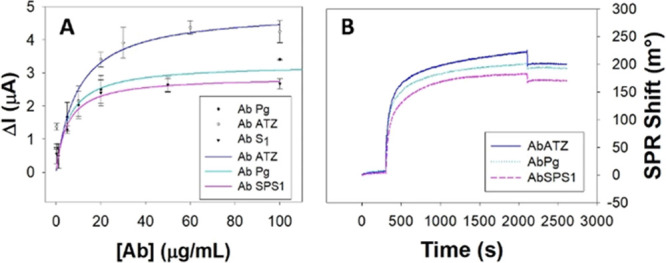
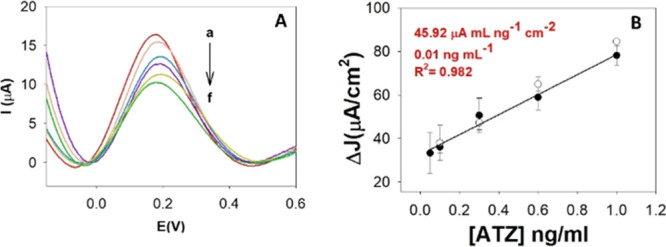
In recent years, several efforts have been made to develop selective, sensitive, fast response, and miniaturized immunosensors with improved performance for the monitoring and screening of analytes in several matrices, significantly expanding the use of this technology in a broad range of applications. However, one of the main technical challenges in developing immunosensors is overcoming the complexity of binding antibodies (Abs) to the sensor surface. Most immobilizing approaches lead to a random orientation of Abs, resulting in lower binding site density and immunoaffinity. In this context, supramolecular chemistry has emerged as a suitable surface modification tool to achieve the preorganization of artificial receptors and to improve the functional properties of self-assembled monolayers. Herein, a supramolecular chemistry/nanotechnology-based platform was conceived to develop sensitive label-free electrochemical immunosensors, by using a resorcarene macrocycle as an artificial linker for the oriented antibody immobilization. To this aim, a water-soluble bifunctional resorc[4]arene architecture (RW) was rationally designed and synthesized to anchor gold-coated magnetic nanoparticles (Au@MNPs) and to maximize the amount of the active immobilized antibody (Ab) in the proper "end-on" orientation. The resulting supramolecular chemistry-modified nanoparticles, RW@Au@MNPs, were deposited onto graphite screen printed electrodes which were then employed to immobilize three different Abs. Furthermore, an immunosensor for atrazine (ATZ) analysis was realized and characterized by the differential pulse voltammetry technique to demonstrate the validity of the developed biosensing platform as a proof of concept for electrochemical immunosensors. The RW-based immunosensor improved Ab loading on Au@MNPs and sensitivity toward ATZ by almost 1.5 times compared to the random platform. Particularly, the electrochemical characterization of the developed immunosensor displays a linearity range toward ATZ within 0.05-1.5 ng/mL, a limit of detection of 0.011 ng/ml, and good reproducibility and stability. The immunosensor was tested by analyzing spiked fortified water samples with a mean recovery ranging from 95.7 to 108.4%. The overall good analytical performances of this immunodevice suggest its application for the screening and monitoring of ATZ in real matrices. Therefore, the results highlighted the successful application of the resorc[4]arene-based sensor design strategy for developing sensitive electrochemical immunosensors with improved analytical performance and simplifying the Ab immobilization procedure.
近年来,人们做出了许多努力来开发具有选择性、敏感性、快速响应和小型化的免疫传感器,以提高在多种基质中分析物监测和筛选的性能,从而极大地扩展了该技术在广泛应用中的使用。然而,开发免疫传感器的主要技术挑战之一是克服将抗体(Abs)结合到传感器表面的复杂性。大多数固定化方法导致 Abs 的随机取向,从而导致结合位点密度和免疫亲和力降低。在这种情况下,超分子化学已成为一种合适的表面修饰工具,可实现人工受体的预组织,并改善自组装单层的功能特性。在此,构想了一种基于超分子化学/纳米技术的平台,通过使用杯[4]芳烃大环作为定向抗体固定化的人工连接物,来开发灵敏的无标记电化学免疫传感器。为此,合理设计并合成了一种水溶性双功能杯[4]芳烃结构(RW),以锚定金涂覆的磁性纳米颗粒(Au@MNPs)并最大限度地增加适当“端到端”取向的活性固定化抗体(Ab)的数量。所得的超分子化学修饰的纳米颗粒 RW@Au@MNPs 沉积在石墨丝网印刷电极上,然后将其用于固定三种不同的 Abs。此外,通过差分脉冲伏安法技术实现了用于分析莠去津(ATZ)的免疫传感器,并对其进行了表征,以证明所开发的生物传感平台作为电化学免疫传感器概念验证的有效性。与随机平台相比,基于 RW 的免疫传感器将 Ab 固定在 Au@MNPs 上的负载和对 ATZ 的灵敏度提高了近 1.5 倍。特别是,所开发的免疫传感器的电化学表征显示出对 ATZ 的线性范围为 0.05-1.5ng/mL,检测限为 0.011ng/ml,具有良好的重现性和稳定性。该免疫传感器通过分析加标 fortified 水样进行了测试,平均回收率在 95.7%至 108.4%之间。该免疫仪器的整体良好分析性能表明,它可用于在实际基质中对 ATZ 进行筛选和监测。因此,结果突出了基于杯[4]芳烃的传感器设计策略在开发具有改进分析性能和简化 Ab 固定化程序的灵敏电化学免疫传感器方面的成功应用。