University of Rome "Tor Vergata", Department of Chemical Science and Technologies, Via della Ricerca Scientifica, 00133, Rome, Italy.
University of Insubria, Department of Biotechnologies and Life Sciences, Varese, Italy.
Biosens Bioelectron. 2021 Jan 1;171:112686. doi: 10.1016/j.bios.2020.112686. Epub 2020 Oct 3.
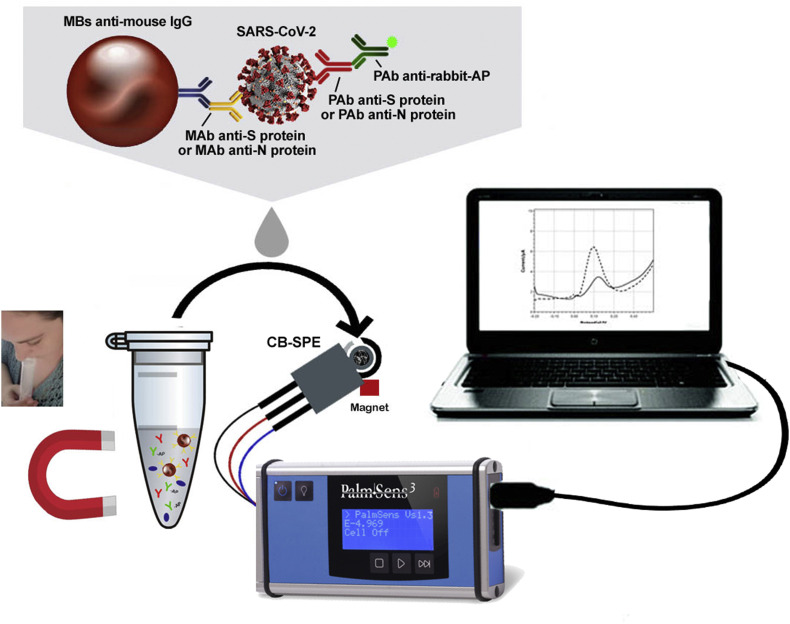
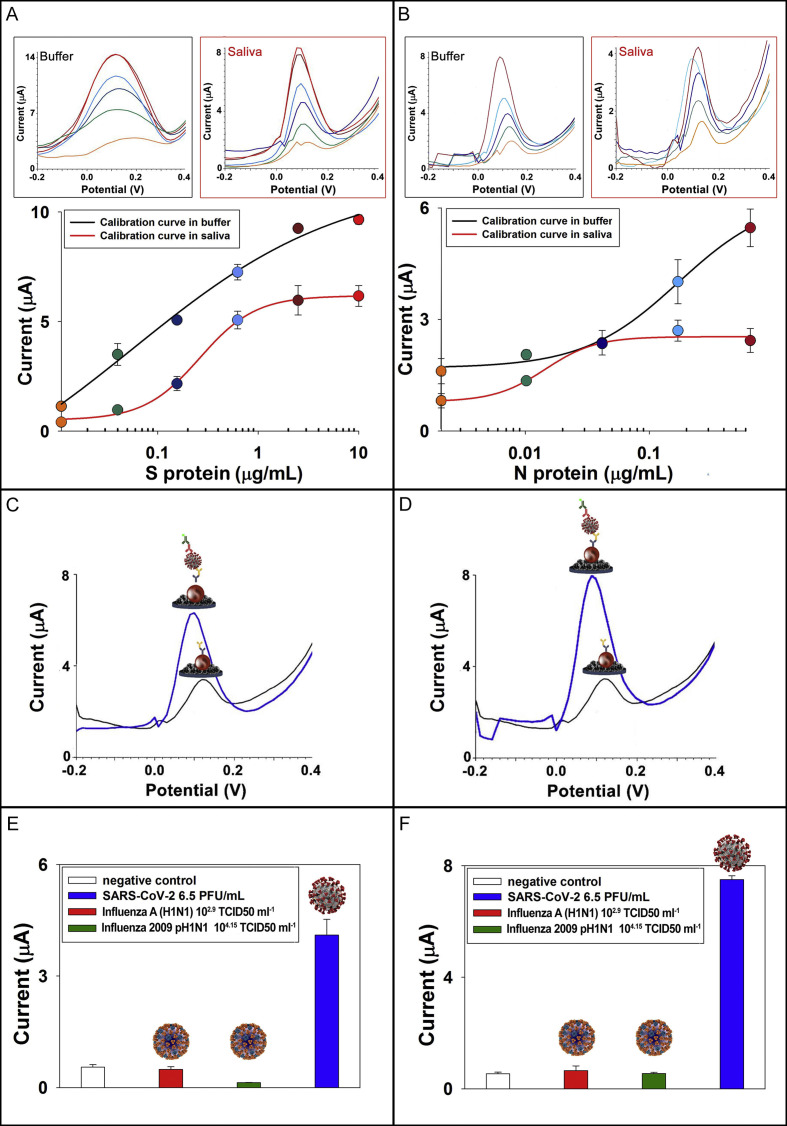
The diffusion of novel SARS-CoV-2 coronavirus over the world generated COVID-19 pandemic event as reported by World Health Organization on March 2020. The huge issue is the high infectivity and the absence of vaccine and customised drugs allowing for hard management of this outbreak, thus a rapid and on site analysis is a need to contain the spread of COVID-19. Herein, we developed an electrochemical immunoassay for rapid and smart detection of SARS-CoV-2 coronavirus in saliva. The electrochemical assay was conceived for Spike (S) protein or Nucleocapsid (N) protein detection using magnetic beads as support of immunological chain and secondary antibody with alkaline phosphatase as immunological label. The enzymatic by-product 1-naphtol was detected using screen-printed electrodes modified with carbon black nanomaterial. The analytical features of the electrochemical immunoassay were evaluated using the standard solution of S and N protein in buffer solution and untreated saliva with a detection limit equal to 19 ng/mL and 8 ng/mL in untreated saliva, respectively for S and N protein. Its effectiveness was assessed using cultured virus in biosafety level 3 and in saliva clinical samples comparing the data using the nasopharyngeal swab specimens tested with Real-Time PCR. The agreement of the data, the low detection limit achieved, the rapid analysis (30 min), the miniaturization, and portability of the instrument combined with the easiness to use and no-invasive sampling, confer to this analytical tool high potentiality for market entry as the first highly sensitive electrochemical immunoassay for SARS-CoV-2 detection in untreated saliva.
新型严重急性呼吸综合征冠状病毒(SARS-CoV-2)在全球的传播引发了 2020 年 3 月世界卫生组织(WHO)报告的 COVID-19 大流行事件。最大的问题是高传染性和缺乏疫苗和定制药物,这使得难以管理这种疫情爆发,因此需要快速和现场分析来遏制 COVID-19 的传播。在此,我们开发了一种用于快速和智能检测唾液中 SARS-CoV-2 冠状病毒的电化学免疫分析方法。该电化学分析方法是基于使用磁性珠作为免疫链的支持物和碱性磷酸酶作为免疫标记物,用于检测刺突(S)蛋白或核衣壳(N)蛋白而构思的。使用碳纳米材料修饰的丝网印刷电极检测酶的副产物 1-萘酚。使用缓冲液中的 S 和 N 蛋白标准溶液和未经处理的唾液评估电化学免疫分析的分析特性,在未经处理的唾液中,S 和 N 蛋白的检测限分别为 19ng/mL 和 8ng/mL。使用生物安全 3 级培养的病毒和唾液临床样本评估其有效性,并与使用实时聚合酶链反应(PCR)测试的鼻咽拭子标本进行比较。该数据的一致性、实现的低检测限、快速分析(30 分钟)、仪器的小型化和便携性以及易于使用和非侵入性采样,使这种分析工具具有很高的市场潜力,成为首个用于未经处理的唾液中 SARS-CoV-2 检测的高灵敏度电化学免疫分析方法。