Service de Radiologie Diagnostique et Interventionnelle adulte, Hôpital de Bicêtre, DMU 14 Smart Imaging, AP-HP, 78 Rue du Général Leclerc 94270, Le Kremlin-Bicêtre, France.
Université Paris-Saclay, CEA, CNRS, Inserm, BioMaps, 4 place du Général Leclerc, 91401, Orsay, France.
Eur Radiol. 2023 Jul;33(7):5107-5117. doi: 10.1007/s00330-023-09426-1. Epub 2023 Feb 9.
To study the impact of COVID-19 on chest CT practice during the different waves using Dose Archiving and Communication System (DACS).
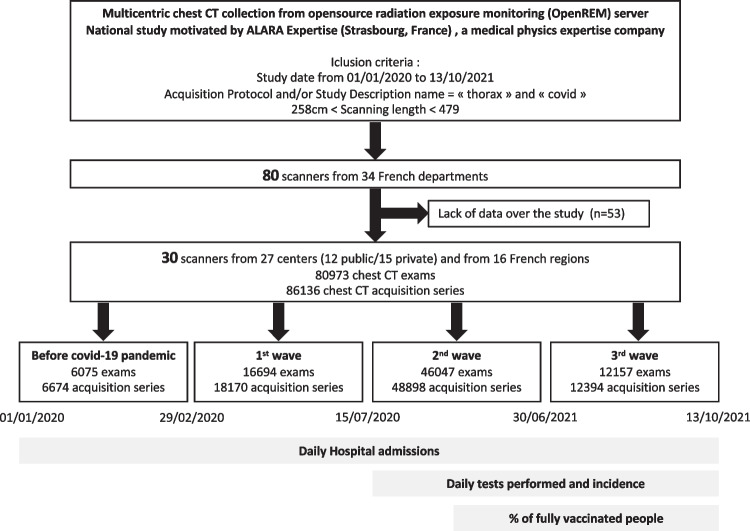
Retrospective study including data from 86,136 chest CT acquisitions from 27 radiology centers (15 private; 12 public) between January 1, 2020, and October 13, 2021, using a centralized DACS. Daily chest CT activity and dosimetry information such as dose length product (DLP), computed tomography dose index (CTDI), and acquisition parameters were collected. Pandemic indicators (daily tests performed, incidence, and hospital admissions) and vaccination rates were collected from a governmental open-data platform. Descriptive statistics and correlation analysis were performed.
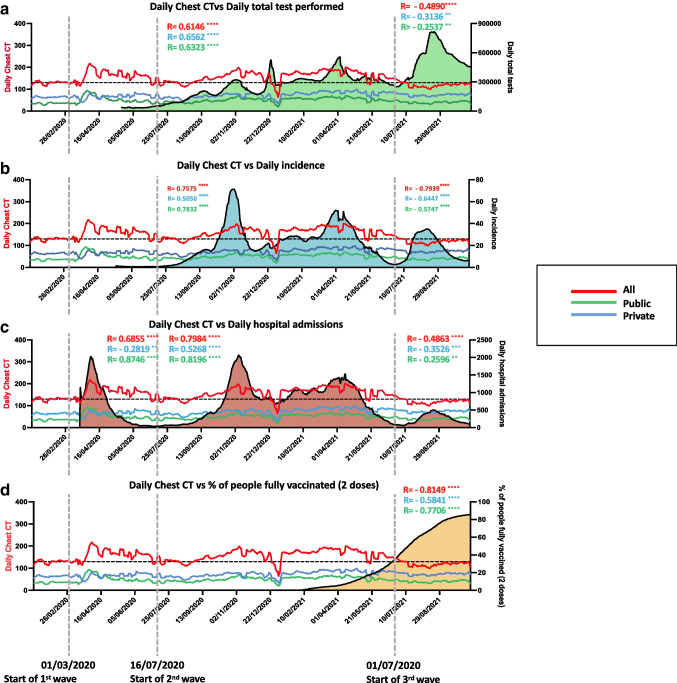
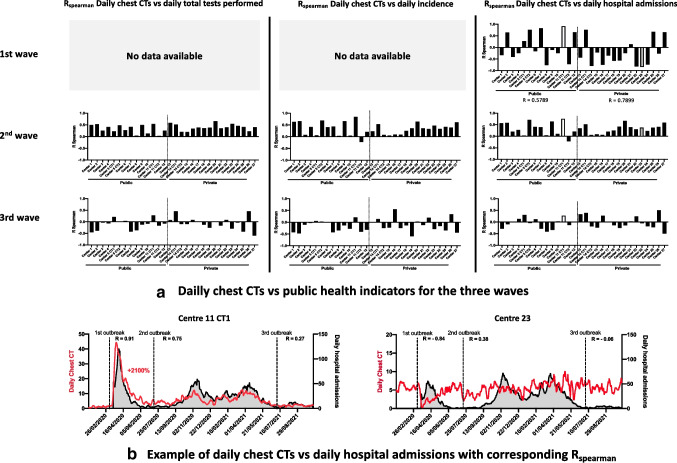
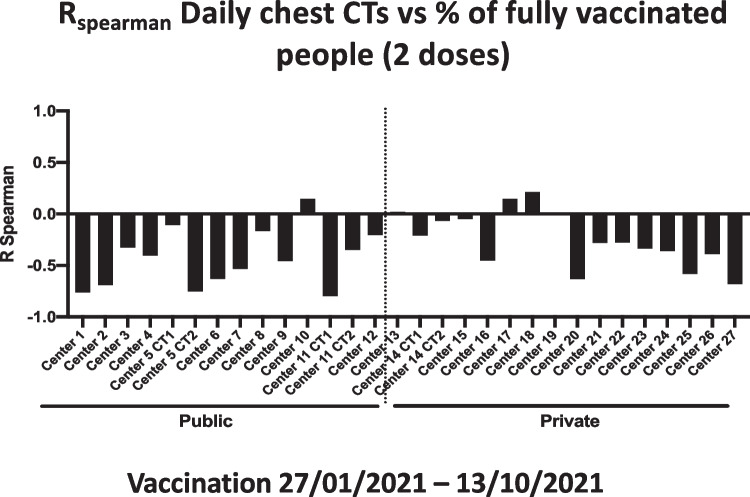
For the first two waves, strong positive and significant correlations were found between all pandemic indicators and total chest CT activity, as high as R = 0.7984 between daily chest CT activity and hospital admissions during the second wave (p < 0.0001). We found differences between public hospitals and private imaging centers during the first wave, with private centers demonstrating a negative correlation between daily chest CT activity and hospital admissions (-0.2819, p = 0.0019). Throughout the third wave, simultaneously with the rise of vaccination rates, total chest CT activity decreased with significant negative correlations with pandemic indicators, such as R = -0.7939 between daily chest CTs and daily incidence (p < 0.0001). Finally, less than 5% of all analyzed chest CTs could be considered as low dose.
During the first waves, COVID-19 had a strong impact on chest CT practice which was lost with the arrival of vaccination. Low-dose protocols remained marginal.
• There was a significant correlation between the number of daily chest CTs and pandemic indicators throughout the first two waves. It was lost during the third wave due to vaccination arrival. • Differences were observed between public and private centers, especially during the first wave, less during the second, and were lost during the third. • During the first three waves of COVID-19 pandemic, few CT helical acquisitions could be considered as low dose with only 3.8% of the acquisitions according to CTDIvol and 4.3% according to DLP.
使用剂量归档和通信系统(DACS)研究 COVID-19 对不同波次期间胸部 CT 检查实践的影响。
回顾性研究,纳入了 2020 年 1 月 1 日至 2021 年 10 月 13 日期间来自 27 个放射学中心(15 个私人中心;12 个公共中心)的 86136 例胸部 CT 采集数据,使用集中式 DACS。收集每日胸部 CT 活动量和剂量学信息,如剂量长度乘积(DLP)、计算机断层扫描剂量指数(CTDI)和采集参数。从政府开放数据平台收集大流行指标(每日检测量、发病率和住院人数)和疫苗接种率。进行描述性统计和相关性分析。
在前两个波次中,所有大流行指标与总胸部 CT 活动量之间均存在强正相关和显著相关性,第二波次中每日胸部 CT 活动量与住院人数之间的相关性高达 R=0.7984(p<0.0001)。我们发现公共医院和私人影像中心在第一波次存在差异,私人中心的每日胸部 CT 活动量与住院人数之间呈负相关(-0.2819,p=0.0019)。在第三波次期间,随着疫苗接种率的上升,总胸部 CT 活动量减少,与大流行指标之间呈显著负相关,例如每日胸部 CT 与每日发病率之间的相关性为 R=-0.7939(p<0.0001)。最后,不到 5%的所有分析胸部 CT 可被视为低剂量。
在前两个波次期间,COVID-19 对胸部 CT 检查实践产生了强烈影响,而随着疫苗接种的到来,这种影响消失了。低剂量方案仍然处于边缘地位。
在第一波次和第二波次中,每日胸部 CT 数量与大流行指标之间存在显著相关性。在第三波次由于疫苗接种的到来,这种相关性消失了。
在第一波次和第二波次中,公共中心和私人中心之间存在差异,尤其是在第一波次,而在第二波次和第三波次中则没有差异。
在 COVID-19 大流行的前三个波次中,根据 CTDIvol,只有 3.8%的采集量和根据 DLP,只有 4.3%的采集量可被认为是低剂量。