Mpaata Charles Norman, Matovu Brian, Takuwa Mercy, Kiwanuka Noah, Lewis Steff, Norrie John, Ononge Sam, Tuck Sharon, Wolters Maria, Demulliez Marc, Ssekitoleko Robert T
Biomedical Engineering Unit, Department of Physiology, School of Biomedical Sciences College of Health Sciences, Makerere University, Kampala, Uganda.
Clinical Trials Unit, School of Public Health, College of Health Sciences, Makerere University, Kampala, Uganda.
Front Med Technol. 2023 Jan 23;4:1054120. doi: 10.3389/fmedt.2022.1054120. eCollection 2022.
In many parts of the world, medical devices and the processes of their development are tightly regulated. However, the current regulatory landscape in Uganda like other developing countries is weak and poorly defined, which creates significant barriers to innovation, clinical evaluation, and translation of medical devices.
To evaluate current knowledge, systems and infrastructure for medical devices regulation and innovation in Uganda.
A mixed methods study design using the methods triangulation strategy was employed in this study. Data of equal weight were collected sequentially. First, a digital structured questionnaire was sent out to innovators to establish individual knowledge and experience with medical device innovation and regulation. Then, a single focus group discussion involving both medical device innovators and regulators to collect data about the current regulatory practices for medical devices in Uganda. Univariate and bivariate analysis was done for the quantitative data to summarize results in graphs and tables. Qualitative data was analyzed using thematic analysis. Ethical review and approval were obtained from the Makerere University School of Biomedical Sciences, Research and Ethics Committee, and the Uganda National Council for Science and Technology.
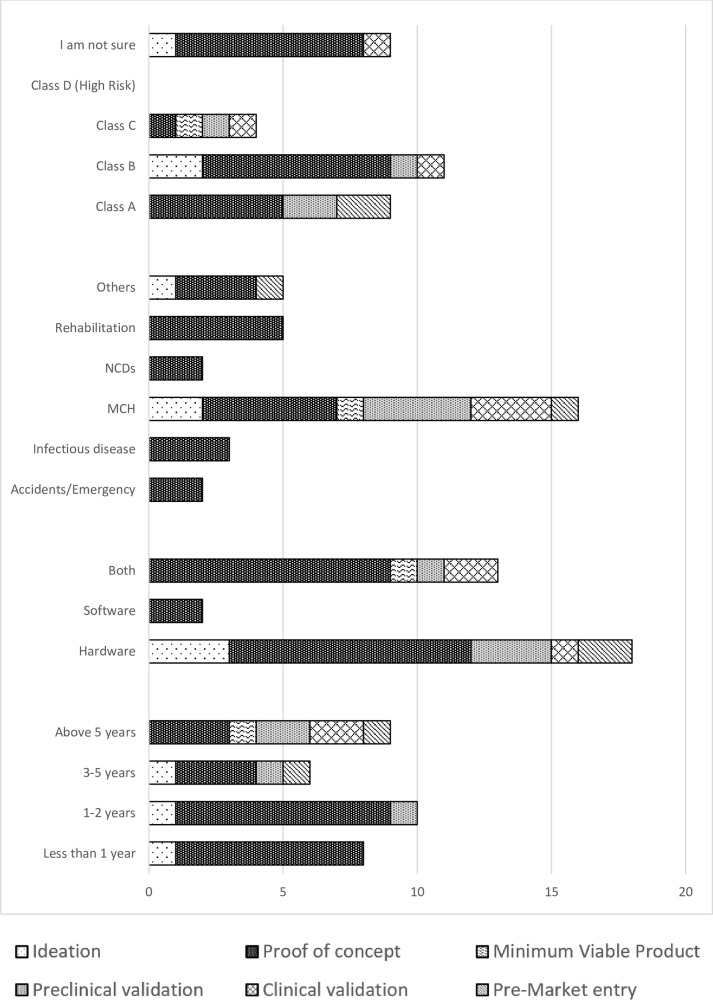
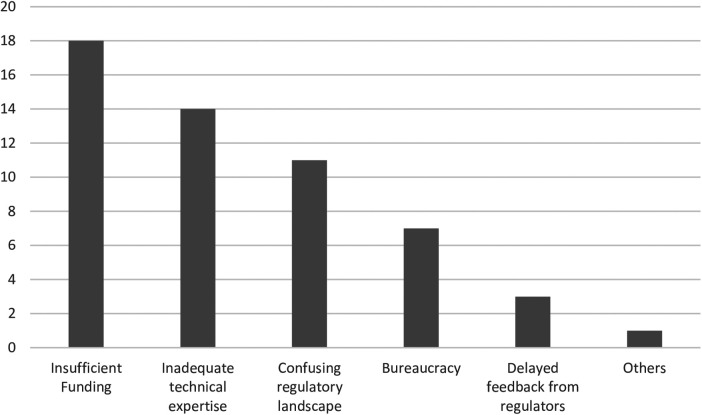
A total of 47 innovators responded to the questionnaire. 14 respondents were excluded since they were not medical device innovators. Majority (76%) of individuals had been innovators for more than a year, held a bachelor's degree with a background in Engineering and applied sciences, and worked in an academic research institute. 22 of the 33 medical device innovators had stopped working on their innovations and had stalled at the proof-of-concept stage. Insufficient funding, inadequate technical expertise and confusing regulatory landscape were major challenges to innovation. The two themes that emerged from the discussion were "developing standards for medical devices regulation" and "implementation of regulations in practical processes". Legal limitations, lengthy processes, and low demand were identified as challenges to developing medical device regulations.
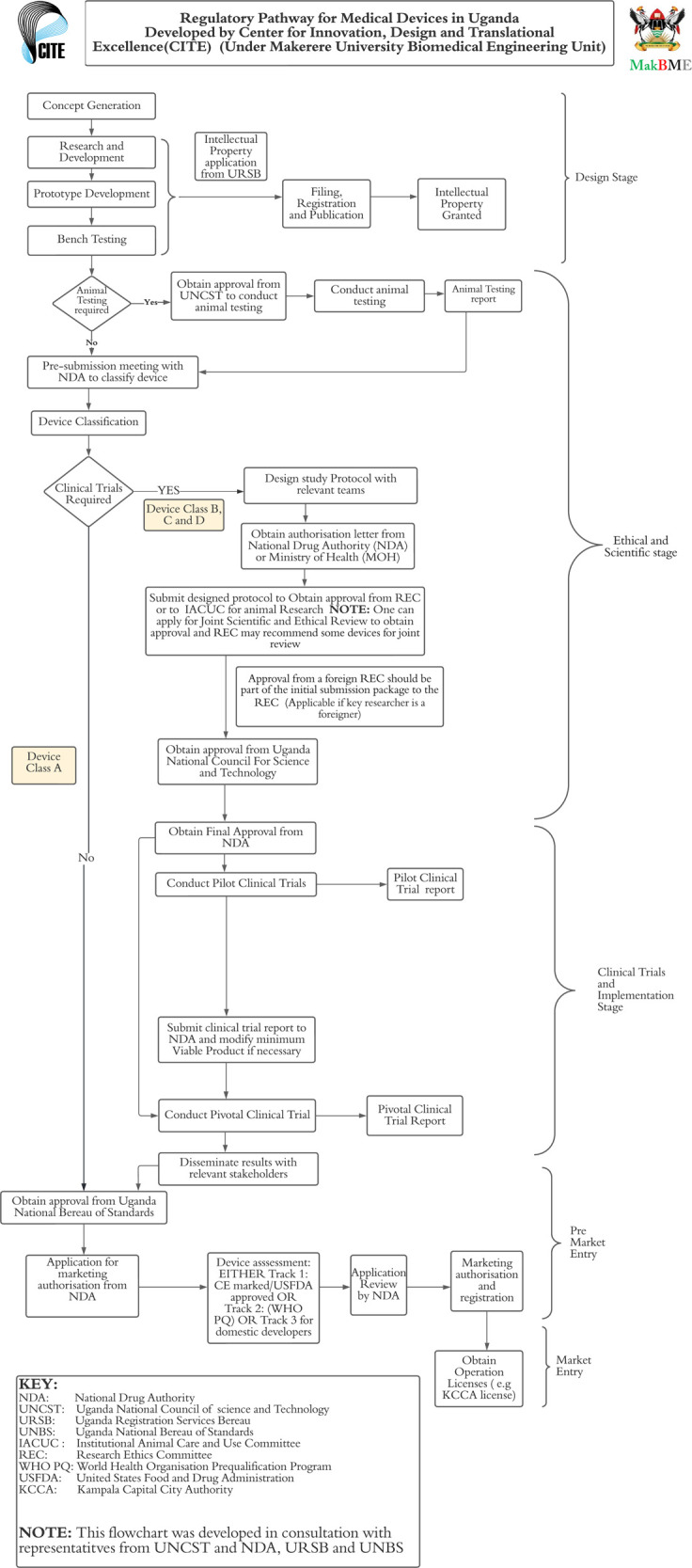
Efforts have been taken by government to create a pathway for medical device innovations to be translated to the market. More work needs to be done to coordinate efforts among stakeholders to build effective medical device regulations in Uganda.
在世界许多地区,医疗设备及其研发过程受到严格监管。然而,与其他发展中国家一样,乌干达目前的监管环境薄弱且界定不清,这给医疗设备的创新、临床评估和转化带来了重大障碍。
评估乌干达医疗设备监管与创新的现有知识、体系和基础设施。
本研究采用混合方法研究设计,运用方法三角测量策略。按顺序收集同等权重的数据。首先,向创新者发放数字结构化问卷,以了解他们在医疗设备创新和监管方面的个人知识和经验。然后,组织一次由医疗设备创新者和监管者参与的焦点小组讨论,收集有关乌干达医疗设备当前监管实践的数据。对定量数据进行单变量和双变量分析,以图表形式总结结果。定性数据采用主题分析方法进行分析。研究获得了马凯雷雷大学医学院生物医学科学、研究与伦理委员会以及乌干达国家科学技术委员会的伦理审查和批准。
共有47名创新者回复了问卷。14名受访者因并非医疗设备创新者而被排除。大多数(76%)个人作为创新者已有一年以上时间,拥有工程和应用科学背景的学士学位,并在学术研究机构工作。33名医疗设备创新者中有22人已停止其创新工作,且在概念验证阶段停滞不前。资金不足、技术专业知识匮乏以及监管环境混乱是创新面临的主要挑战。讨论中出现的两个主题是“制定医疗设备监管标准”和“在实际过程中实施监管”。法律限制、流程冗长和需求低迷被确定为制定医疗设备法规的挑战。
政府已努力为医疗设备创新转化为市场创造途径。乌干达需要开展更多工作来协调利益相关者之间的努力,以建立有效的医疗设备法规。