Department of Nutrition & Dietetics, University Hospitals Coventry & Warwickshire NHS Trust, Coventry, United Kingdom.
Department of Twin Research and Genetic Epidemiology, King's College London, London, United Kingdom.
Clin J Am Soc Nephrol. 2023 Apr 1;18(4):435-445. doi: 10.2215/CJN.0000000000000119. Epub 2023 Mar 9.
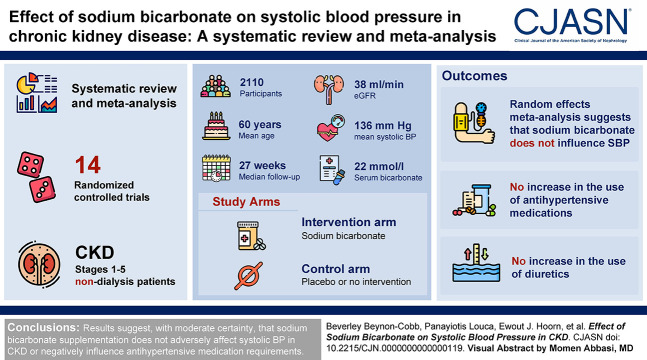
Individuals with CKD are at a higher risk of cardiovascular morbidity and mortality. Acidosis is positively correlated with CKD progression and elevated systolic BP. Sodium bicarbonate is an efficacious treatment of acidosis, although this may also increase systolic BP. In this systematic review and meta-analysis, we summarize the evidence evaluating systolic BP and antihypertensive medication change (which may indicate systolic BP change) in response to sodium bicarbonate therapy in individuals with CKD.
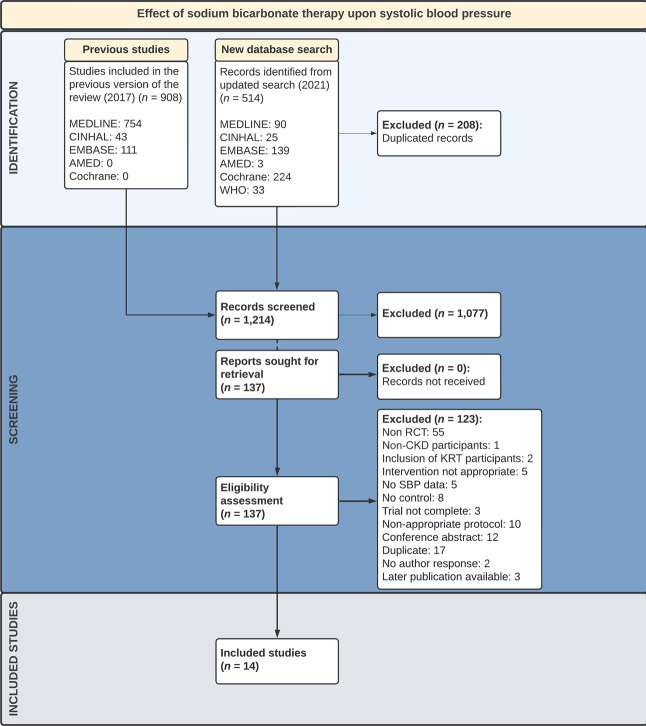
Medical Literature Analysis and Retrieval System Online, Excerpta Medica database, Cumulative Index to Nursing and Allied Health Literature, Allied and Complementary Medicine Database, Cochrane Central Register of Controlled Trials, and World Health Organization (WHO) trials registry databases were searched for randomized control trials where sodium bicarbonate was compared with placebo/usual care in CKD stage G1-5 non-dialysis-dependent populations. Random effects meta-analyses were used to evaluate changes in systolic BP and BP-modifying drugs after sodium bicarbonate intervention.
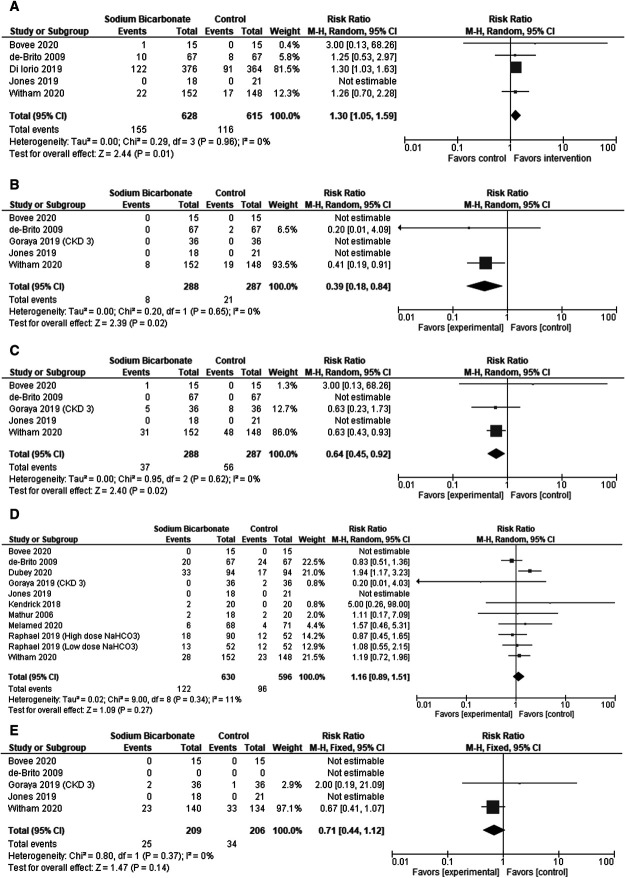
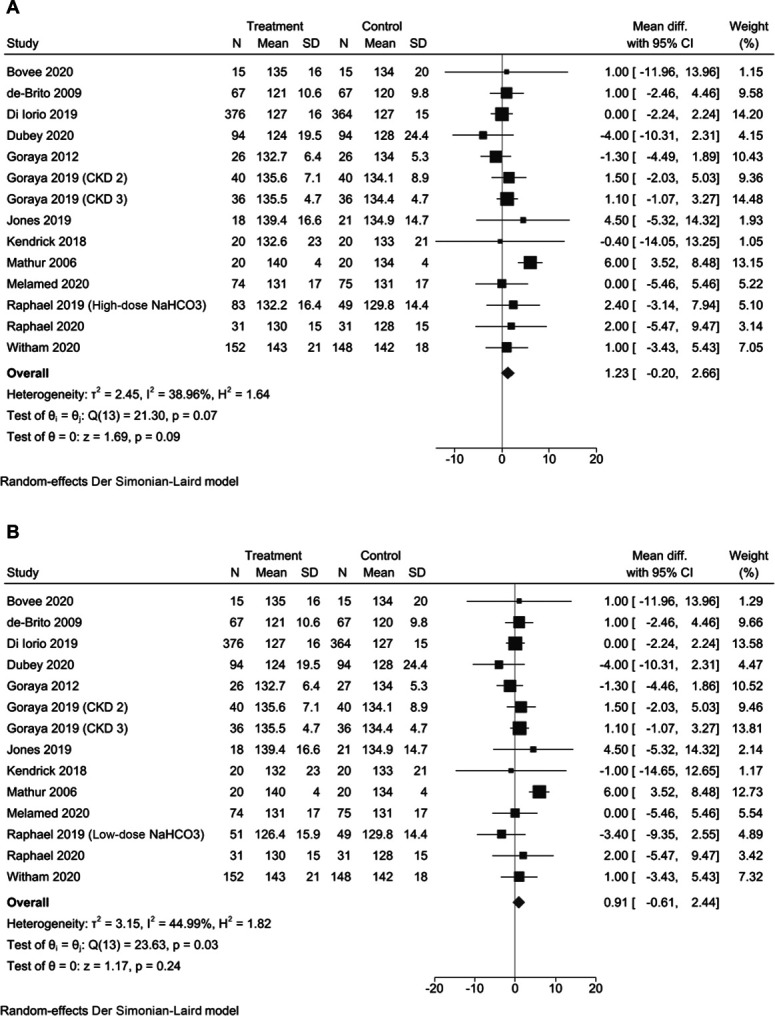
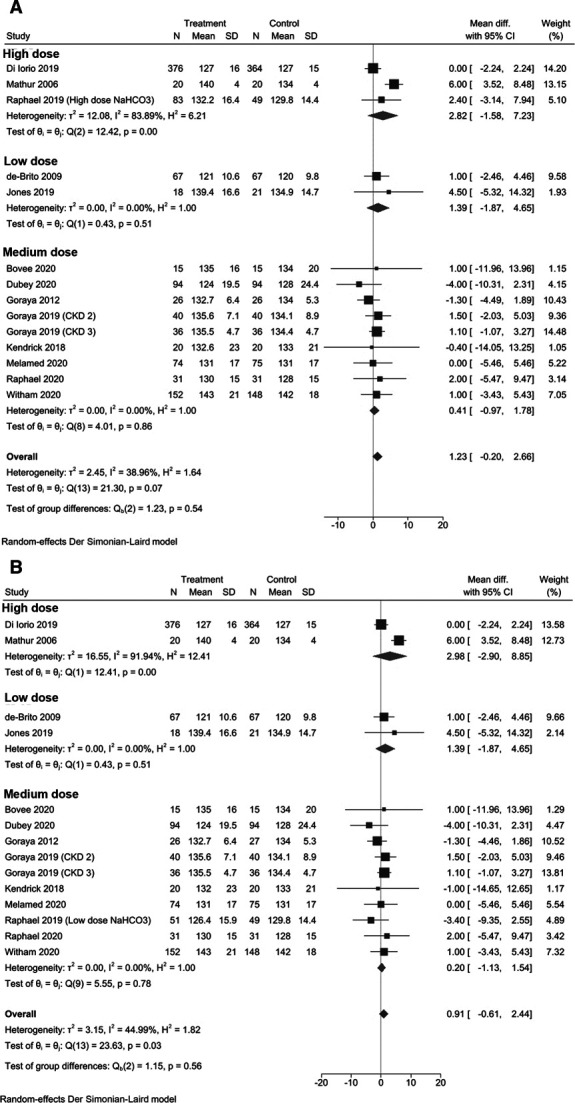
Fourteen randomized control trials (2110 individuals, median follow-up 27 [interquartile range 97] weeks, mean age 60 [SD 10] years, mean systolic BP 136 [SD 17] mm Hg, mean eGFR 38 [SD 10] ml/min, mean serum bicarbonate 22 [SD 4] mmol/L) were eligible for inclusion. Meta-analysis suggested that sodium bicarbonate did not influence systolic BP in individuals with CKD stage G1-5. Results were consistent when stratifying by dose of sodium bicarbonate or duration of intervention. Similarly, there was no significant increase in the use of antihypertensive medication or diuretics in individuals taking sodium bicarbonate, whereas there was a greater decrease in antihypertensive medication use in individuals taking sodium bicarbonate compared with controls.
Our results suggest, with moderate certainty, that sodium bicarbonate supplementation does not adversely affect systolic BP in CKD or negatively influence antihypertensive medication requirements.
患有 CKD 的个体患心血管发病率和死亡率的风险更高。酸中毒与 CKD 进展和收缩压升高呈正相关。碳酸氢钠是酸中毒的有效治疗方法,尽管这也可能增加收缩压。在这项系统评价和荟萃分析中,我们总结了评估 CKD 个体接受碳酸氢钠治疗后收缩压和降压药物变化(可能表明收缩压变化)的证据。
检索了 Medical Literature Analysis and Retrieval System Online、Excerpta Medica 数据库、Cumulative Index to Nursing and Allied Health Literature、Allied and Complementary Medicine Database、Cochrane Central Register of Controlled Trials 和世界卫生组织(WHO)试验注册数据库,以查找将碳酸氢钠与 CKD 阶段 G1-5 非透析依赖人群中的安慰剂/常规护理进行比较的随机对照试验。使用随机效应荟萃分析评估碳酸氢钠干预后收缩压和降压药物的变化。
纳入了 14 项随机对照试验(2110 名个体,中位随访时间 27 [四分位距 97] 周,平均年龄 60 [标准差 10] 岁,平均收缩压 136 [标准差 17] mmHg,平均 eGFR 38 [标准差 10] ml/min,平均血清碳酸氢盐 22 [标准差 4] mmol/L)。荟萃分析表明,碳酸氢钠对 CKD 阶段 G1-5 的个体的收缩压没有影响。按碳酸氢钠剂量或干预持续时间分层时,结果一致。同样,接受碳酸氢钠治疗的个体中,降压药物或利尿剂的使用没有显著增加,而接受碳酸氢钠治疗的个体中,降压药物的使用减少幅度更大。
我们的结果表明,碳酸氢钠补充剂不会对 CKD 患者的收缩压产生不利影响,也不会对降压药物的需求产生负面影响,这一结论具有中等确定性。