Hultin Sebastian, Hood Chris, Campbell Katrina L, Toussaint Nigel D, Johnson David W, Badve Sunil V
Australasian Kidney Trials Network, The University of Queensland, Brisbane, Australia.
University of Sydney, Sydney, Australia.
Kidney Int Rep. 2020 Dec 31;6(3):695-705. doi: 10.1016/j.ekir.2020.12.019. eCollection 2021 Mar.
Preclinical studies suggest treatment of metabolic acidosis may slow chronic kidney disease (CKD) progression. This systematic review aimed to summarize evidence from randomized controlled trials (RCTs) concerning the benefits and risks of bicarbonate therapy on kidney outcomes.
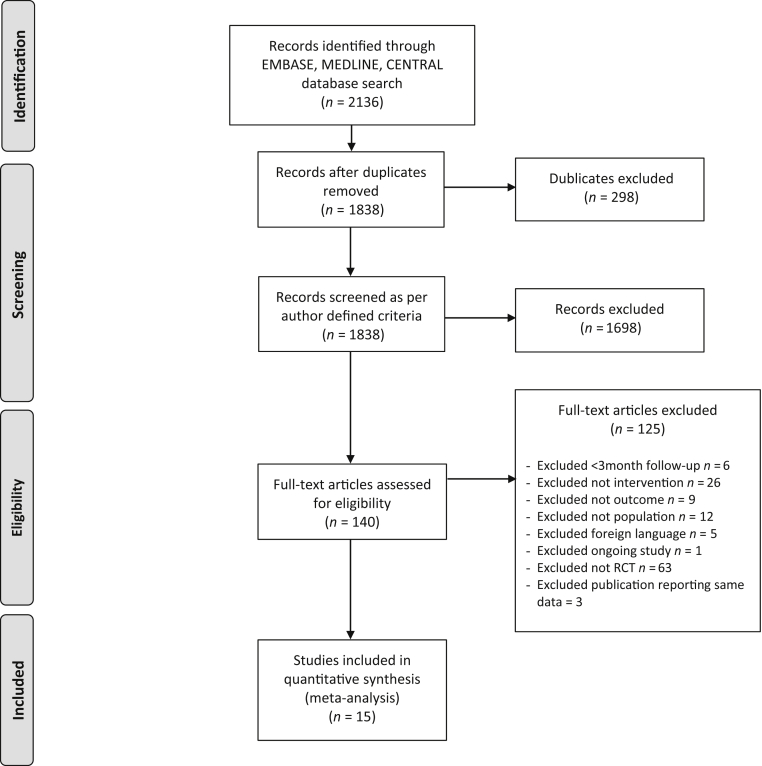
Medline, EMBASE, and Cochrane databases were searched for RCTs with ≥3 months' follow-up in patients with CKD (estimated glomerular filtration rate [eGFR] ≤60 ml/min per 1.73 m and/or proteinuria) comparing the effects of sodium bicarbonate with placebo/no study medication on kidney outcomes. The primary outcome was change from baseline to last measurement in kidney function measured as either eGFR or creatinine clearance. Treatment effects were summarized using random-effects meta-analysis.
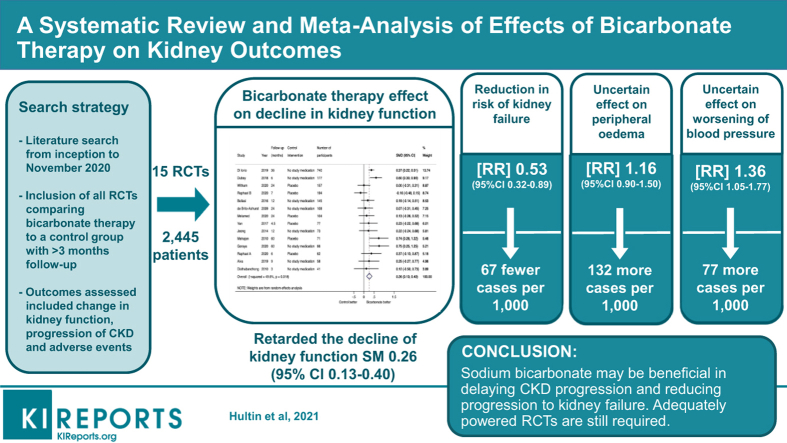
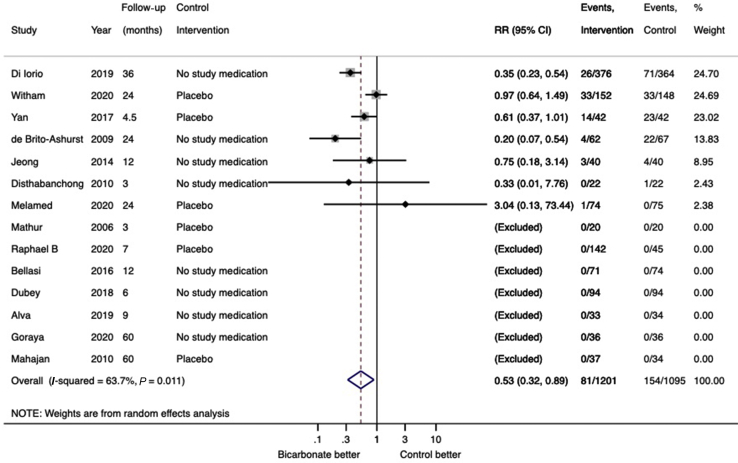
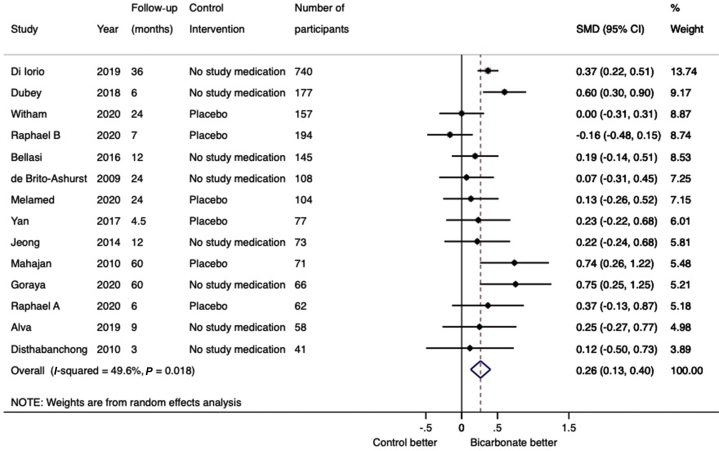
Fifteen trials (2445 participants, median follow-up 12 months) were eligible for inclusion. Compared with placebo or no study medication, sodium bicarbonate retarded the decline in kidney function (standardized mean difference [SMD]: 0.26; 95% confidence interval [CI]: 0.13-0.40; = 50%, low certainty evidence), and reduced the risk of end-stage kidney failure (risk ratio [RR]: 0.53; 95% CI 0.32-0.89; = 69%, low certainty evidence). The effect of sodium bicarbonate on proteinuria (SMD: -0.09; 95% CI -0.27 to 0.09; = 28%, very low certainty evidence), systolic blood pressure (weighted mean difference [WMD]: -0.57 mm Hg; 95% CI -2.32 to 1.18; = 0%, low certainty evidence), all-cause death (RR: 0.81; 95% CI: 0.39-1.68; = 30%; very low certainty evidence) and edema (RR: 1.16; 95% CI: 0.90-1.50; = 28%; low certainty evidence) were uncertain.
Sodium bicarbonate may slow CKD progression. Adequately powered randomized trials are required to evaluate the benefits and risks of sodium bicarbonate in CKD.
临床前研究表明,治疗代谢性酸中毒可能会减缓慢性肾脏病(CKD)的进展。本系统评价旨在总结来自随机对照试验(RCT)的证据,以探讨碳酸氢盐治疗对肾脏结局的益处和风险。
检索Medline、EMBASE和Cochrane数据库,查找对CKD患者(估计肾小球滤过率[eGFR]≤60 ml/min/1.73 m²和/或蛋白尿)进行至少3个月随访的RCT,比较碳酸氢钠与安慰剂/无研究用药对肾脏结局的影响。主要结局是从基线到最后一次测量时,以eGFR或肌酐清除率衡量的肾功能变化。采用随机效应荟萃分析总结治疗效果。
15项试验(2445名参与者,中位随访时间12个月)符合纳入标准。与安慰剂或无研究用药相比,碳酸氢钠延缓了肾功能下降(标准化均数差[SMD]:0.26;95%置信区间[CI]:0.13 - 0.40;I² = 50%,低确定性证据),并降低了终末期肾衰竭风险(风险比[RR]:0.53;95% CI 0.32 - 0.89;I² = 69%,低确定性证据)。碳酸氢钠对蛋白尿(SMD:-0.09;95% CI -0.27至0.09;I² = 28%,极低确定性证据)、收缩压(加权均数差[WMD]:-0.57 mmHg;95% CI -2.32至1.18;I² = 0%,低确定性证据)、全因死亡(RR:0.81;95% CI:0.39 - 1.68;I² = 30%;极低确定性证据)和水肿(RR:1.16;95% CI:0.90 - 1.50;I² = 28%;低确定性证据)的影响尚不确定。
碳酸氢钠可能减缓CKD进展。需要开展足够样本量的随机试验来评估碳酸氢钠在CKD中的益处和风险。