College of Health, Medicine and Wellbeing, University of Newcastle, 130 University Drive, Callaghan, NSW, 2308, Australia.
Hunter Medical Research Institute, New Lambton Heights, NSW, 2305, Australia.
BMC Pregnancy Childbirth. 2023 Feb 9;23(1):105. doi: 10.1186/s12884-023-05359-1.
The incidence of pregnancy-associated cancer (PAC), comprising cancer diagnosed during pregnancy or within one year postpartum, is increasing. We investigated the obstetric management and outcomes of women with PAC and their babies.
A population-based observational study of all women who gave birth between 1994 and 2013 in New South Wales, Australia. Women were stratified into three groups: those diagnosed during pregnancy (gestational cancer group), those diagnosed within one year of giving birth (postpartum cancer group), and a no-PAC group. Generalized estimating equations were used to examine the association between PAC and adverse maternal and neonatal outcomes.
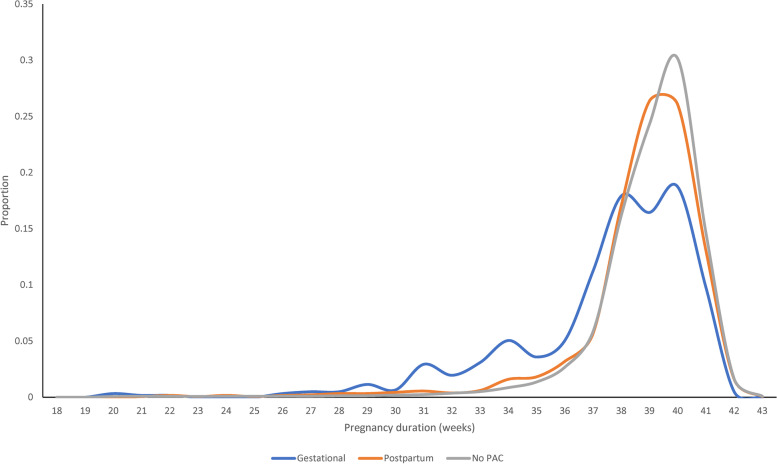
One million seven hundred eighty-eight thousand four hundred fifty-onepregnancies were included-601 women (614 babies) were in the gestational cancer group, 1772 women (1816 babies) in the postpartum cancer group, and 1,786,078 women (1,813,292 babies) in the no-PAC group. The overall crude incidence of PAC was 132.7/100,000 women giving birth. The incidence of PAC increased significantly over the twenty-year study period from 93.5/100,000 in 1994 to 162.5/100,000 in 2013 (2.7% increase per year, 95% CI 1.9 - 3.4%, p-value < 0.001). This increase was independent of maternal age. The odds of serious maternal complications (such as acute abdomen, acute renal failure, and hysterectomy) were significantly higher in the gestational cancer group (adjusted odds ratio (AOR) 5.07, 95% CI 3.72 - 6.90) and the postpartum cancer group (AOR 1.55, 95% CI 1.16 - 2.09). There was no increased risk of perinatal mortality in babies born to women with PAC. However, babies of women with gestational cancer (AOR 8.96, 95% CI 6.96 - 11.53) or postpartum cancer (AOR 1.36, 95% CI 1.05 - 1.81) were more likely to be planned preterm birth. Furthermore, babies of women with gestational cancer had increased odds of a severe neonatal adverse outcome (AOR 3.13, 95% CI 2.52 - 4.35).
Women with PAC are more likely to have serious maternal complications. While their babies are not at increased risk of perinatal mortality, they are more likely to experience poorer perinatal outcomes associated with preterm birth. The higher rate of birth intervention among women with gestational cancers reflects the complexity of clinical decision-making in this context.
妊娠相关癌症(PAC)的发病率不断上升,包括在怀孕期间或产后一年内诊断出的癌症。我们研究了患有 PAC 的女性及其婴儿的产科管理和结局。
这是一项基于人群的观察性研究,纳入了 1994 年至 2013 年期间在澳大利亚新南威尔士州分娩的所有女性。将女性分为三组:妊娠期间诊断出的(妊娠期癌症组)、产后一年内诊断出的(产后癌症组)和无 PAC 组。使用广义估计方程研究 PAC 与不良母婴结局之间的关联。
共纳入 178.8451 万例妊娠,其中 601 例(614 例婴儿)为妊娠期癌症组,1772 例(1816 例婴儿)为产后癌症组,1786078 例(1813292 例婴儿)为无 PAC 组。整体粗发率为 132.7/100000 名分娩女性。在 20 年的研究期间,PAC 的发病率显著上升,从 1994 年的 93.5/100000 上升至 2013 年的 162.5/100000(每年增加 2.7%,95%CI 1.9-3.4%,p 值<0.001)。这种增加与产妇年龄无关。与无 PAC 组相比,妊娠期癌症组(调整优势比(AOR)5.07,95%CI 3.72-6.90)和产后癌症组(AOR 1.55,95%CI 1.16-2.09)发生严重产妇并发症(如急性腹痛、急性肾衰竭和子宫切除术)的几率显著更高。PAC 组婴儿围产儿死亡率无增加风险。然而,患有妊娠期癌症的女性(AOR 8.96,95%CI 6.96-11.53)或产后癌症(AOR 1.36,95%CI 1.05-1.81)的婴儿更有可能计划早产。此外,患有妊娠期癌症的女性的婴儿发生严重新生儿不良结局的几率更高(AOR 3.13,95%CI 2.52-4.35)。
患有 PAC 的女性更有可能出现严重的产妇并发症。尽管她们的婴儿围产儿死亡率没有增加,但更有可能出现与早产相关的较差围产儿结局。患有妊娠期癌症的女性的分娩干预率更高,反映了这种情况下临床决策的复杂性。