Anhui Medical University, Hefei, P.R. China.
Anhui Professional & Technical Institute of Athletics, Hefei, P.R. China.
Inquiry. 2023 Jan-Dec;60:469580231155295. doi: 10.1177/00469580231155295.
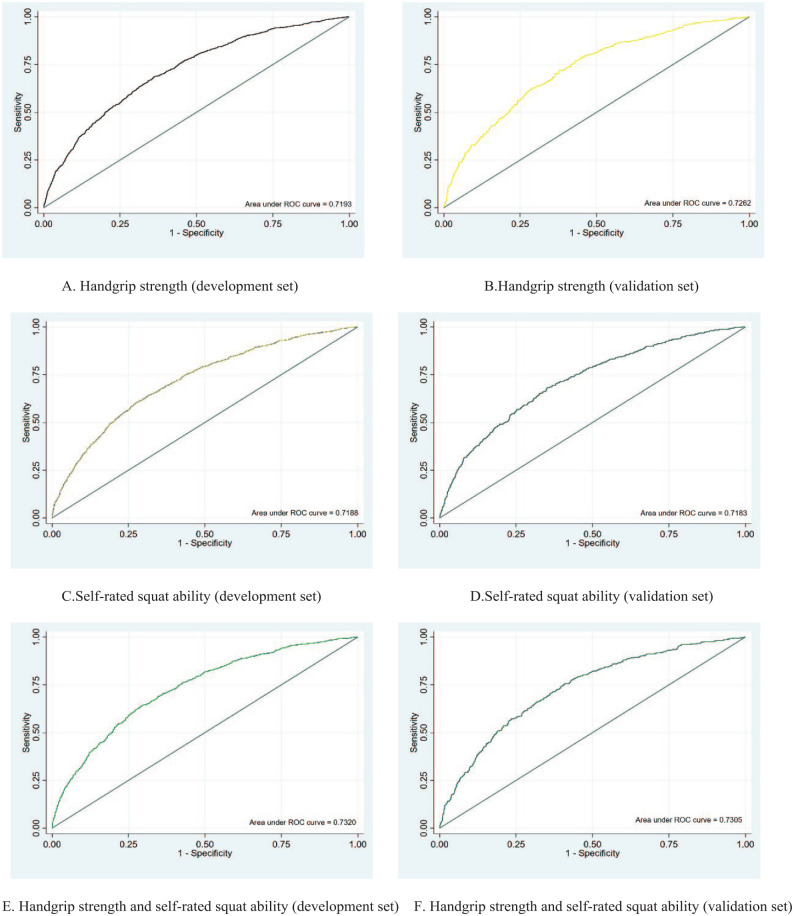
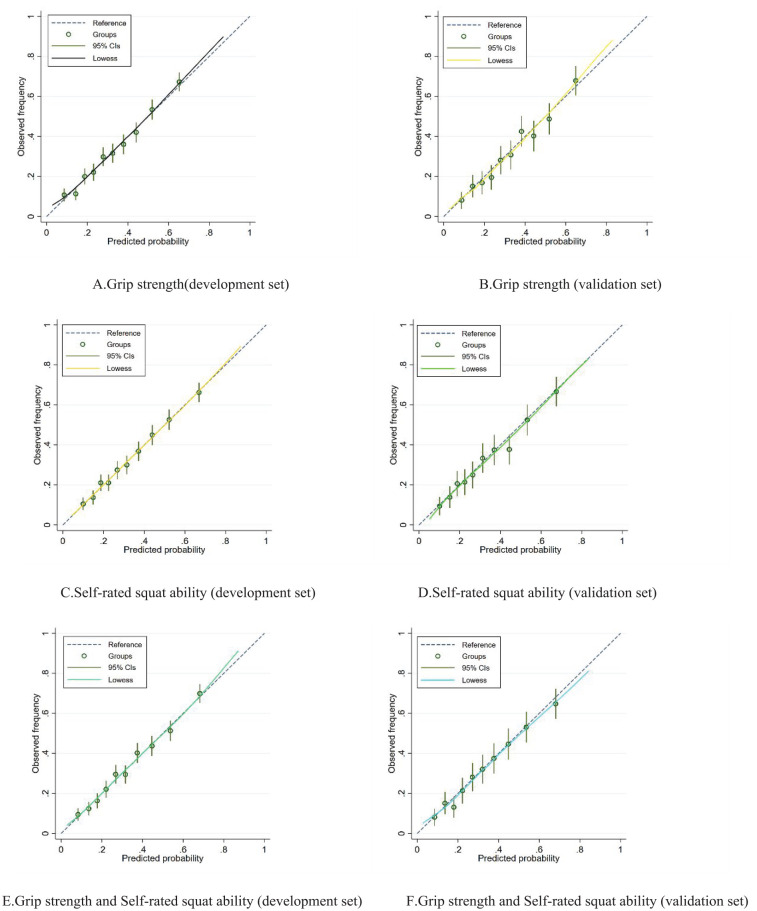
Early identification of individuals with mild cognitive impairment (MCI) is essential to combat worldwide dementia threats. Physical function indicators might be low-cost early markers for cognitive decline. To establish an early identification tool for MCI by combining physical function indicators (upper and lower limb function) via a clinical prediction modeling strategy. A total of 5393 participants aged 60 or older were included in the model. The variables selected for the model included sociodemographic characteristics, behavioral factors, mental status and chronic conditions, upper limb function (handgrip strength), and lower limb function (self-rated squat ability). Two models were developed to test the predictive value of handgrip strength (Model 1) or self-rated squat ability (Model 2) separately, and Model 3 was developed by combining handgrip strength and self-rated squat ability. The 3 models all yielded good discrimination performance (area under the curve values ranged from 0.719 to 0.732). The estimated net reclassification improvement values were 0.3279 and 0.1862 in Model 3 when comparing Model 3 to Model 1 and Model 2, respectively. The integrated discrimination improvement values were estimated as 0.0139 and 0.0128 when comparing Model 3 with Model 1 and Model 2, respectively. The model that contains both upper and lower limb function has better performance in predicting MCI. The final prediction model is expected to assist health workers in early identification of MCI, thus supporting early interventions to reduce future risk of AD, particularly in socioeconomically deprived communities.
早期识别轻度认知障碍(MCI)个体对于应对全球痴呆威胁至关重要。身体功能指标可能是认知能力下降的低成本早期标志物。通过临床预测建模策略,结合身体功能指标(上肢和下肢功能)建立 MCI 的早期识别工具。共有 5393 名 60 岁或以上的参与者纳入模型。模型中选择的变量包括社会人口统计学特征、行为因素、精神状态和慢性疾病、上肢功能(握力)和下肢功能(自我评估深蹲能力)。分别建立了两个模型来测试握力(模型 1)或自我评估深蹲能力(模型 2)的预测价值,模型 3 通过结合握力和自我评估深蹲能力来建立。这 3 个模型的区分性能均较好(曲线下面积值范围为 0.719 至 0.732)。当将模型 3 与模型 1 和模型 2 进行比较时,模型 3 的估计净重新分类改善值分别为 0.3279 和 0.1862。当将模型 3 与模型 1 和模型 2 进行比较时,模型 3 的综合区分改善值分别估计为 0.0139 和 0.0128。包含上肢和下肢功能的模型在预测 MCI 方面表现更好。最终的预测模型有望帮助卫生工作者早期识别 MCI,从而支持早期干预以降低未来患 AD 的风险,尤其是在社会经济贫困社区。