Cha Jung-Joon, Nguyen Ngoc-Luu, Tran Cong, Shin Won-Yong, Lee Seul-Gee, Lee Yong-Joon, Lee Seung-Jun, Hong Sung-Jin, Ahn Chul-Min, Kim Byeong-Keuk, Ko Young-Guk, Choi Donghoon, Hong Myeong-Ki, Jang Yangsoo, Ha Jinyong, Kim Jung-Sun
Division of Cardiology, Cardiovascular Center, Korea University Anam Hospital, Korea University College of Medicine, Seoul, Republic of Korea.
Department of Electrical Engineering, Sejong University, Seoul, Republic of Korea.
Front Cardiovasc Med. 2023 Jan 25;10:1082214. doi: 10.3389/fcvm.2023.1082214. eCollection 2023.
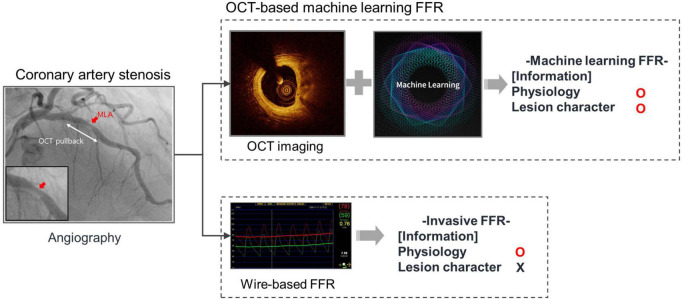
This study aimed to evaluate and compare the diagnostic accuracy of machine learning (ML)- fractional flow reserve (FFR) based on optical coherence tomography (OCT) with wire-based FFR irrespective of the coronary territory.
ML techniques for assessing hemodynamics features including FFR in coronary artery disease have been developed based on various imaging modalities. However, there is no study using OCT-based ML models for all coronary artery territories.
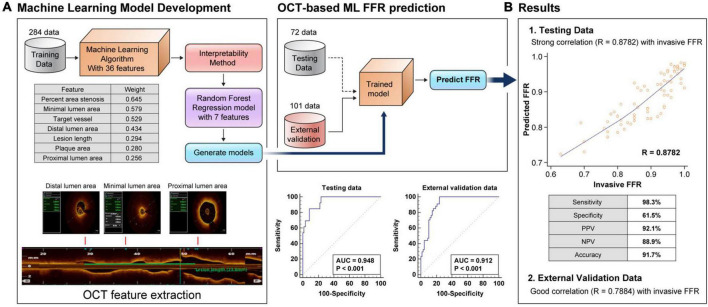
OCT and FFR data were obtained for 356 individual coronary lesions in 130 patients. The training and testing groups were divided in a ratio of 4:1. The ML-FFR was derived for the testing group and compared with the wire-based FFR in terms of the diagnosis of ischemia (FFR ≤ 0.80).
The mean age of the subjects was 62.6 years. The numbers of the left anterior descending, left circumflex, and right coronary arteries were 130 (36.5%), 110 (30.9%), and 116 (32.6%), respectively. Using seven major features, the ML-FFR showed strong correlation ( = 0.8782, < 0.001) with the wire-based FFR. The ML-FFR predicted wire-based FFR ≤ 0.80 in the test set with sensitivity of 98.3%, specificity of 61.5%, and overall accuracy of 91.7% (area under the curve: 0.948). External validation showed good correlation ( = 0.7884, < 0.001) and accuracy of 83.2% (area under the curve: 0.912).
OCT-based ML-FFR showed good diagnostic performance in predicting FFR irrespective of the coronary territory. Because the study was a small-size study, the results should be warranted the performance in further large-scale research.
本研究旨在评估并比较基于光学相干断层扫描(OCT)的机器学习(ML)-血流储备分数(FFR)与基于导丝的FFR在诊断准确性方面的差异,且不考虑冠状动脉节段。
基于各种成像方式,已开发出用于评估包括冠状动脉疾病中FFR在内的血流动力学特征的ML技术。然而,尚无针对所有冠状动脉节段使用基于OCT的ML模型的研究。
获取了130例患者356个个体冠状动脉病变的OCT和FFR数据。训练组和测试组按4:1的比例划分。为测试组推导ML-FFR,并在缺血诊断(FFR≤0.80)方面与基于导丝的FFR进行比较。
受试者的平均年龄为62.6岁。左前降支、左旋支和右冠状动脉的数量分别为130条(36.5%)、110条(30.9%)和116条(32.6%)。使用七个主要特征,ML-FFR与基于导丝的FFR显示出强相关性(r = 0.8782,P < 0.001)。ML-FFR在测试集中预测基于导丝的FFR≤0.80时,敏感性为98.3%,特异性为61.5%,总体准确性为91.7%(曲线下面积:0.948)。外部验证显示出良好的相关性(r = 0.7884,P < 0.001),准确性为83.2%(曲线下面积:0.912)。
基于OCT的ML-FFR在预测FFR方面显示出良好的诊断性能,且不考虑冠状动脉节段。由于本研究规模较小,其结果应在进一步的大规模研究中得到验证。