Applied Neuroscience Laboratory, Department of Physical Therapy, Universidade Federal de Pernambuco, Recife, Pernambuco, Brazil.
NAPeN Network (Núcleo de Assistência e Pesquisa em Neuromodulação), Brazil.
Neural Plast. 2021 Sep 21;2021:5664647. doi: 10.1155/2021/5664647. eCollection 2021.
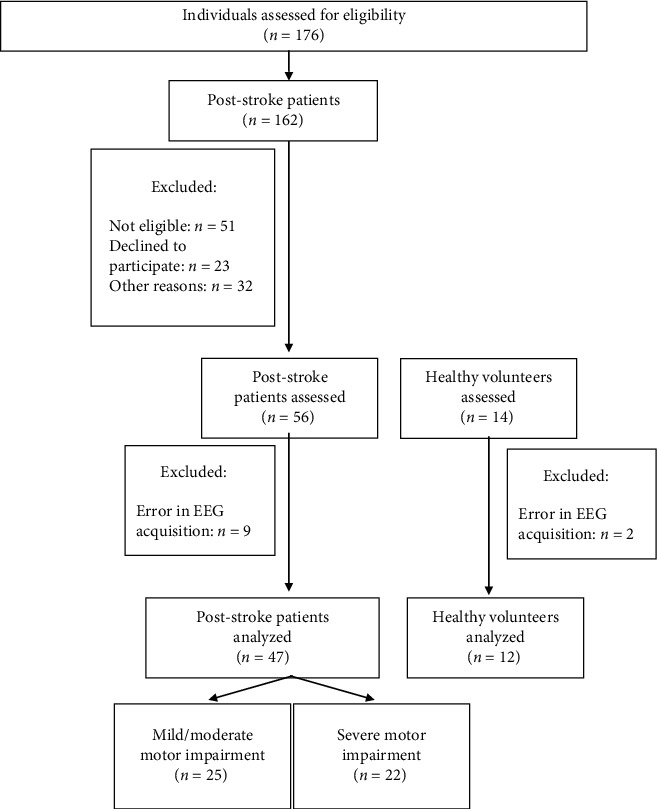
The ratio between slower and faster frequencies of brain activity may change after stroke. However, few studies have used quantitative electroencephalography (qEEG) index of ratios between slower and faster frequencies such as the delta/alpha ratio (DAR) and the power ratio index (PRI; delta + theta/alpha + beta) for investigating the difference between the affected and unaffected hemisphere poststroke. Here, we proposed a new perspective for analyzing DAR and PRI within each hemisphere and investigated the motor impairment-related interhemispheric frequency oscillations. Forty-seven poststroke subjects and twelve healthy controls were included in the study. Severity of upper limb motor impairment was classified according to the Fugl-Meyer assessment in mild/moderate ( = 25) and severe ( = 22). The qEEG indexes (PRI and DAR) were computed for each hemisphere (intrahemispheric index) and for both hemispheres (cerebral index). Considering the cerebral index (DAR and PRI), our results showed a slowing in brain activity in poststroke patients when compared to healthy controls. Only the intrahemispheric PRI index was able to find significant interhemispheric differences of frequency oscillations. Despite being unable to detect interhemispheric differences, the DAR index seems to be more sensitive to detect motor impairment-related frequency oscillations. The intrahemispheric PRI index may provide insights into therapeutic approaches for interhemispheric asymmetry after stroke.
脑活动慢波和快波频率之间的比例在中风后可能会发生变化。然而,很少有研究使用较慢和较快频率之间的定量脑电图 (qEEG) 指数(例如 delta/alpha 比 (DAR) 和 delta + theta/alpha + beta 的功率比指数 (PRI))来研究中风后患侧和非患侧半球之间的差异。在这里,我们提出了一种新的方法来分析每个半球内的 DAR 和 PRI,并研究了与运动障碍相关的半球间频率振荡。该研究纳入了 47 名中风后患者和 12 名健康对照者。根据 Fugl-Meyer 上肢运动功能评估,将上肢运动功能损伤的严重程度分为轻度/中度(=25 例)和重度(=22 例)。计算了每个半球(半球内指数)和两个半球(大脑指数)的 qEEG 指数(PRI 和 DAR)。考虑到大脑指数(DAR 和 PRI),与健康对照组相比,中风后患者的脑活动明显减慢。只有半球内的 PRI 指数能够发现频率振荡的显著半球间差异。尽管无法检测到半球间差异,但 DAR 指数似乎更能检测到与运动障碍相关的频率振荡。半球内的 PRI 指数可能为中风后半球间不对称的治疗方法提供了新的思路。