Department of Epidemiology, Rollins School of Public Health, Emory University, Atlanta, GA, United States.
Department of Gynecology and Obstetrics, Emory University School of Medicine, Atlanta, GA, United States.
Front Public Health. 2023 Jan 24;11:1029741. doi: 10.3389/fpubh.2023.1029741. eCollection 2023.
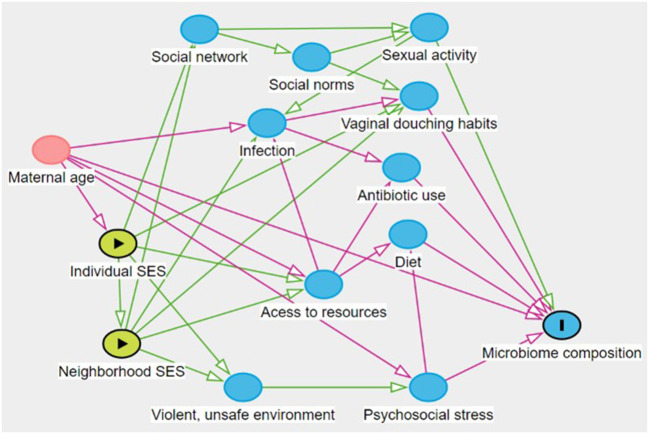
The vaginal microbiome is a dynamic ecosystem that is important for women's health. Its composition has been associated with risk for menopausal symptoms, sexually transmitted infections, gynecologic cancer, and preterm birth. Conventional risk factors for a vaginal microbiome linked with these adverse health outcomes include sexual behaviors, hygiene practices, individual social factors, and stress levels. However, there has been limited research on socio-contextual determinants, and whether neighborhood context modifies the association with individual socioeconomic factors.
Socioeconomically diverse pregnant African American women in Atlanta, Georgia ( = 439) provided residential addresses and first trimester vaginal swab samples, which underwent sequencing, taxonomic classification, and assignment into mutually exclusive CST (community state types) hierarchical clustering. Linear probability models were used to estimate prevalence differences (PD) for the associations of neighborhood factors with vaginal microbiome CST and to evaluate for additive interaction with maternal level of education, health insurance type, and recruitment hospital.
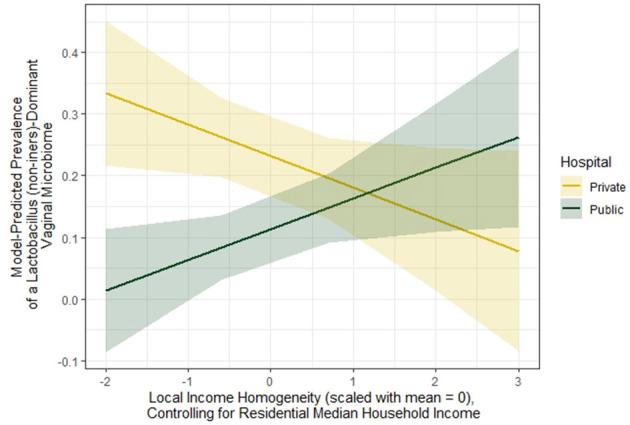
Factors such as higher (vs. lower) maternal education, private (vs. public) insurance, and private (vs. public) hospital were associated with higher prevalence of -dominant vaginal microbiome CSTs typically associated with better health outcomes. When considering the joint effects of these individual socioeconomic status and residential neighborhood factors on vaginal microbiome CST, most combinations showed a greater than additive effect among the doubly exposed; however, in the case of local income homogeneity and local racial homogeneity, there was evidence of a crossover effect between those with less-advantaged individual socioeconomic status and those with more-advantaged individual socioeconomic status. Compared to women at the public hospital who lived in economically diverse neighborhoods, women at the private hospital who lived in economically diverse neighborhoods had a 21.9% higher prevalence of -dominant CSTs, while women at the private hospital who lived in less economically diverse neighborhoods (the doubly exposed) had only an 11.7% higher prevalence of -dominant CSTs, showing a crossover effect (interaction term -value = 0.004).
In this study, aspects of residential neighborhood context were experienced differently by women on the basis of their individual resources, and the joint effects of these exposures on vaginal microbiome CST showed a departure from simple additivity for some factors.
阴道微生物群是一个动态的生态系统,对女性健康很重要。其组成与绝经症状、性传播感染、妇科癌症和早产的风险有关。与这些不良健康结果相关的阴道微生物群的传统危险因素包括性行为、卫生习惯、个体社会因素和压力水平。然而,关于社会背景决定因素的研究有限,并且还不清楚邻里环境是否会改变与个体社会经济因素的关联。
在佐治亚州亚特兰大的社会经济多样化的怀孕非裔美国女性(=439)提供了居住地址和妊娠早期阴道拭子样本,这些样本经过了测序、分类学分类,并分配到相互排斥的 CST(社区状态类型)层次聚类中。线性概率模型用于估计与阴道微生物群 CST 相关的邻里因素的患病率差异(PD),并评估与母亲教育水平、健康保险类型和招募医院的加性交互作用。
较高(与较低相比)的母亲教育、私人(与公共相比)保险和私人(与公共相比)医院等因素与更常见的与健康结果更好相关的 -dominant 阴道微生物群 CST 呈正相关。当考虑到这些个体社会经济地位和居住邻里因素对阴道微生物群 CST 的联合影响时,大多数组合在双重暴露者中表现出大于相加的效应;然而,在当地收入同质性和当地种族同质性方面,那些处于不利个体社会经济地位的人和那些处于有利个体社会经济地位的人之间存在交叉效应。与住在经济多样化社区的公立医院的女性相比,住在经济多样化社区的私立医院的女性的 -dominant CST 患病率高 21.9%,而住在经济多样化程度较低的社区的私立医院的女性(双重暴露者)的 -dominant CST 患病率仅高 11.7%,表现出交叉效应(交互项 - 值=0.004)。
在这项研究中,居住邻里环境的某些方面根据女性的个体资源而有所不同,并且这些暴露因素对阴道微生物群 CST 的联合影响表现出一些因素偏离简单相加的情况。