Biology and Environmental Chemistry Division, Sustainable System Research Laboratory, Central Research Institute of Electric Power Industry, 1646 Abiko, Abiko-shi, Chiba 270-1194, Japan.
Central Research Institute of Electric Power Industry, 2-11-1 Iwado kita, Komae-shi, Tokyo 201-8511, Japan.
J Radiat Res. 2023 Mar 23;64(2):412-419. doi: 10.1093/jrr/rrad006.
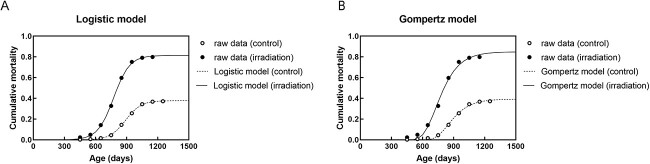
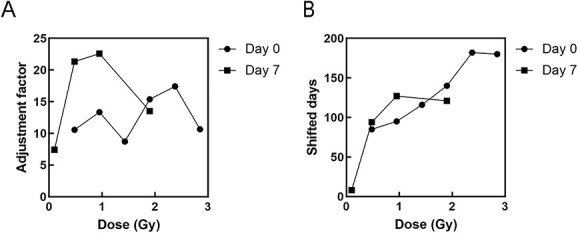
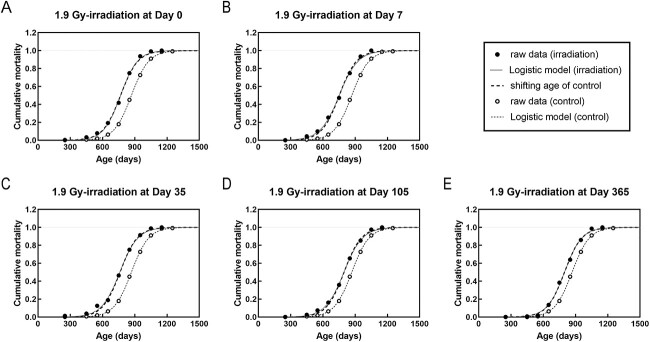
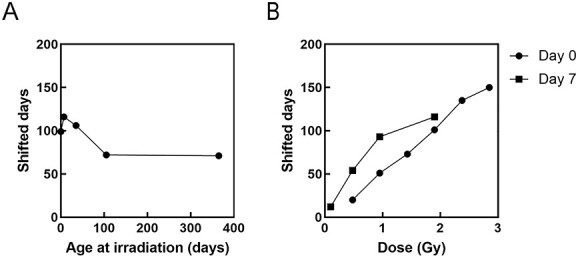
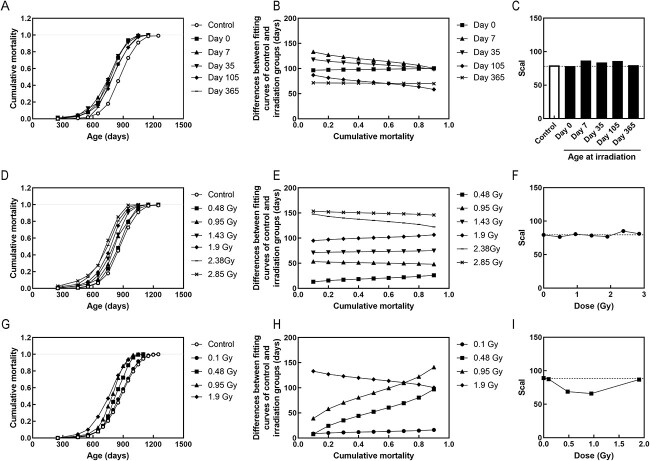
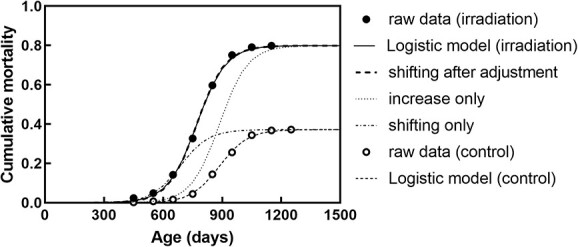
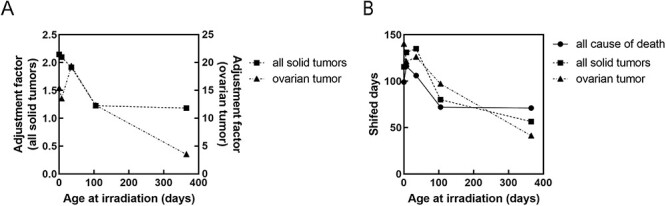
Recently, the question of whether cancer risk is only accelerated but not increased by radiation exposure has been raised. To explore this matter, we analyzed whether the cumulative mortality of irradiated mice could be explained by x-axis (age) shifted cumulative mortality of nonirradiated mice. We reanalyzed publicly available data on observed cumulative mortality or prevalence in irradiated female B6C3F1 mice that lived their entire lifespan. The results showed that the irradiated curve was well matched to uniformly shifted nonirradiated curve for the cumulative mortality of all causes of death but not for the cumulative mortality of all solid tumors and prevalence of ovarian tumors as is. After adjusting lifetime mortalities, it was also well matched for all solid and ovarian tumors. The shifted days by irradiation were 71-116 days for all causes of death, 56-135 days for all solid tumors, and 41-140 days for ovarian tumors in the 1.9 Gy-irradiated group. The response was switched between irradiation at 35 and 105 days consistently for all the above indexes, supporting the hypothesis that radiation sensitivity differs between juvenile and adults. The shifted days of all causes of death showed a tendency of linear response to dose. This concept of shifting the age of death can be applied not only for all cause of death but also for mortality of all solid tumors after adjusting the magnitude. These findings contribute to the discussion on the application of the 'shifting age of death' concept to radiation protection.
最近,有人提出了一个问题,即辐射暴露是否只会加速而不会增加癌症风险。为了探讨这个问题,我们分析了是否可以用 X 轴(年龄)移位的非照射小鼠的累积死亡率来解释照射小鼠的累积死亡率。我们重新分析了可公开获得的关于接受照射的 B6C3F1 雌性小鼠的观察到的累积死亡率或流行率的数据,这些小鼠度过了整个生命周期。结果表明,照射曲线与所有死因的累积死亡率均匀移位的非照射曲线很好地吻合,但与所有实体瘤的累积死亡率和卵巢肿瘤的流行率不一致。在调整终生死亡率后,所有实体瘤和卵巢肿瘤的死亡率也很好地吻合。在 1.9Gy 照射组中,所有死因的照射移位天数为 71-116 天,所有实体瘤为 56-135 天,卵巢肿瘤为 41-140 天。对于所有上述指标,照射在 35 天和 105 天之间的反应都是一致的,这支持了这样一种假设,即幼年和成年的辐射敏感性不同。所有死因的移位天数与剂量呈线性反应趋势。这种将死亡年龄移位的概念不仅可以应用于所有死因,还可以应用于调整幅度后的所有实体瘤死亡率。这些发现有助于讨论将“死亡年龄移位”概念应用于辐射防护。