Department of Physics and Astronomy, Institute for Quantum Science and Technology, University of Calgary, Calgary, AB, T2N 1N4, Canada.
BCAM - Basque Center for Applied Mathematics, Alameda de Mazarredo 14, 48009, Bilbao, Basque Country, Spain.
Sci Rep. 2023 Feb 10;13(1):2401. doi: 10.1038/s41598-022-25280-5.
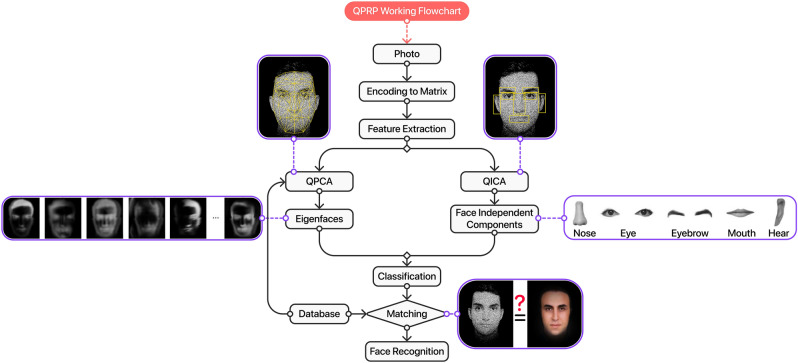
Face recognition is one of the most ubiquitous examples of pattern recognition in machine learning, with numerous applications in security, access control, and law enforcement, among many others. Pattern recognition with classical algorithms requires significant computational resources, especially when dealing with high-resolution images in an extensive database. Quantum algorithms have been shown to improve the efficiency and speed of many computational tasks, and as such, they could also potentially improve the complexity of the face recognition process. Here, we propose a quantum machine learning algorithm for pattern recognition based on quantum principal component analysis, and quantum independent component analysis. A novel quantum algorithm for finding dissimilarity in the faces based on the computation of trace and determinant of a matrix (image) is also proposed. The overall complexity of our pattern recognition algorithm is [Formula: see text]-N is the image dimension. As an input to these pattern recognition algorithms, we consider experimental images obtained from quantum imaging techniques with correlated photons, e.g. "interaction-free" imaging or "ghost" imaging. Interfacing these imaging techniques with our quantum pattern recognition processor provides input images that possess a better signal-to-noise ratio, lower exposures, and higher resolution, thus speeding up the machine learning process further. Our fully quantum pattern recognition system with quantum algorithm and quantum inputs promises a much-improved image acquisition and identification system with potential applications extending beyond face recognition, e.g., in medical imaging for diagnosing sensitive tissues or biology for protein identification.
人脸识别是机器学习中最普遍的模式识别示例之一,在安全、访问控制和执法等众多领域都有广泛的应用。使用经典算法进行模式识别需要大量的计算资源,特别是在处理大规模数据库中的高分辨率图像时。量子算法已被证明可以提高许多计算任务的效率和速度,因此它们也有可能提高人脸识别过程的复杂性。在这里,我们提出了一种基于量子主成分分析和量子独立成分分析的量子机器学习算法,用于模式识别。还提出了一种基于矩阵(图像)迹和行列式计算的寻找人脸差异的新型量子算法。我们的模式识别算法的整体复杂度为[公式:见文本],其中 N 是图像的维度。作为这些模式识别算法的输入,我们考虑了使用关联光子的量子成像技术获得的实验图像,例如“无相互作用”成像或“幽灵”成像。将这些成像技术与我们的量子模式识别处理器结合使用,可以提供具有更好信噪比、更低曝光度和更高分辨率的输入图像,从而进一步加快机器学习过程。我们的全量子模式识别系统与量子算法和量子输入相结合,有望实现更先进的图像采集和识别系统,其潜在应用不仅限于人脸识别,例如在医学成像中用于诊断敏感组织,或在生物学中用于蛋白质识别。