Cha Dong Ik, Ahn Soo Hyun, Lee Min Woo, Jeong Woo Kyoung, Song Kyoung Doo, Kang Tae Wook, Rhim Hyunchul
Department of Radiology, Samsung Medical Center, Sungkyunkwan University School of Medicine, 81 Irwon-ro, Gangnam-gu, Seoul 06351, Republic of Korea.
Department of Mathematics, Ajou University, Suwon 16499, Republic of Korea.
Cancers (Basel). 2023 Jan 22;15(3):687. doi: 10.3390/cancers15030687.
Although the prognosis after radiofrequency ablation (RFA) for hepatocellular carcinoma (HCC) may vary according to different risk levels, there is no standardized follow-up protocol according to each patient's risk. This study aimed to stratify patients according to their risk of recurrence-free survival (RFS) and early (≤2 years) tumor recurrence (ETR) after RFA for HCC based on predictive models and nomograms and to compare the survival times of the risk groups derived from the models.
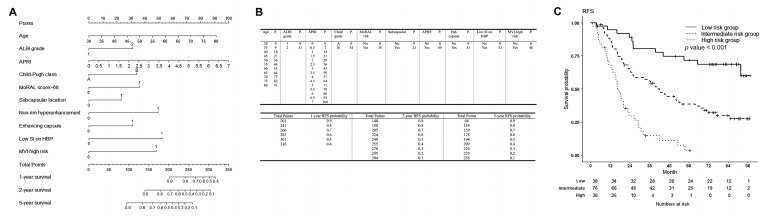
Patients who underwent RFA for a single HCC (≤3 cm) between January 2012 and March 2014 ( = 152) were retrospectively reviewed. Patients were classified into low-, intermediate-, and high-risk groups based on the total nomogram points for RFS and ETR, respectively, and compared for each outcome. Restricted mean survival times (RMSTs) in the three risk groups were evaluated for both RFS and ETR to quantitatively evaluate the difference in survival times.
Predictive models for RFS and ETR were constructed with c-indices of 0.704 and 0.730, respectively. The high- and intermediate-risk groups for RFS had an 8.5-fold and 2.9-fold higher risk of events than the low-risk group (both < 0.001), respectively. The high- and intermediate-risk groups for ETR had a 17.7-fold and 7.0-fold higher risk than the low-risk group (both < 0.001), respectively. The RMST in the high-risk group was significantly lower than that in the other two groups 9 months after RFA, and that in the intermediate-risk group became lower than that in the low-risk group after 21 months with RFS and 24 months with ETR.
Our predictive models were able to stratify patients into three groups according to their risk of RFS and ETR after RFA for HCC. Differences in RMSTs may be used to establish different follow-up protocols for the three risk groups.
尽管肝细胞癌(HCC)射频消融(RFA)后的预后可能因不同风险水平而异,但尚无根据每位患者风险制定的标准化随访方案。本研究旨在基于预测模型和列线图,对HCC患者RFA后的无复发生存(RFS)风险和早期(≤2年)肿瘤复发(ETR)风险进行分层,并比较模型得出的风险组的生存时间。
回顾性分析2012年1月至2014年3月间因单一HCC(≤3 cm)接受RFA治疗的患者(n = 152)。根据RFS和ETR的总列线图点数,分别将患者分为低、中、高风险组,并对各结局进行比较。评估三个风险组中RFS和ETR的受限平均生存时间(RMST),以定量评估生存时间的差异。
构建的RFS和ETR预测模型的c指数分别为0.704和0.730。RFS的高风险组和中风险组发生事件的风险分别比低风险组高8.5倍和2.9倍(均P < 0.001)。ETR的高风险组和中风险组分别比低风险组高17.7倍和7.0倍(均P < 0.001)。RFA后9个月,高风险组的RMST显著低于其他两组,RFS时21个月后、ETR时24个月后,中风险组的RMST低于低风险组。
我们的预测模型能够根据HCC患者RFA后的RFS和ETR风险将患者分为三组。RMST的差异可用于为三个风险组制定不同的随访方案。