Sorvina Alexandra, Antoniou Michael, Esmaeili Zahra, Kochetkova Marina
Centre for Cancer Biology, An Alliance Between SA Pathology and the University of South Australia, Adelaide, SA 5000, Australia.
Cancers (Basel). 2023 Jan 27;15(3):791. doi: 10.3390/cancers15030791.
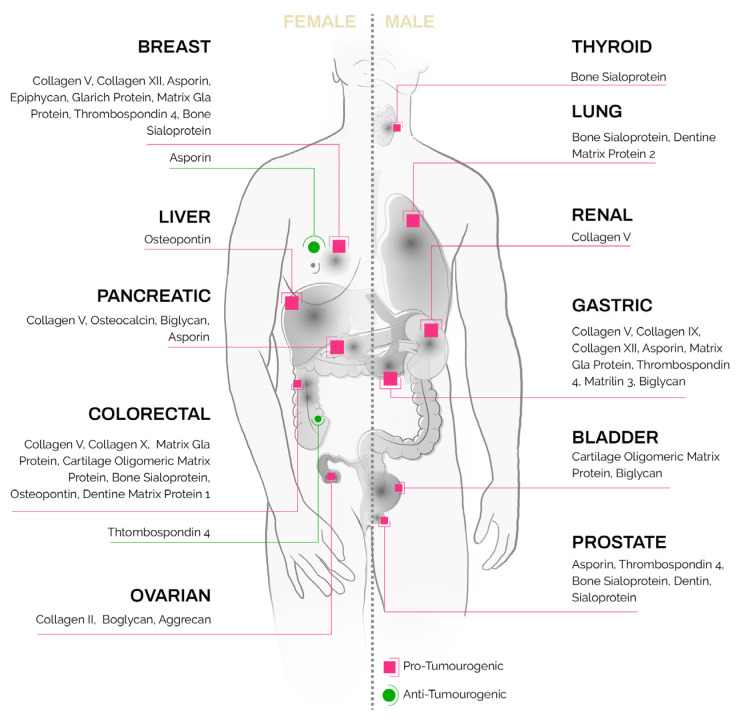
The extracellular matrix (ECM) is the complex three-dimensional network of fibrous proteins and proteoglycans that constitutes an essential part of every tissue to provide support for normal tissue homeostasis. Tissue specificity of the ECM in its topology and structure supports unique biochemical and mechanical properties of each organ. Cancers, like normal tissues, require the ECM to maintain multiple processes governing tumor development, progression and spread. A large body of experimental and clinical evidence has now accumulated to demonstrate essential roles of numerous ECM components in all cancer types. Latest findings also suggest that multiple tumor types express, and use to their advantage, atypical ECM components that are not found in the cancer tissue of origin. However, the understanding of cancer-specific expression patterns of these ECM proteins and their exact roles in selected tumor types is still sketchy. In this review, we summarize the latest data on the aberrant expression of bone and cartilage ECM proteins in epithelial cancers and their specific functions in the pathogenesis of carcinomas and discuss future directions in exploring the utility of this selective group of ECM components as future drug targets.
细胞外基质(ECM)是由纤维蛋白和蛋白聚糖构成的复杂三维网络,是每个组织的重要组成部分,为正常组织稳态提供支持。ECM在拓扑结构上的组织特异性支持每个器官独特的生化和机械特性。与正常组织一样,癌症需要ECM来维持多个控制肿瘤发生、发展和扩散的过程。现在已经积累了大量实验和临床证据,证明众多ECM成分在所有癌症类型中都起着重要作用。最新研究结果还表明,多种肿瘤类型表达并利用起源癌组织中未发现的非典型ECM成分。然而,对于这些ECM蛋白的癌症特异性表达模式及其在特定肿瘤类型中的确切作用,我们的了解仍然很粗略。在这篇综述中,我们总结了关于上皮癌中骨和软骨ECM蛋白异常表达的最新数据及其在癌发病机制中的特定功能,并讨论了将这一特定ECM成分作为未来药物靶点进行探索的未来方向。