Schrobback Peggy, Zhang Airong, Loechel Barton, Ricketts Katie, Ingham Aaron
Agriculture and Food, Commonwealth Scientific and Industrial Research Organisation (CSIRO), Brisbane, QLD 4067, Australia.
Health and Biosecurity, Commonwealth Scientific and Industrial Research Organisation (CSIRO), Brisbane, QLD 4102, Australia.
Foods. 2023 Jan 25;12(3):538. doi: 10.3390/foods12030538.
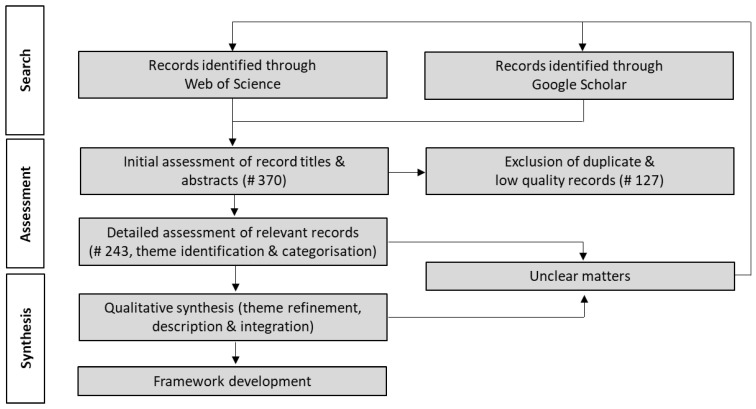
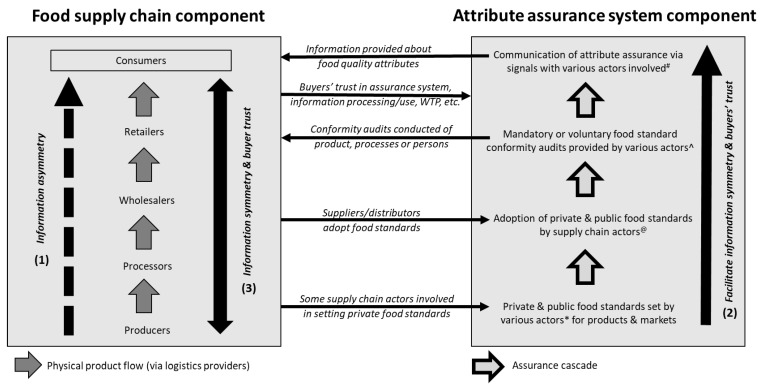
Food credence attributes (e.g., food safety, organic, and carbon neutral production methods) are quality characteristics of products that cannot be assessed by buyers at the point of sale without additional information (e.g., certification labels). Hence, the ability to access credence attributes of a particular product can result in a situation termed as asymmetric distributed information among supply chain stakeholders (e.g., producers, processors, wholesalers, retailers, consumer) where one party of a market transaction is in possession of more information about a product than the other party. This situation can lead to potential inefficiencies, e.g., misinformation, risk of food borne illness, or opportunistic behavior such as fraud. The present study sought to develop a conceptual framework that describes a) the motivation for key stakeholders to participate in the market for food credence attributes, b) the type of food credence attributes that key stakeholders provide, and c) current mechanisms to address the issue of information asymmetry among the stakeholders in the food system. The study was conducted using an integrative literature review. The developed framework consists of two components: a) the food supply chain and b) the attribute assurance system among which multiple links exist. The findings suggest that retailers, processors, NGOs, and government authorities are influential stakeholders within the supply chain of food credence attributes by imposing food quality standards which can address information asymmetry among food actors. While the credence attribute assurance system (e.g., food standards, third party food attribute assurance providers) can potentially address the issue of asymmetric information among market stakeholders, a range of issues remain. These include food standards as a potential market entry barrier for food producers and distributors, limited food standard harmonization, and communication challenges of food attribute assurance (e.g., consumers' signal processing, signal use and trust). The syntheses presented in this study contributes to stakeholders' (e.g., supply chain actors, scientists, policy makers) improved understanding about the components of the credence food system and their integration as well as the drivers for change in this system.
食品信任属性(如食品安全、有机和碳中和生产方法)是产品的质量特征,买家在销售点若无额外信息(如认证标签)则无法评估。因此,获取特定产品信任属性的能力可能导致一种在供应链利益相关者(如生产商、加工商、批发商、零售商、消费者)之间被称为信息不对称分布的情况,即市场交易中的一方比另一方拥有更多关于产品的信息。这种情况可能导致潜在的低效率,如错误信息、食源性疾病风险或欺诈等机会主义行为。本研究旨在建立一个概念框架,描述:a)关键利益相关者参与食品信任属性市场的动机;b)关键利益相关者提供的食品信任属性类型;c)当前解决食品系统中利益相关者之间信息不对称问题的机制。该研究采用综合文献综述的方法进行。所建立的框架由两个部分组成:a)食品供应链;b)属性保证系统,两者之间存在多个环节。研究结果表明,零售商、加工商、非政府组织和政府当局通过制定食品质量标准,在食品信任属性供应链中是有影响力的利益相关者,这些标准可以解决食品行业参与者之间的信息不对称问题。虽然信任属性保证系统(如食品标准、第三方食品属性保证提供者)有可能解决市场利益相关者之间的信息不对称问题,但仍存在一系列问题。这些问题包括食品标准可能成为食品生产商和经销商的市场进入壁垒、食品标准协调有限以及食品属性保证的沟通挑战(如消费者的信号处理、信号使用和信任)。本研究中的综合分析有助于利益相关者(如供应链参与者、科学家、政策制定者)更好地理解信任食品系统的组成部分及其整合情况,以及该系统变化的驱动因素。