Yan Xin, Laurent Sophie, Hue Isabelle, Cabon Sylvie, Grua-Priol Joelle, Jury Vanessa, Federighi Michel, Boué Geraldine
Oniris, INRAE, SECALIM, 44300 Nantes, France.
Oniris, Université de Nantes, CNRS, GEPEA UMR 6144, 44322 Nantes, France.
Foods. 2023 Jan 28;12(3):572. doi: 10.3390/foods12030572.
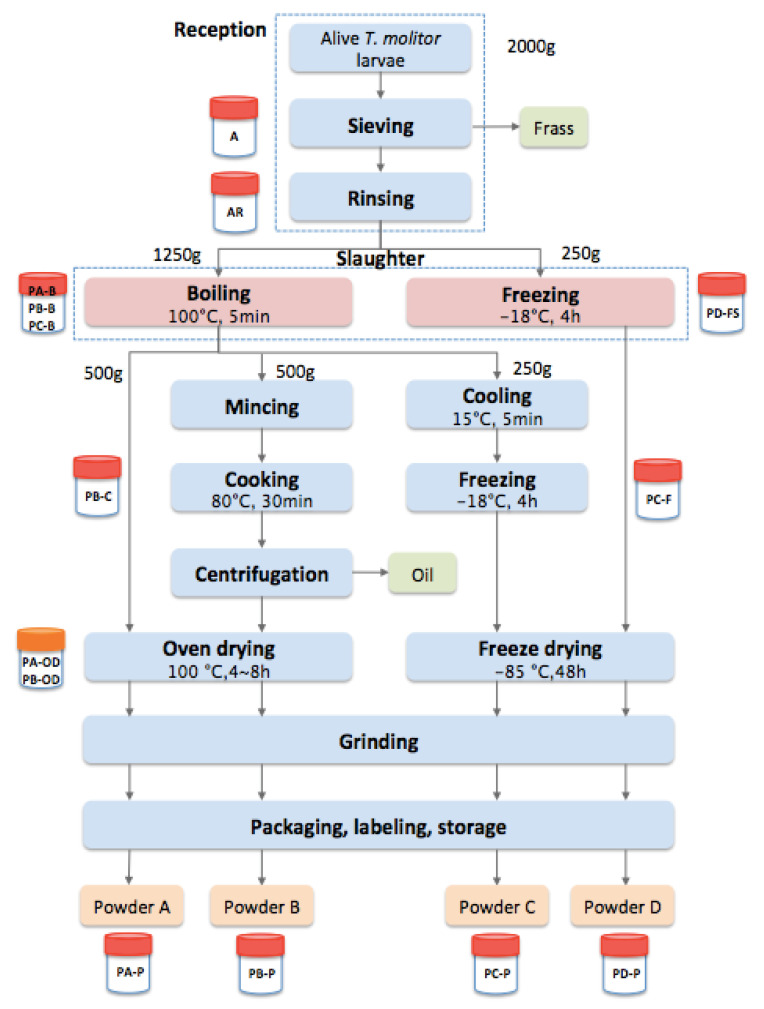
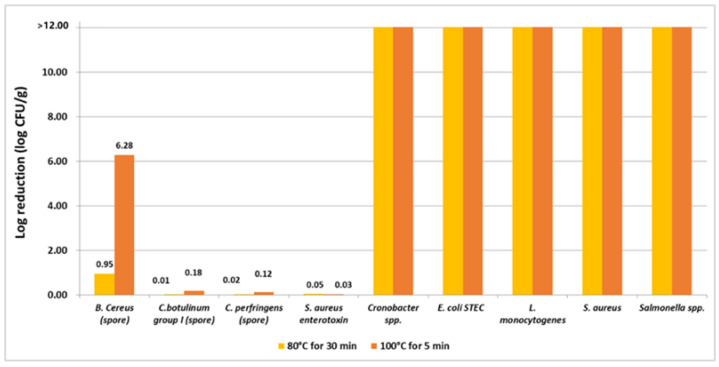
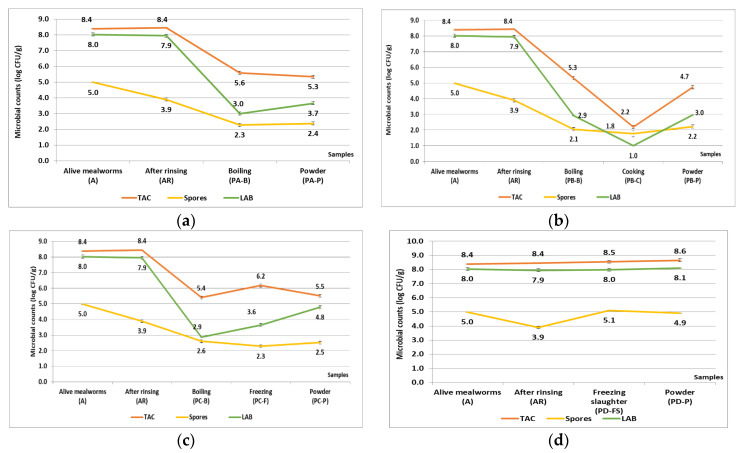
, the first edible insect approved as a novel food in the EU, is a promising candidate for alternative protein sources, implementing circular and sustainable production systems. This study aims to determine the microbiological quality and physicochemical properties of mealworm powders obtained by four different processing pathways. Contents of dry matter, protein, fat, ash, water activity (aw) and a range of microbial counts were measured and analyzed by one-way ANOVA with Tukey's test. Results showed small differences in the proximate composition of the powder samples (protein 55.62-57.90% and fat 23.63-28.21% of dry matter, DM), except for the one that underwent a defatting step (protein 70.04% and fat 16.84%), < 0.05. A level of water activity of less than 0.2 was reached for all pathways. Fresh mealworm samples had high total aerobic counts (8.4 log CFU/g) but were free of foodborne pathogens. Heat treatments applied during transformation were sufficient to kill vegetative cells (reduction of 2.8-5.1 log CFU/g) rather than bacterial endospores (reduction of 0.3-1.8 log CFU/g). Results were confirmed by predictive microbiology. This study validated the efficacy of a boiling step as critical control points (CCPs) of insect powder processing, providing primary data for the implementation of HACCP plans.
作为欧盟首个被批准为新型食品的可食用昆虫,黄粉虫是实现循环和可持续生产系统的替代蛋白质来源的一个有前景的候选者。本研究旨在确定通过四种不同加工途径获得的黄粉虫粉的微生物质量和理化性质。通过单向方差分析和Tukey检验测量并分析了干物质、蛋白质、脂肪、灰分、水分活度(aw)以及一系列微生物计数的含量。结果表明,除了经过脱脂步骤的样品(蛋白质含量70.04%,脂肪含量16.84%)外,粉末样品的近似组成差异较小(蛋白质占干物质的55.62 - 57.90%,脂肪占23.63 - 28.21%),P < 0.05。所有途径的水分活度均低于0.2。新鲜黄粉虫样品的需氧菌总数较高(8.4 log CFU/g),但未检测到食源性病原体。转化过程中进行的热处理足以杀死营养细胞(减少2.8 - 5.1 log CFU/g),但对细菌芽孢的杀灭效果较差(减少0.3 - 1.8 log CFU/g)。预测微生物学证实了该结果。本研究验证了煮沸步骤作为昆虫粉加工关键控制点(CCP)的有效性,为实施危害分析与关键控制点(HACCP)计划提供了基础数据。