Agrawal Vibhav, Hazratifard Mehdi, Elmiligi Haytham, Gebali Fayez
Department of Electrical and Computer Engineering, University of Victoria, Victoria, BC V8P 5C2, Canada.
Diagnostics (Basel). 2023 Jan 25;13(3):439. doi: 10.3390/diagnostics13030439.
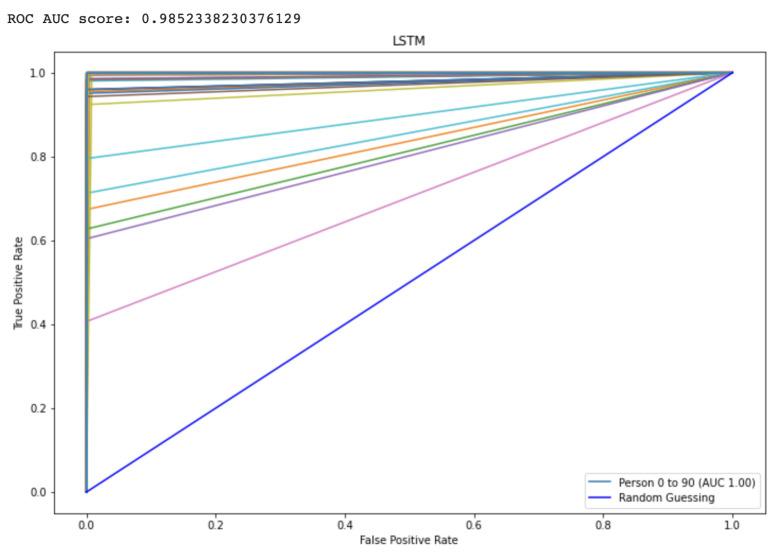
Personal authentication security is an essential area of research in privacy and cybersecurity. For individual verification, fingerprint and facial recognition have proved particularly useful. However, such technologies have flaws such as fingerprint fabrication and external impediments. Different AI-based technologies have been proposed to overcome forging or impersonating authentication concerns. Electrocardiogram (ECG)-based user authentication has recently attracted considerable curiosity from researchers. The Electrocardiogram is among the most reliable advanced techniques for authentication since, unlike other biometrics, it confirms that the individual is real and alive. This study utilizes a user authentication system based on electrocardiography (ECG) signals using deep learning algorithms. The ECG data are collected from users to create a unique biometric profile for each individual. The proposed methodology utilizes Convolutional Neural Networks (CNNs) and Long Short-Term Memory (LSTM) to analyze the ECG data. The CNNs are trained to extract features from the ECG data, while the LSTM networks are used to model the temporal dependencies in the data. The evaluation of the performance of the proposed system is conducted through experiments. It demonstrates that it effectively identifies users based on their ECG data, achieving high accuracy rates. The suggested techniques obtained an overall accuracy of 98.34% for CNN and 99.69% for LSTM using the Physikalisch-Technische Bundesanstalt (PTB) database. Overall, the proposed system offers a secure and convenient method for user authentication using ECG data and deep learning algorithms. The approach has the potential to provide a secure and convenient method for user authentication in various applications.
个人认证安全是隐私和网络安全领域的一个重要研究方向。对于个人身份验证而言,指纹识别和面部识别已被证明特别有用。然而,此类技术存在诸如指纹伪造和外部干扰等缺陷。人们已经提出了不同的基于人工智能的技术来克服伪造或冒充认证方面的问题。基于心电图(ECG)的用户认证最近引起了研究人员的极大关注。心电图是最可靠的先进认证技术之一,因为与其他生物特征识别不同,它能确认个体是真实且活着的。本研究利用深度学习算法,构建了一个基于心电图(ECG)信号的用户认证系统。从用户那里收集心电图数据,为每个人创建独特的生物特征档案。所提出的方法利用卷积神经网络(CNN)和长短期记忆网络(LSTM)来分析心电图数据。训练卷积神经网络从心电图数据中提取特征,而长短期记忆网络则用于对数据中的时间依赖性进行建模。通过实验对所提出系统的性能进行评估。结果表明,该系统能够基于心电图数据有效地识别用户,准确率很高。使用德国物理技术联邦研究所(PTB)数据库,所建议的技术在卷积神经网络方面的总体准确率为98.34%,在长短期记忆网络方面为99.69%。总体而言,所提出的系统为使用心电图数据和深度学习算法进行用户认证提供了一种安全便捷的方法。该方法有可能在各种应用中为用户认证提供一种安全便捷的方法。